
About Afghanistan
Dari (also known as Afghan Persian) - spoken by ~77% of the population. It is the official lingua franca (common trade and everyday language) and is understood by most people.
Pashto - spoken by ~48% of the population (mainly ethnic Pashtuns).
Uzbeki 11%, English 6%, Turkmani 3%, Urdu 3%, and other minority languages are also spoken.
Both Dari and Pashto are official languages of Afghanistan.
| Geography |
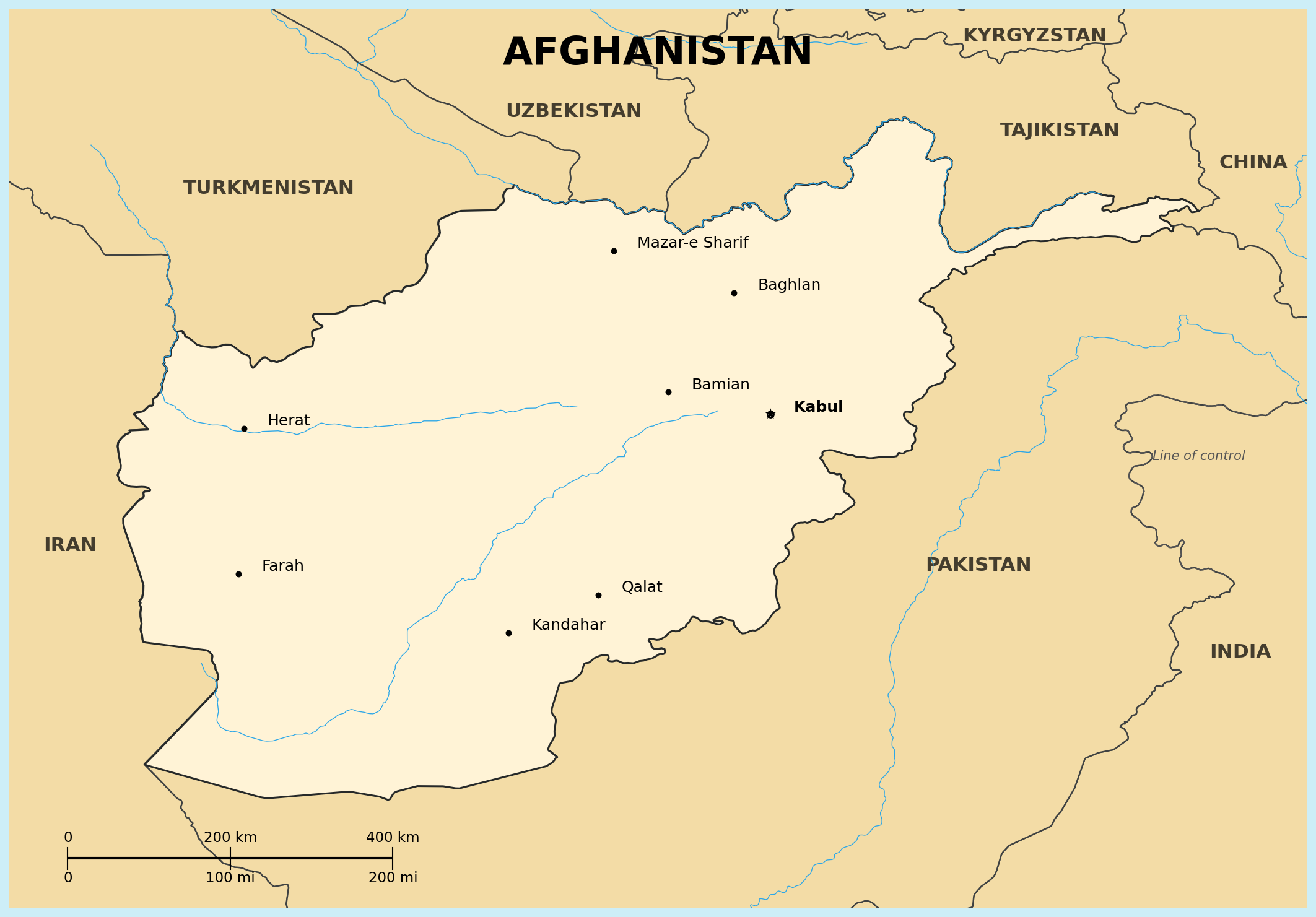
Location: Southern Asia, north and west of Pakistan, east of Iran
Geographic coordinates: 33 00 N, 65 00 E
Map references: Asia
Area:
total: 652,230 sq km
land: 652,230 sq km
water: 0 sq km
Area - comparative: almost six times the size of Virginia; slightly smaller than Texas
Land boundaries:
total: 5,987 km
border countries: China 91 km, Iran 921 km, Pakistan 2,670 km, Tajikistan 1,357 km, Turkmenistan 804 km, Uzbekistan 144 km
Coastline: 0 km (landlocked)
Maritime claims: none (landlocked)
Climate: arid to semiarid; cold winters and hot summers
Terrain: mostly rugged mountains; plains in north and southwest
Elevation extremes:
lowest point: Amu Darya 258 m
highest point: Noshak 7,492 m
Natural resources: natural gas, petroleum, coal, copper, chromite, talc, barites, sulfur, lead, zinc, iron ore, salt, precious and semiprecious stones, arable land
Land use:
agricultural land: 58.4%
arable land: 12%
forest: 1.9%
other: 39.7% (2023 est.)
Irrigated land: 24,930 sq km (2022)
Natural hazards: damaging earthquakes occur in Hindu Kush mountains; flooding; droughts
Environment - current issues: limited natural freshwater resources; inadequate potable water; soil degradation; overgrazing; deforestation; desertification; air and water pollution in urban areas
Geography - note: landlocked; the Hindu Kush mountains that run northeast to southwest divide the northern provinces from the rest of the country
| People |
Population: 49,474,805 (2025 est.)
Age structure:
0-14 years: 39.6%
15-64 years: 57.5%
65 years and over: 2.9% (2024 est.)
Population growth rate: 2.86% (2025 est.)
Net migration rate: -1.62 migrant(s)/1,000 population (2025 est.)
Sex ratio:
at birth: 1.05 male(s)/female
total population: 1.02 male(s)/female (2024 est.)
Infant mortality rate: 42 deaths/1,000 live births (2025 est.)
Life expectancy at birth:
total population: 54.4 years
male: 52.8 years
female: 56.1 years (2024 est.)
Total fertility rate: 4.89 children born/woman (2025 est.)
Nationality:
noun: Afghan(s)
adjective: Afghan
Ethnic groups: current, reliable statistical data on ethnicity in Afghanistan are not available; Afghanistan's 2004 Constitution cited Pashtun, Tajik, Hazara, Uzbek, Turkman, Baluch, Pashaie, Nuristani, Aymaq, Arab, Qirghiz, Qizilbash, Gujur, and Brahwui ethnicities; Afghanistan has dozens of other small ethnic groups
Religions: Muslim 99.7% (Sunni 84.7-89.7%, Shia 10-15%), other <0.3% (2009 est.)
Languages: Afghan Persian or Dari (official, lingua franca) 77%, Pashto (official) 48%, Uzbeki 11%, English 6%, Turkmani 3%, Urdu 3%, Pashaie 1%, Nuristani 1%, Arabic 1%, Balochi 1%, other <1% (2020 est.)
Literacy:
definition: age 15 and over can read and write
total population: 37.3%
male: 52.1%
female: 26.6% (2021-2022 est.)
| Government |
Country name:
conventional long form: Islamic Republic of Afghanistan (prior to 15 August 2021; current name disputed)
conventional short form: Afghanistan
Data code: AF
Government type: theocratic; the United States does not recognize the Taliban Government
National capital: Kabul
Administrative divisions: 34 provinces (welayat); Badakhshan, Badghis, Baghlan, Balkh, Bamyan, Daykundi, Farah, Faryab, Ghazni, Ghor, Helmand, Herat, Jowzjan, Kabul, Kandahar, Kapisa, Khost, Kunar, Kunduz, Laghman, Logar, Nangarhar, Nimroz, Nuristan, Paktika, Paktiya, Panjshir, Parwan, Samangan, Sar-e Pul, Takhar, Uruzgan, Wardak, Zabul
Independence: 19 August 1919 (from UK control over Afghan foreign affairs)
Executive branch: Taliban Leader Haibatullah AKHUNDZADA has been chief of state and effective head of government since 15 August 2021; no internationally recognized elected government is currently in place
Legal system: the Taliban is implementing its own interpretation of Islamic law, partially based on the Hanifi school of Islamic jurisprudence, with strict enforced punishments (2021)
| Economy |
Economy - overview: low-income South Asian economy; stable after major contraction due to the Taliban takeover, but recovery remains fragile; widespread poverty and obstacles to human development; import-reliant for food, fuel, and machinery; ongoing sanctions, suspended development aid, and frozen reserve assets
GDP (purchasing power parity): $82.238 billion (2023 est.)
GDP - real growth rate: 2.3% (2023 est.)
GDP - per capita: $2,000 (2023 est.)
Inflation rate: -6.6% (2024 est.)
Labor force: 9.133 million (2024 est.)
Unemployment rate: 13.3% (2024 est.)
Population below poverty line: 54.5% (2016 est.)
Industries: small-scale production of bricks, textiles, soap, furniture, shoes, fertilizer, apparel, food products, non-alcoholic beverages, mineral water, cement; handwoven carpets; natural gas, coal, copper
Agriculture - products: wheat, milk, grapes, watermelons, potatoes, cantaloupes/melons, vegetables, rice, onions, maize
Exports - partners: Pakistan 42%, India 40%, China 4%, UAE 2%, Turkey 2% (2023)
Imports - partners: UAE 28%, Pakistan 15%, China 15%, Uzbekistan 12%, Kazakhstan 9% (2023)
Currency: afghani (AFN)
| Communications |
Telephones - mobile cellular: 25.6 million subscriptions (2024 est.)
Internet users: 18% of population (2023 est.)
Internet country code: .af
| Transportation |
Airports: 68 (2025)
| Military |
Military branches: the Taliban claims authority over a Ministry of Defense and a National Army, and has formed police forces under a Ministry of Interior (2025)
| Transnational Issues |
Refugees and internally displaced persons:
IDPs: 5,457,183 (2024 est.)
Illicit drugs: major illicit drug-producing and/or drug-transit country; major precursor-chemical producer (2025)