
Country information
Jamaica
- Capital
- Kingston
- Population
- 2,774,538
Languages spoken
About Jamaica
English - the sole official language.
Jamaican Patois (Jamaican Creole) - the vernacular language, spoken by nearly the entire population in everyday life, distinct from standard English in grammar and vocabulary.
English is the sole official language of Jamaica.
| Geography |
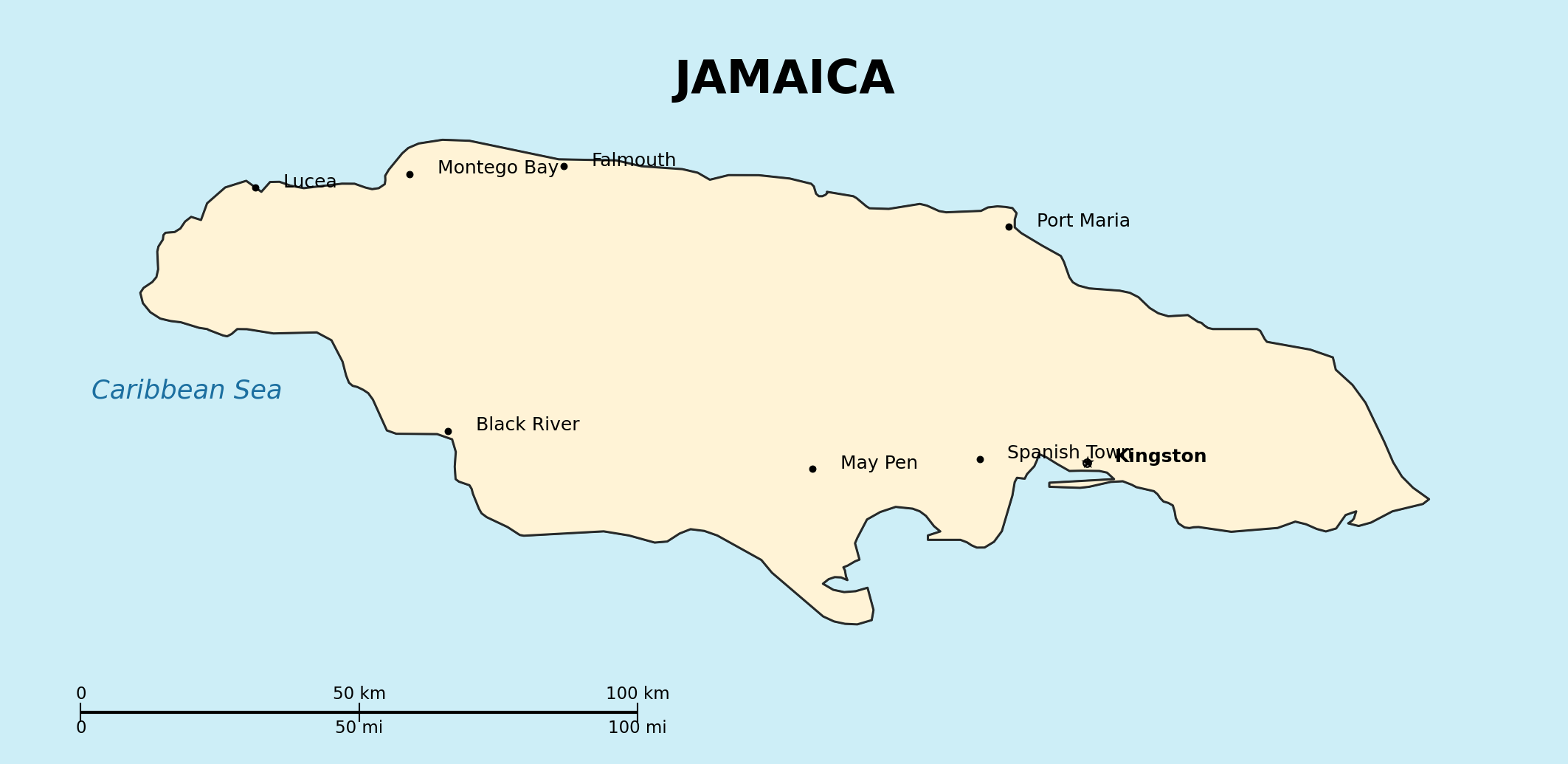
Location: Caribbean, island south of Cuba
Map references: Central America and the Caribbean
Area:
total: 10,991 sq km; third largest island in the Caribbean, after Cuba and Hispaniola
Geography - note: strategic location between the Cayman Trench and Jamaica Channel, main sea lanes for the Panama Canal
| People |
Population: 2,824,913-2,938,503 (2024-2025 est.)
Age structure:
0-14 years: 21.11-23.8%
15-64 years: 65.7-69.31%
65 years and over: 9.58-10.4%
Life expectancy at birth:
total population: 75.75-76.3 years
male: 73.98-74.5 years
female: 77.6-78.1 years
Infant mortality rate: 11.17-18.3 deaths/1,000 live births
Nationality:
noun/adjective: Jamaican(s)
Ethnic groups: African 76.3%, Mixed/Afro-European 15.1%, Indian/Afro-Indian 3.4%, White 3.2%, Chinese/Afro-Chinese 1.2%, other 0.8% (2024 est.)
Religions: Protestant 64.8% (Seventh Day Adventist, Pentecostal, Baptist, and others), Roman Catholic 2.2%, Rastafarian 1.1%, none 21.3% (2011 est.)
Languages: English (official), Jamaican Patois
Population distribution: high density throughout, increasing in and around Kingston, Montego Bay, and Port Esquivel
| Government |
Country name:
conventional short form: Jamaica; motto "Out of Many, One People"
Data code: JM
Government type: unitary parliamentary constitutional monarchy; a Commonwealth realm
National capital: Kingston
Independence: 6 August 1962 (from the UK)
Executive branch:
chief of state: King Charles III, represented by Governor-General Patrick Allen
head of government: Prime Minister Andrew Holness
Background: the native Taino, who had inhabited Jamaica for centuries, were gradually exterminated and replaced with enslaved Africans; England seized the island in 1655, establishing a plantation economy based on sugar, cocoa, and coffee; the abolition of slavery in 1834 freed a quarter-million enslaved people; Jamaica gained independence from the UK in 1962
| Economy |
Economy - overview: upper-middle-income Caribbean island economy; key agriculture and tourism sectors; challenges include high crime, youth unemployment, and poverty; susceptible to natural disasters including hurricanes
GDP (purchasing power parity): $33.775 billion (2024 est.)
GDP - real growth rate: -0.5% (2025)
GDP - per capita: $12,283 PPP (2024 est.)
Inflation rate: 3.7% (2018)
Unemployment rate: 3.5% (October 2024)
Population below poverty line: 17.1% (2016)
Currency: Jamaican dollar (JMD)
| Military |
Military branches: Jamaica Defense Force (JDF): Jamaica Regiment (Land Force), Maritime/Air/Cyber Command (MACC), Support Brigade, Jamaica National Reserve (2025)