

About Korea (South)
Korean - the sole official language, spoken by nearly the entire population, written using the Hangul alphabet.
English is widely taught and used in business, though it holds no official status.
Korean is the sole official language of South Korea.
| Geography |
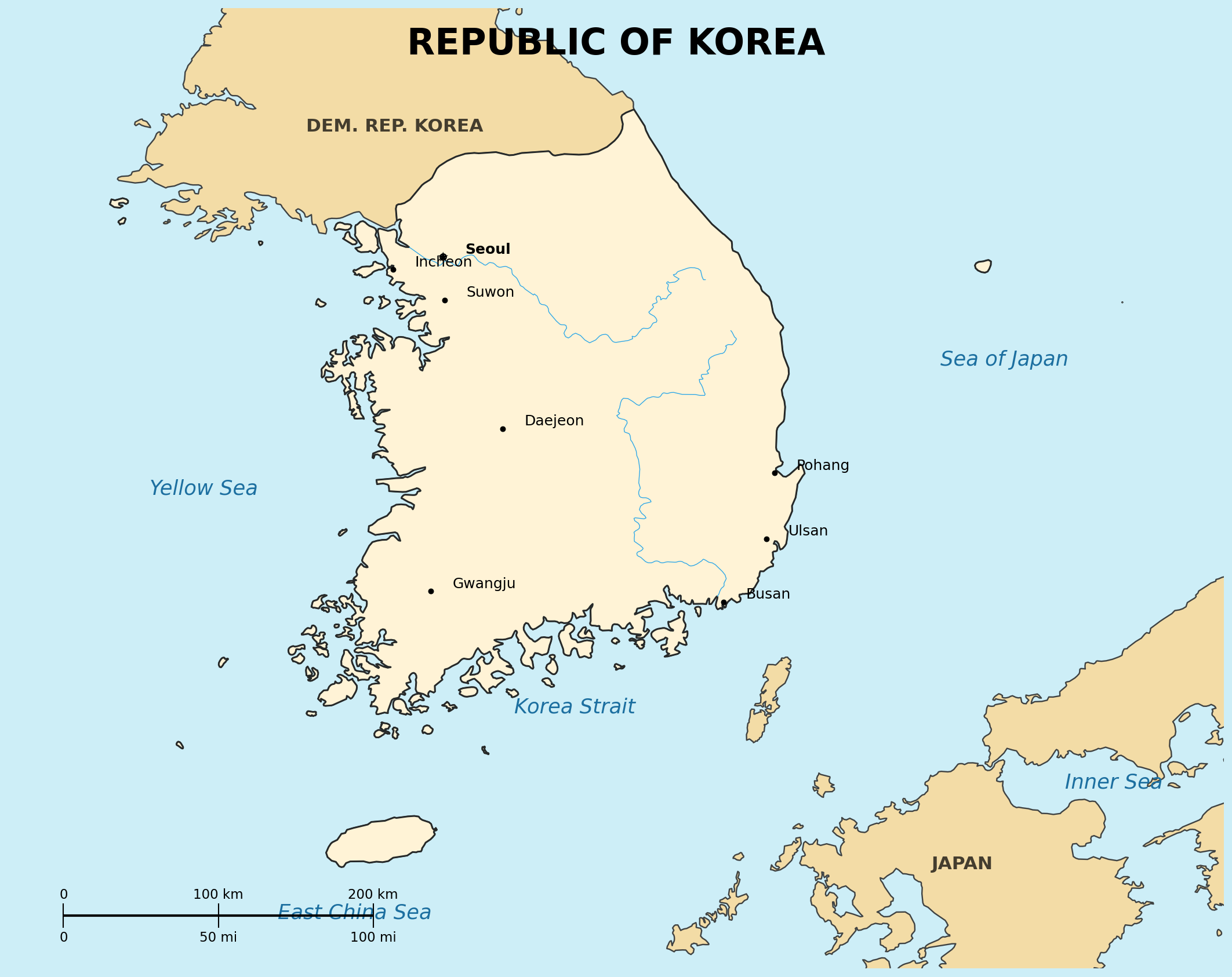
Location: Eastern Asia, southern half of the Korean Peninsula bordering the Sea of Japan and the Yellow Sea
Map references: Asia
Area:
total: 99,720 sq km
Land boundaries:
border countries: North Korea
Natural hazards: occasional typhoons bring high winds and floods; low-level seismic activity common in the southwest; Halla volcano (1,950 m) is considered historically active
Geography - note: strategic location on the Korea Strait; about 3,000 mostly small and uninhabited islands lie off the western and southern coasts
| People |
Population: 51,486,343 (2025 est.)
Urbanization: 81.5% of the population is urban (2023)
Nationality:
noun/adjective: Korean(s)
Religions: Protestant 17%, Buddhist 16%, Catholic 6%, none 60% (2021 est.); many people also carry on Confucian traditions and practices
Languages: Korean, English
Population distribution: primarily concentrated in the lowland areas; Gyeonggi Province in the northwest, which surrounds Seoul and contains the port of Incheon, is the most densely populated; Gangwon in the northeast is the least populated
Major urban areas: 9.988 million Seoul (capital), 3.472 million Busan, 2.849 million Incheon, 2.181 million Daegu (2023)
| Government |
Country name:
conventional long form: Republic of Korea
conventional short form: South Korea
Data code: KS
Government type: presidential republic
National capital: Seoul; the name originates from the Korean word meaning "capital city"; served as the capital of unified Korea from 1392 to 1910; Sejong, ~120 km south of Seoul, serves as an administrative capital for segments of government
Administrative divisions: 9 provinces (do) and 6 metropolitan cities (gwangyeoksi)
Executive branch:
chief of state and head of government: President LEE Jae-myung (since 4 June 2025, elected in a special snap election following the impeachment of former President YOON Suk-yeol)
prime minister: KIM Min-seok (since 3 July 2025), principal executive assistant to the president
Background: the Korean War (1950-1953) saw South Korea successfully defend itself against a North Korean invasion; this catalyzed a period of remarkable economic growth, propelling South Korea into a fully functioning modern democracy and advanced global economy
| Economy |
Economy - overview: high-income, export- and technology-oriented economy; a cornerstone of East Asia's economic landscape; global leader in electronics, semiconductors, shipbuilding, and automobiles
GDP (purchasing power parity): $3.36 trillion (2025)
GDP - real growth rate: 1.0% (2025)
GDP - per capita: $67,550 PPP (2026f)
Inflation rate: 2.5% (2024)
Unemployment rate: 2.7% (2025 est.)
Labor force: 28,466,640 (2020)
Population below poverty line: 14.4% (2016 est.)
Currency: South Korean won (KRW)
| Military |
Military branches: Armed Forces of the Republic of Korea: Army (ROKA), Navy (ROKN, includes Marine Corps), Air Force (ROKAF); Korea Coast Guard; Korean National Police Agency (2025)
Military manpower: approximately 500,000 active Armed Forces personnel (2025)