

About Kuwait
Arabic - the sole official language, specifically the Kuwaiti dialect.
English - widely spoken, particularly in business and education, reflecting historical ties with Britain.
Given Kuwait's large expatriate population (roughly 70% of residents), Hindi, Malayalam, Urdu, Pashto, Tagalog, and Persian are also commonly spoken.
Arabic is the sole official language of Kuwait.
| Geography |
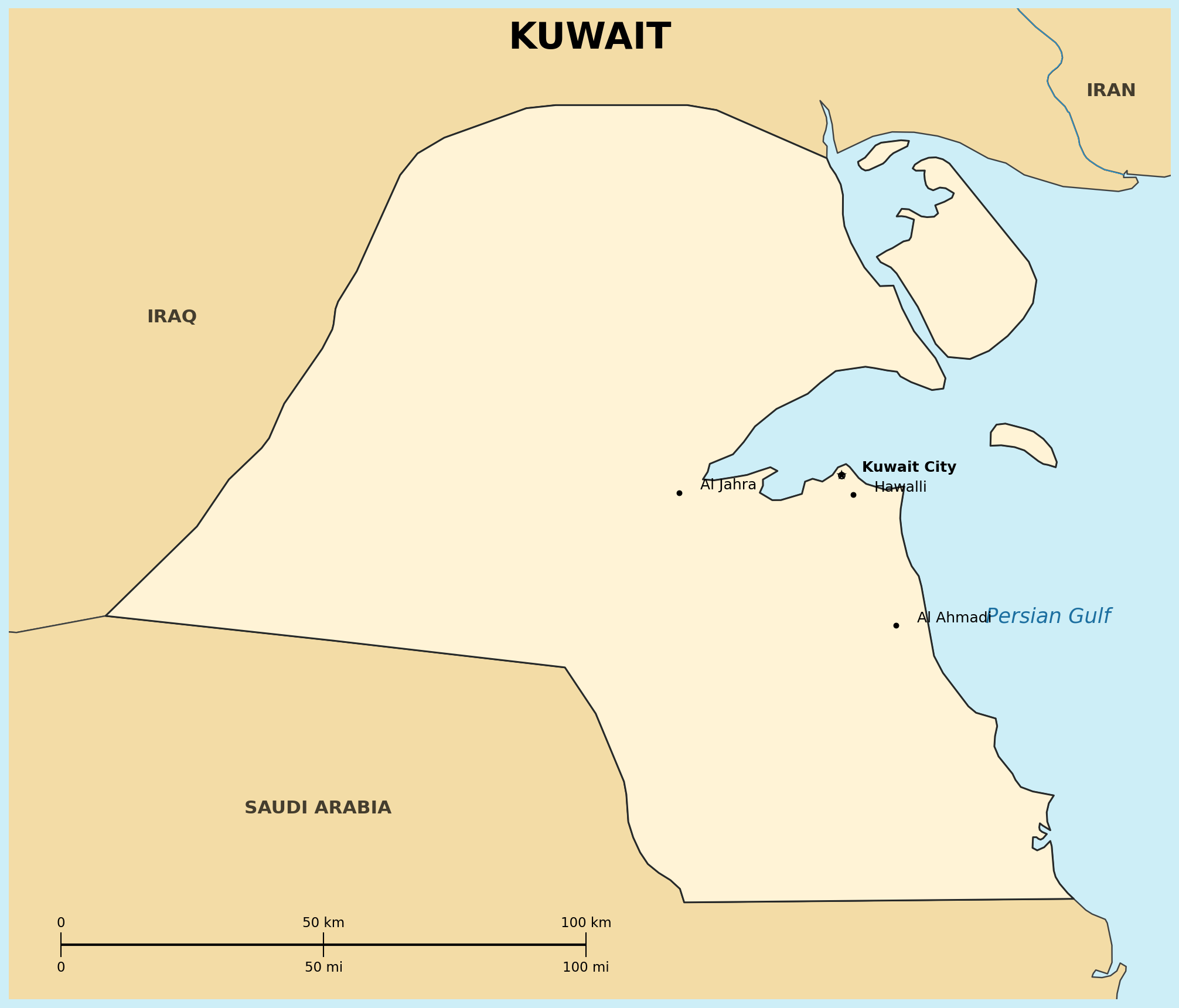
Location: Middle East, bordering the Persian Gulf, between Iraq and Saudi Arabia
Map references: Middle East
Area:
total: 17,818 sq km
Land boundaries:
border countries: Iraq, Saudi Arabia
| People |
Population: 3,172,511-4,900,000 (varies significantly by source, reflecting citizen vs. total resident population; 2024-2025 est.)
Age structure:
0-14 years: 19.49-23.32%
15-64 years: 73.28-76.71%
65 years and over: 3.4-3.8%
Life expectancy at birth:
total population: 79.13-84.6 years (varies by source)
Infant mortality rate: 7.43 deaths/1,000 live births
Nationality:
noun/adjective: Kuwaiti(s)
Ethnic groups: Kuwaiti 30.4%, other Arab 27.4%, Asian 40.3%, African 1%, other 0.9% (2018 est.); non-Kuwaitis account for roughly 70% of the population
Religions: Muslim (official) 74.6%, Christian 18.2%, other/unspecified 7.2% (2013 est.; total population, about 72% of which are immigrants)
Languages: Arabic (official, Kuwaiti dialect), English (widely spoken)
Literacy: total population 96.5% (male 97.1%, female 95.3%) (2020 est.)
Population distribution: densest settlement along the Persian Gulf, particularly in Kuwait City and on Bubiyan Island; significant population extends south and west along highways radiating from the capital
| Government |
Country name:
conventional long form: State of Kuwait
conventional short form: Kuwait; the name derives from the Arabic al-kuwayt, a diminutive of the Hindustani term kut, meaning "a fortress-like house"
Data code: KU
Government type: constitutional emirate; a city-state society where Kuwaiti citizens are a minority in their own country, with the Gulf's most assertive parliament, making politics unusually contentious for the region
National capital: Kuwait City
| Economy |
Economy - overview: high-income economy heavily dependent on petroleum, petrochemicals, and related industries; extensive welfare system for citizens; working to diversify beyond oil with investments in infrastructure, education, and healthcare
GDP (purchasing power parity): $249.255 billion (2024 est.)
GDP - real growth rate: 3.3% (2025f)
GDP - per capita: $51,200 PPP (2025 est.)
Inflation rate: 3.0% (2024)
Unemployment rate: 2.1%
Industries: petroleum, petrochemicals, steelmaking, cement, shipbuilding and repair, desalination, food processing, construction materials
Currency: Kuwaiti dinar (KWD)
| Military |
Military service age and obligation: 18 years of age for voluntary military service, men and women; 12-month compulsory service for men aged 18-35, split between 4 months training and 8 months military service (2025)