

About Latvia
Latvian - the sole official language, spoken by ~56.3% of the population at home.
Russian - spoken by ~33.8% of the population at home, reflecting the country's significant Russian-speaking minority.
Livonian is considered an indigenous language with special legal status, and Latgalian written language and Latvian Sign Language also hold special legal status.
Latvian is the sole official language of Latvia.
| Geography |
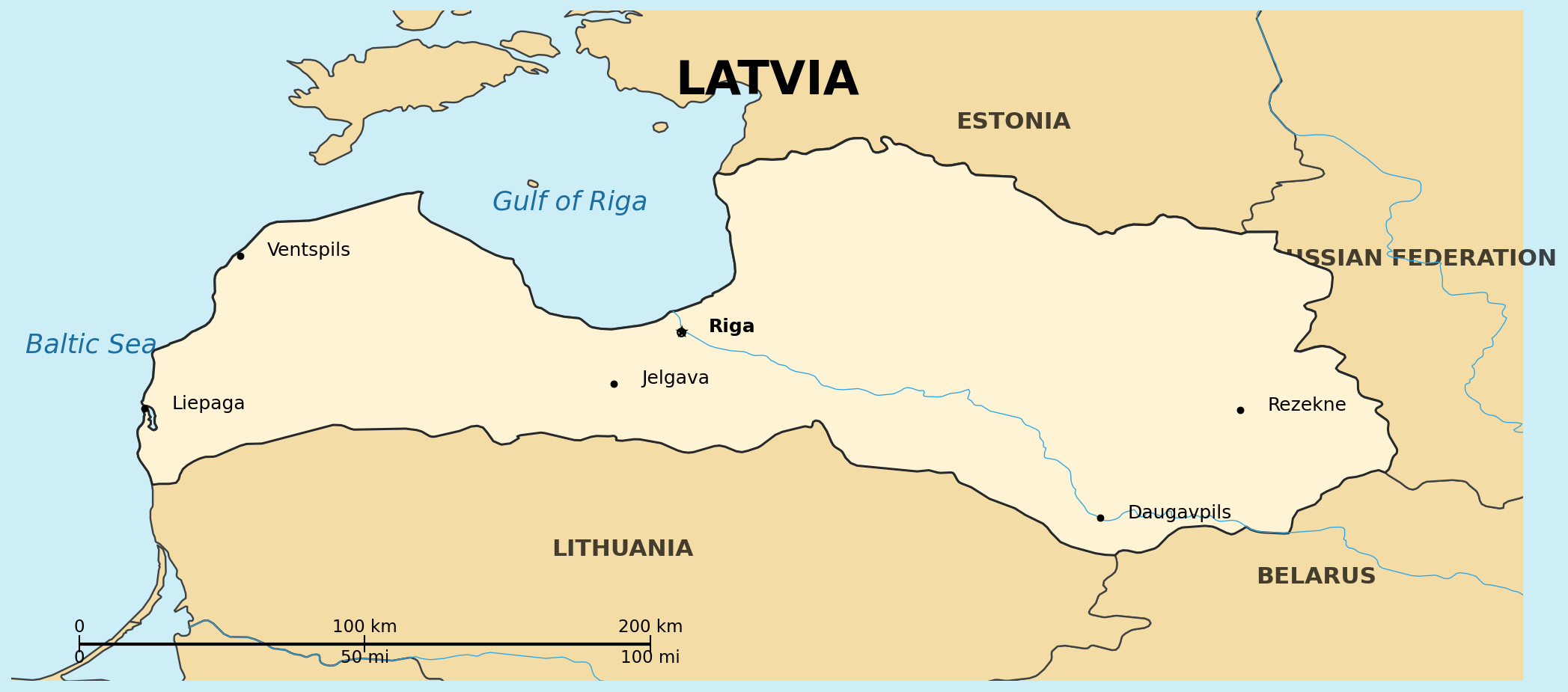
Location: Northern Europe, bordering the Baltic Sea, between Estonia and Lithuania
Map references: Europe
Area:
total: 64,559-64,589 sq km
Land boundaries:
total: 1,370 km
border countries: Belarus 161 km, Estonia 333 km, Lithuania 544 km, Russia 332 km
| People |
Population: 1.8-1.89 million (2025 est.)
Age structure:
0-14 years: 14.7-15.24%
15-64 years: 63%
65 years and over: 19.85-22.2%
Median age: 43.8-43.9 years
Life expectancy at birth:
total population: 75.7-76.4 years
male: 71.7-72 years
female: 80.2 years
Nationality:
noun/adjective: Latvian(s)
Ethnic groups: Latvians 62.4%, Russians 23.7%, Belarusians 3.0%, Ukrainians 3.0% (2023)
Religions: Lutheran 36.2%, Roman Catholic 19.5%, Orthodox 19.1%, unspecified/none 23.5% (2017 est.)
Languages: Latvian (official) 56.3%, Russian 33.8%, other 0.6% (2011 est.; language usually spoken at home)
Population distribution: largest concentration in and around the port and capital city of Riga; small agglomerations scattered throughout the country
| Government |
Country name:
conventional short form: Latvia; de jure continuous with its declaration of independence on 18 November 1918
Data code: LG
Government type: parliamentary republic
National capital: Riga
Executive branch:
chief of state: President Edgars Rinkevics (elected 2023)
| Economy |
Economy - overview: high-income EU and Eurozone economy; small, open economy with exports contributing more than half of GDP; well-developed transit services, timber/wood-processing, agriculture, and machinery/electronics manufacturing; weak recent recovery amid skilled-labor shortages and an uncertain trade environment; declining population and low birth rate pose long-term challenges
GDP (purchasing power parity): $81.79-82.4 billion (2024-2025 est.)
GDP - real growth rate: -0.4% (2024); 2.4% (2025f)
GDP - per capita: $43,526-44,110 PPP (2024-2025 est.)
Inflation rate: 1.3% (2024)
Unemployment rate: 6.6% (2025 est.)
Population below poverty line: 24.3% at risk of poverty or social exclusion (2024)
Industries: processed foods, processed wood products, textiles, processed metals, pharmaceuticals, railroad cars, synthetic fibers, electronics
Currency: Euro (EUR)