

About Lebanon
Arabic - the sole official language, spoken by nearly the entire population.
French - widely spoken as a second language, a legacy of the French Mandate period.
English is also commonly spoken, particularly in business, and Armenian is spoken by the sizable Armenian minority.
Arabic is the sole official language of Lebanon.
| Geography |
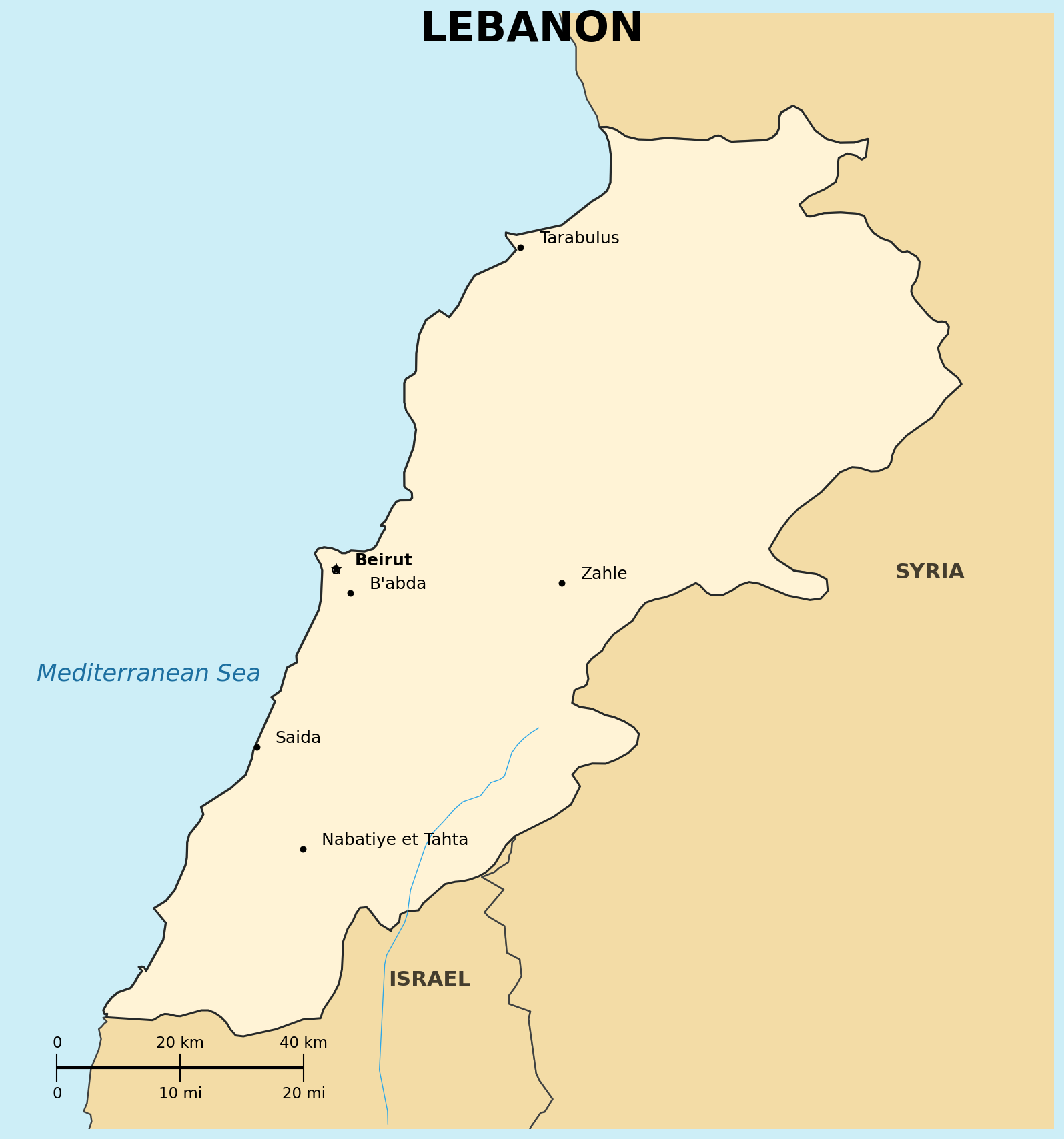
Location: Middle East, bordering the Mediterranean Sea, between Israel and Syria
Map references: Middle East
Area:
total: 10,400 sq km
Land boundaries:
border countries: Israel, Syria
Climate: Mediterranean; mild to cool, wet winters with hot, dry summers; the Lebanon Mountains experience heavy winter snows
| People |
Population: 5.36-5.9 million (2024-2026 est.)
Age structure:
0-14 years: 18.9%
15-64 years: 71.6%
65 years and over: 9.5% (2024 est.)
Median age: 29.4 years (2025 est.)
Nationality:
noun/adjective: Lebanese
Religions: Muslim 67.8% (Sunni 31.9%, Shia 31.2%, smaller Alawite and Ismaili populations), Christian 32.4% (Maronite Catholics the largest group), Druze 4.5% (2020 est.; citizen population only, excludes Syrian and Palestinian refugees; 18 religious sects officially recognized)
Languages: Arabic (official), French, English, Armenian
Literacy: total population 92-95.1% (male 94.8-96.9%, female 89.5-93.3%) (2018-2019 est.)
Population distribution: majority live on or near the Mediterranean coast, particularly in and around the capital, Beirut
| Government |
Country name:
conventional long form: Lebanese Republic
conventional short form: Lebanon; the name derives from the Semitic root lbn, meaning "white," likely referring to the country's snow-capped mountains
Data code: LE
Government type: parliamentary democratic republic
National capital: Beirut
Independence: 22 November 1943 (from the League of Nations mandate under French administration)
Background: located at the crossroads of three continents, rich in cultural and religious diversity; subject to various foreign conquerors including the Romans, Arabs, and Ottomans; after WWI, France acquired a mandate over the northern portion of the former Ottoman Syria province, from which Lebanon was demarcated in 1920; gained independence in 1943; the 1975-1990 civil war resulted in an estimated 120,000 fatalities, followed by years of instability; sectarianism remains a key element of Lebanese political life
| Economy |
Economy - overview: lower-middle-income Middle Eastern economy in severe crisis; hyperinflation and sharp poverty increases; banks have effectively ceased lending; further economic contraction and destroyed infrastructure resulting from the Israel-Hezbollah conflict
GDP (purchasing power parity): $63.168 billion (2024 est.)
GDP - real growth rate: -7.5% (2024)
GDP - per capita: $11,815 PPP (2024 est.)
Inflation rate: 210% (2022 est.)
Unemployment rate: 6.2% (2019)
Population below poverty line: 27.4% (2012); 63% on less than $5.50/day (2011)
Currency: Lebanese pound (LBP)
| Military |
Military - note: the Lebanese Armed Forces' (LAF) inventory consists mostly of older or secondhand equipment from an array of countries, including France, Germany, Russia, and especially the US (2025)