
About Lesotho
Sesotho - the official national language, spoken by ~99.7% of the population.
English - also official, used in government and education.
Phuthi, Xhosa, and Zulu are also spoken by smaller communities.
Sesotho and English are both official languages of Lesotho.
| Geography |
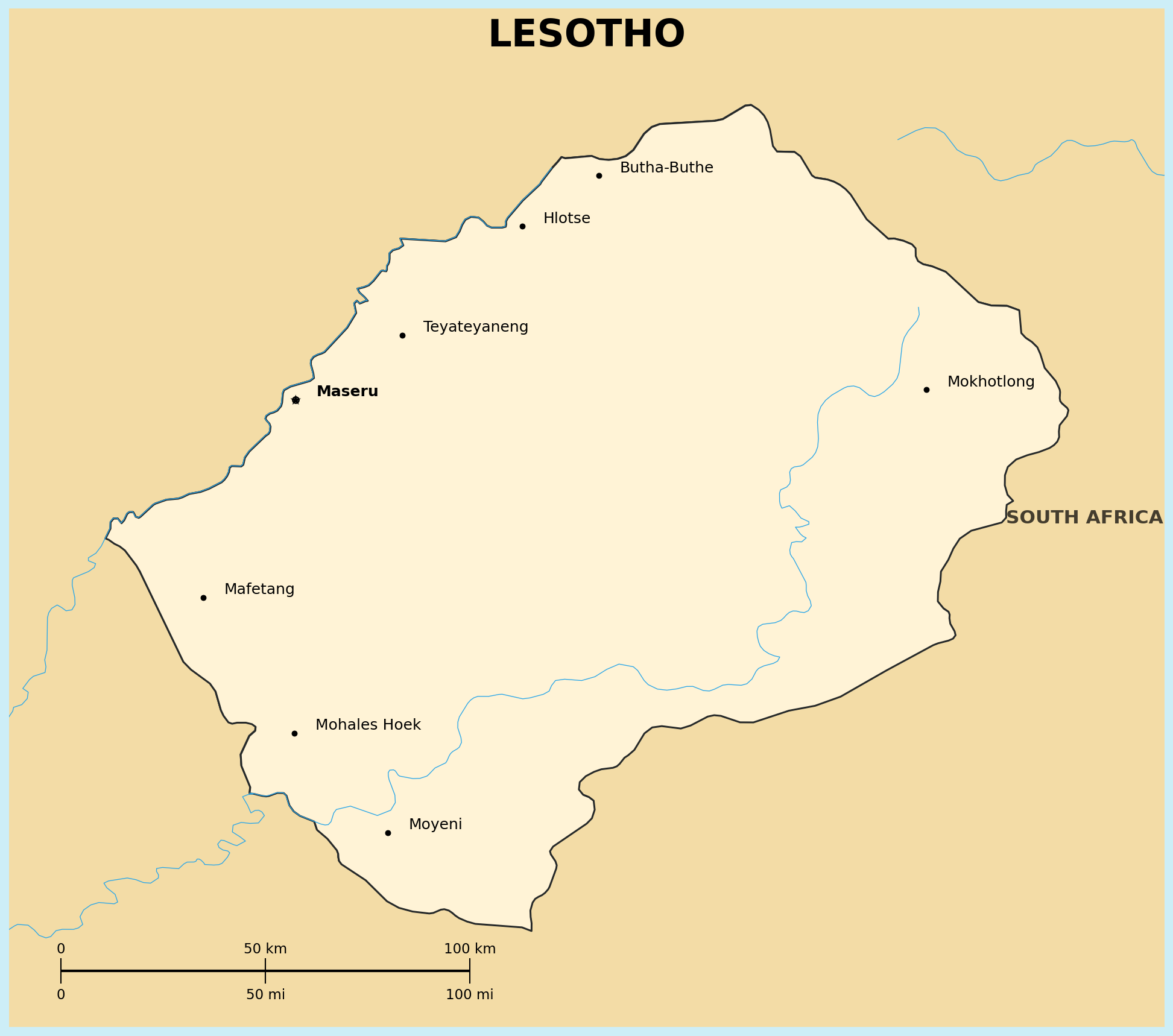
Location: Southern Africa, an enclave of South Africa
Map references: Africa
Area:
total: 30,355 sq km
Land boundaries:
border countries: South Africa (entirely surrounded)
Terrain: mountainous; more than 80% of the country lies above 1,800 m (5,900 ft)
Geography - note: landlocked; entirely encircled by South Africa, bordering the provinces of KwaZulu-Natal, Free State, and Eastern Cape; depends on South Africa for access to the outside world
| People |
Population: 2.13-2.22 million (2024-2025 est.)
Age structure:
0-14 years: 32%
15-64 years: 62.7%
65 years and over: 5.4% (2024 est.)
Nationality:
noun: Mosotho (singular), Basotho (plural)
adjective: Basotho
Ethnic groups: Sotho 99.7%, other 0.3% (includes Kwena, Nguni/Hlubi and Phuthi, Zulu)
Religions: Protestant 47.8% (Pentecostal, Lesotho Evangelical, Anglican), Roman Catholic 39.3%, other Christian 9.1% (2014 est.); about 96% of Basotho are practicing Christians
Languages: Sesotho (official), English (official), Phuthi, Xhosa, Zulu
Literacy: total population 90.4% (male 83.2%, female 96.6%) (2024 est.)
Population distribution: relatively higher density in the western half, with the capital Maseru and smaller cities of Mafeteng, Teyateyaneng, and Leribe attracting the most people
| Government |
Country name:
conventional long form: Kingdom of Lesotho
conventional short form: Lesotho; the name comes from the Sotho people, meaning "dark-skinned"; former name Basutoland
former: Basutoland
Data code: LT
Government type: parliamentary constitutional monarchy
National capital: Maseru; the name means "[place of] red sandstones" in Sesotho
Independence: 4 October 1966 (from the UK)
Background: established as a kingdom in the early 19th century, followed by a long period of foreign rule; constitutional government was restored in 1993 after seven years of military rule; violent protests and a military mutiny following a contentious 1998 election prompted a brief intervention by South African and Batswana military forces under the Southern African Development Community (SADC)
| Economy |
Economy - overview: least-developed, lower-middle-income economy; heavily dependent on remittances from Basotho working in South Africa, apparel manufacturing, and agriculture; among the world's highest HIV/AIDS prevalence rates
GDP (purchasing power parity): $7.41 billion (2025 est.)
GDP - real growth rate: 1.5% (2025)
GDP - per capita: $3,380 PPP (2025 est.)
Inflation rate: 3.1% (2010 est.)
Unemployment rate: 22.8% (2025 est.)
Population below poverty line: 40%
Currency: Lesotho loti (LSL)
| Military |
Military branches: Lesotho Defense Force (LDF), responsible for sovereignty and internal security; in practice, external security is guaranteed by South Africa; began in 1964 as the Police Mobile Unit (2025)