

About Libya
Arabic - the official language, spoken by the majority of the population.
Tamazight (Berber) - spoken by the indigenous Amazigh people, particularly in mountainous regions; includes dialects such as Nafusi, Ghadamis, Suknah, Awjilah, and Tamasheq.
Italian and English are also widely understood in major cities.
Arabic is the sole official language of Libya.
| Geography |
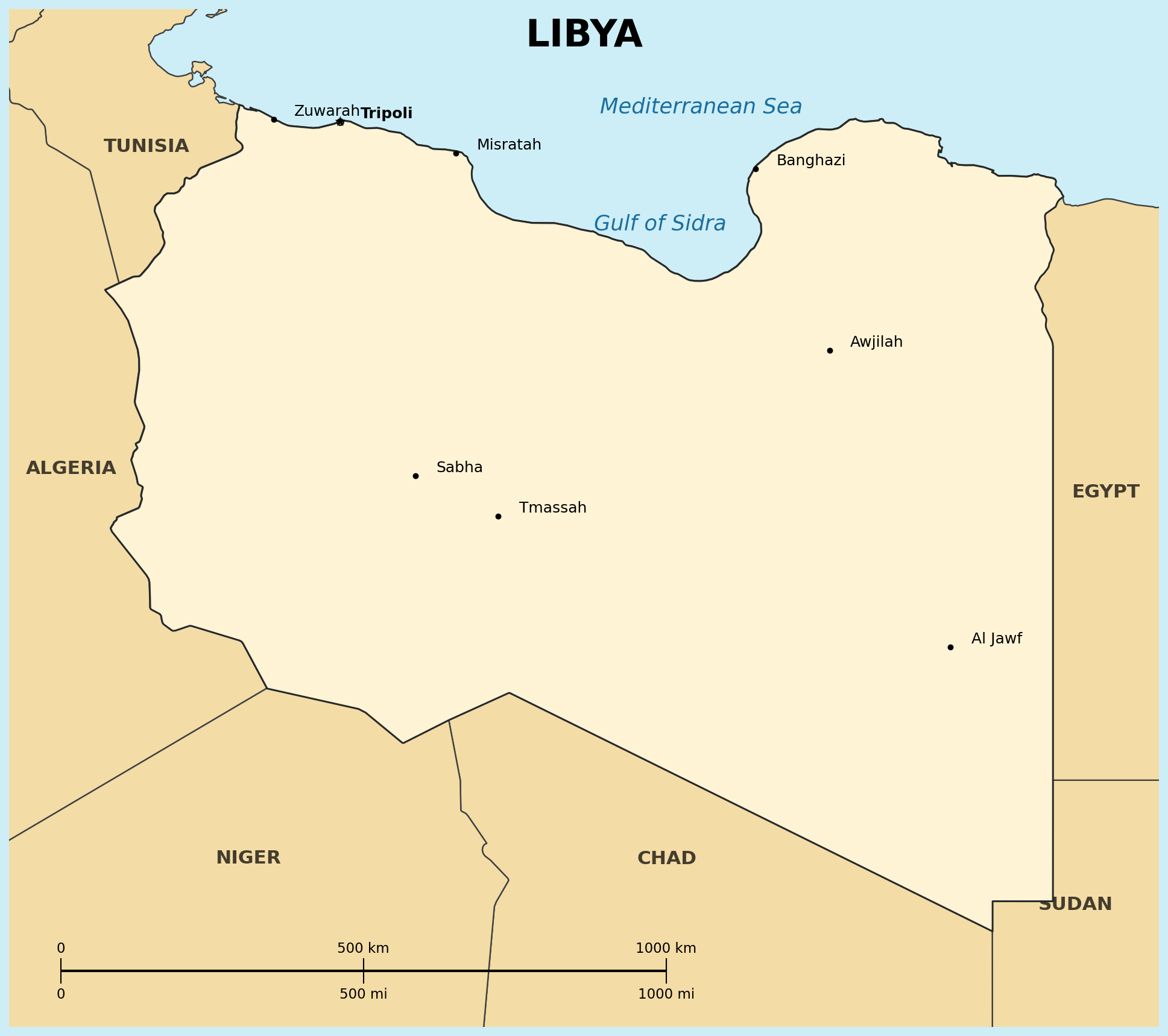
Location: Northern Africa, bordering the Mediterranean Sea, between Egypt and Tunisia
Map references: Africa
Area:
total: 1,759,541 sq km
Land boundaries:
border countries: Algeria, Chad, Egypt, Niger, Sudan, Tunisia
Terrain: mostly barren, flat to undulating plains, plateaus, depressions; more than 90% of the country is desert or semidesert
Geography - note: the volcano Waw an Namus lies in south-central Libya in the middle of the Sahara; its caldera is an oasis ("oasis of mosquitoes") containing several small lakes hosting many species of insects and birds
| People |
Population: 7,361,263-7,417,134 (2024 est.); among the least densely populated countries in the world
Age structure:
0-14 years: 32.3%
15-64 years: 63.2%
65 years and over: 4.6% (2024 est.)
Median age: 26.4 years (2025 est.)
Life expectancy at birth:
total population: 77.7 years
male: 75.5 years
female: 80 years (2024 est.)
Infant mortality rate: 10.4 deaths/1,000 live births (2025 est.)
Nationality:
noun/adjective: Libyan(s)
Ethnic groups: Amazigh (Berber) and Arab 97%, other 3% (includes Egyptian, Greek, Indian, Italian, Maltese, Pakistani, Tunisian, Turkish)
Religions: Muslim (official; virtually all Sunni) 96.6%, Christian 2.7%, other minorities <1% each (2020 est.)
Languages: Arabic (official), Italian, English (widely understood in major cities); Tamazight (Nafusi, Ghadamis, Suknah, Awjilah, Tamasheq)
| Government |
Country name:
conventional long form: State of Libya
conventional short form: Libya
local long form: Dawlat Libiya
local short form: Libiya
Data code: LY
Government type: in transition; divided governance between rival authorities (Tripoli-based Government of National Unity and eastern-based structures)
National capital: Tripoli
Background: Berbers have inhabited the region since ancient times; Phoenicians, Greeks, Carthaginians, Persians, Egyptians, Romans, and Vandals ruled at various points; Islam spread through the region in the 7th century; Italians took control around Tripoli in 1911, holding it until defeat in WWII in 1943; Muammar GADDAFI seized power in a 1969 coup and ruled until being overthrown and killed in the 2011 Libyan Civil War (with NATO intervention); a second civil war followed, formally ending in October 2020, though the country remains divided between rival governments and armed factions
| Economy |
Economy - overview: upper-middle-income, fossil-fuel-based North African economy; oil is the dominant driver of GDP; historically disrupted by conflict, oil blockades, and COVID-19; central bank and financial stability challenges tied to the ongoing political division
GDP (purchasing power parity): $123.99 billion (2025 est.)
GDP - real growth rate: 17.3% (2025)
GDP - per capita: $17,760 PPP (2025 est.)
Inflation rate: 2% (2024)
Unemployment rate: 18.74% (2023 est.)
Labor force: 2,534,196 (2023)
Currency: Libyan dinar (LYD)
| Military |
Military - note: the Libyan Armed Forces of the Tripoli-based Government of National Unity (GNU) include a mix of nominally integrated units, tribal armed groups, militias, civilian volunteers, and foreign contractors; the rival Libyan National Army (LNA) controls the east; the two forces are separated by a fortified line of control near Sirte; Turkey supports the GNU, while Russia and the UAE have supplied the LNA (2025)
| Transnational Issues |
Trafficking in persons - tier rating: Special Case (2025)