
Country information
Lithuania
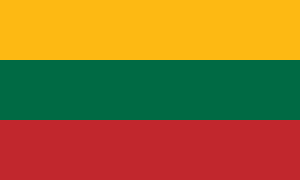
- Capital
- Vilnius
- Population
- 2,884,324
Languages spoken
About Lithuania
Lithuanian - the sole official language, spoken by ~85.3% of the population as a first language; one of the oldest living Indo-European languages, closely related to Latvian.
Russian - spoken by ~6.8% as a first language, and Polish by ~5.1%, reflecting minority communities.
Lithuanian is the sole official language of Lithuania.
| Geography |
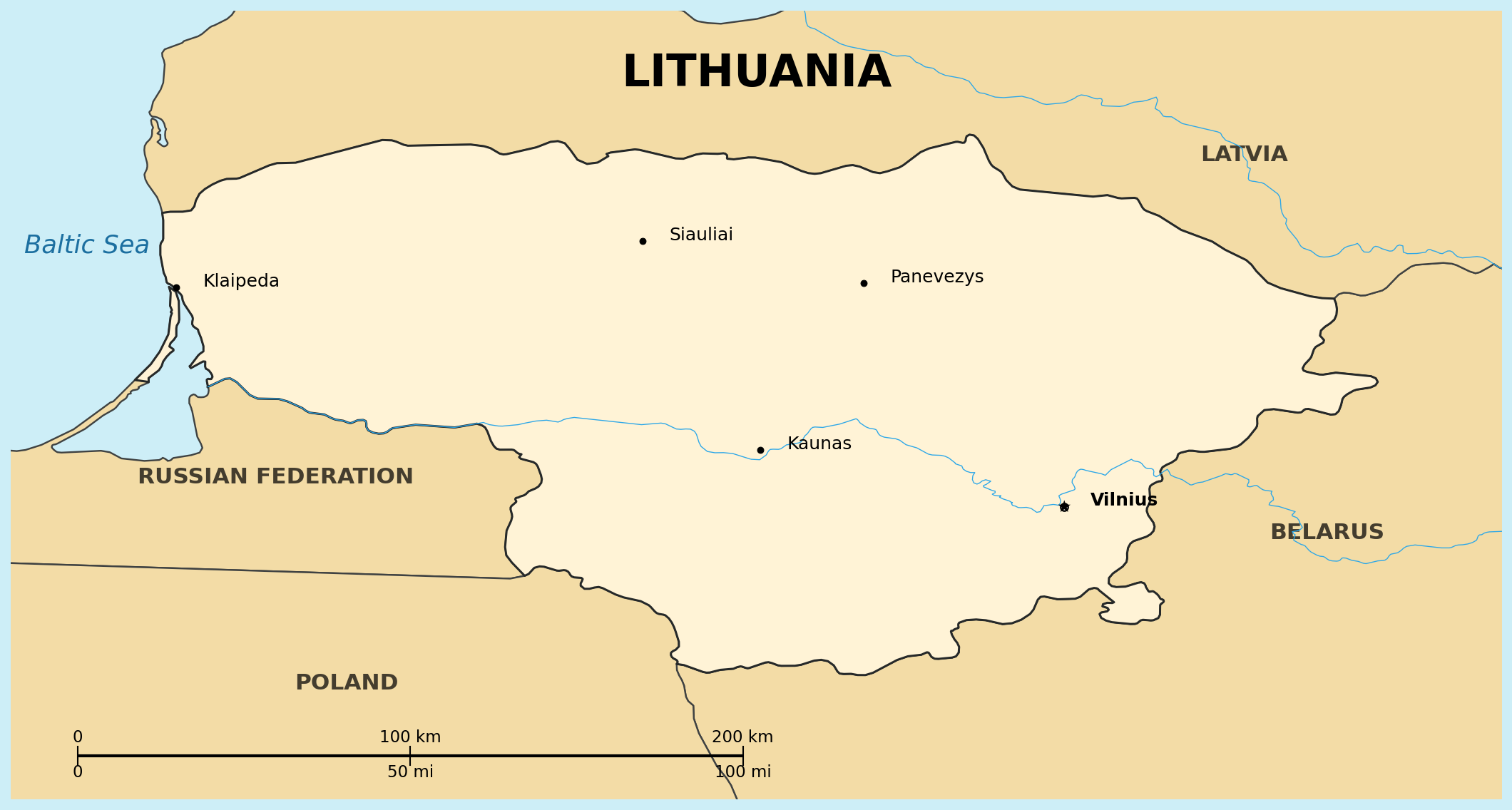
Location: Northern Europe, bordering the Baltic Sea, between Latvia and Russia (Kaliningrad)
Map references: Europe
Area:
total: 65,300 sq km
Land boundaries:
border countries: Belarus, Latvia, Poland, Russia (Kaliningrad)
| People |
Population: 2.79-2.9 million (2024-2026 est.)
Age structure:
0-14 years: 15.01%
15-64 years: 65.31%
65 years and over: 19.67% (2017 est.)
Life expectancy at birth: total population 77.0 years (World Bank, 2025)
Infant mortality rate: 2.8 deaths/1,000 live births
Nationality:
noun/adjective: Lithuanian(s)
Religions: Roman Catholic 77.2%, Russian Orthodox 4.1%, none 6.1% (2011 est.)
Languages: Lithuanian (official) 85.3%, Russian 6.8%, Polish 5.1%, other 1.1% (2021 est.)
Population distribution: fairly even throughout the country, with somewhat greater concentrations in the southern cities of Vilnius and Kaunas, and the western port of Klaipeda
| Government |
Country name:
conventional short form: Lithuania; meaning of the name is obscure, possibly from lietava ("small river") or lietus ("rain"/"land of rain")
Data code: LH
Government type: semi-presidential republic
National capital: Vilnius
Background: the last European country to adopt Christianity; led the Baltic exit from the USSR in 1990, becoming the first Soviet republic to declare independence, though Moscow did not recognize it until 1991; the last Russian troops withdrew in 1993; joined NATO and the EU in 2004, the eurozone in 2015, and OECD in 2018; emigration shrank the population by roughly a quarter, though return migration and Ukrainian/Belarusian arrivals have recently reversed the trend
| Economy |
Economy - overview: high-income EU and Eurozone economy, the largest Baltic economy; Vilnius is a fintech-licensing leader and Kaunas an industrial hub; lasers (a world-class niche), furniture (including for IKEA), and food exports drive growth; achieved full energy decoupling from Russia via the Klaipeda LNG terminal
GDP (purchasing power parity): $159.68-176.929 billion (2024-2026 est.)
GDP - real growth rate: 2.92% (2025)
GDP - per capita: $61,052 PPP (2026 est.)
Inflation rate: 0.7-3.4% (varies by year; 2024-2025)
Unemployment rate: 6.7-6.9% (2025); youth unemployment 15.9% (Jan 2026)
Population below poverty line: 22.6% (2025)
Industries: petroleum refining, food processing, energy supplies, chemicals, furniture, wood products, textiles and clothing
Currency: Euro (EUR)