
Country information
North Macedonia
- Capital
- Skopje
- Population
- 1,822,612
Languages spoken
About North Macedonia
Macedonian - the official language nationally, spoken by ~61.4% of the population as a mother tongue.
Albanian - also official, spoken by ~24.3%, and elevated to national official status in 2018.
Turkish, Romani, Aromanian (Vlach), and Bosnian are also spoken; minority languages are co-official with Macedonian in municipalities where they are spoken by at least 20% of the population.
Macedonian and Albanian are the official languages of North Macedonia.
| Geography |
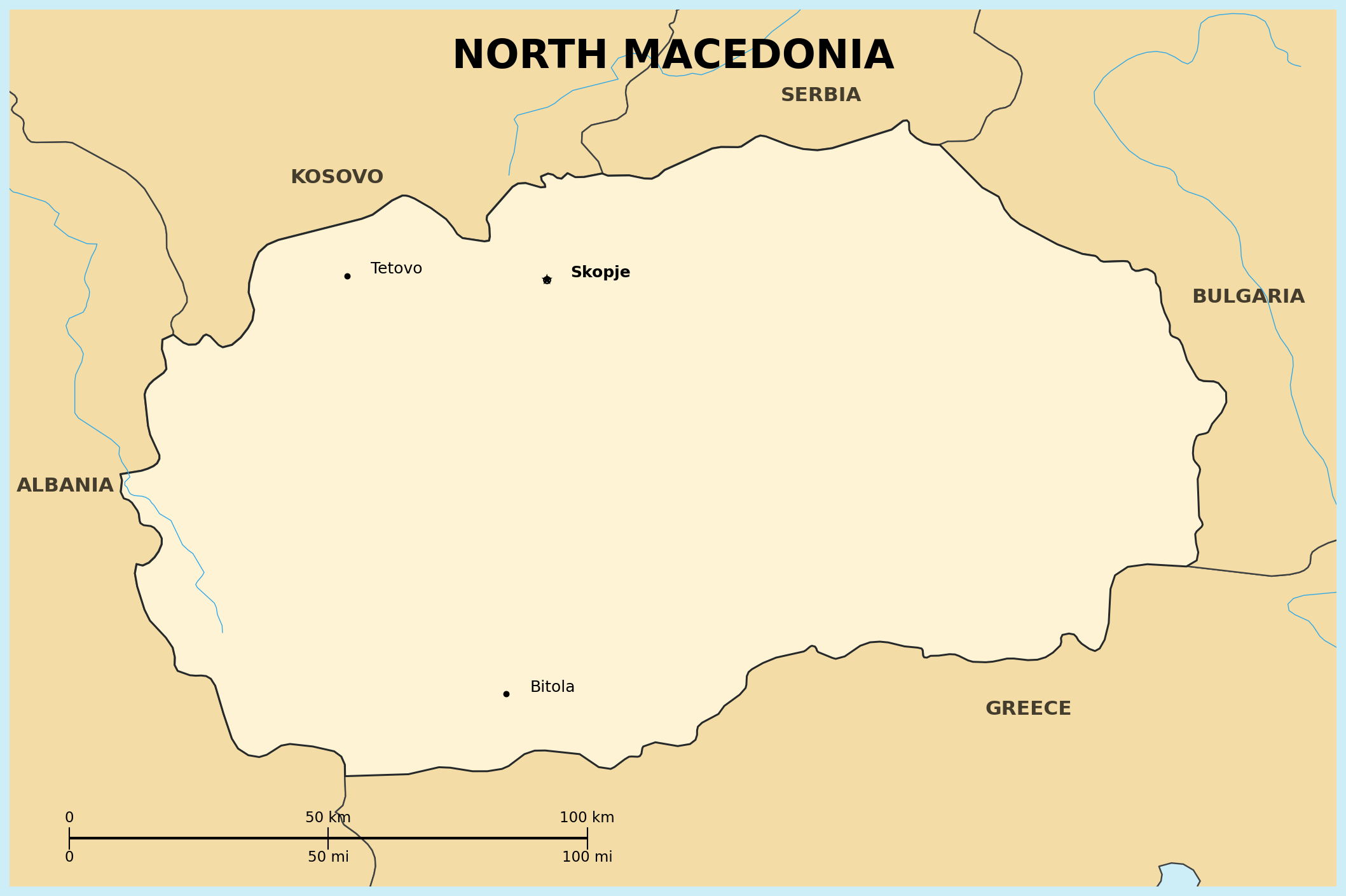
Location: Southeastern Europe, landlocked, north of Greece
Map references: Europe
Area:
total: 25,436-25,713 sq km
Land boundaries:
border countries: Albania, Bulgaria, Greece, Kosovo, Serbia
| People |
Population: 1.82-2.14 million (2024-2025 est.)
Life expectancy at birth: total population 76.6 years (World Bank, 2024)
Nationality:
noun/adjective: Macedonian(s)
Ethnic groups: Macedonian 58.4%, Albanian 24.3%, Turkish 3.9%, Romani 2.5%, Serb 1.3%, other 2.4%, no data 7.2% (2021 est.); North Macedonia has not conducted a census since 2002 prior to 2021; Romani populations are usually underestimated and may represent 6.5-13% of the population
Languages: Macedonian (official) 61.4%, Albanian (official) 24.3%, Turkish 3.4%, Romani 1.7%, other (Aromanian/Vlach, Bosnian) 2%, unspecified 7.2% (2021 est.)
Literacy: total population 96.1% (2002 est.)
| Government |
Country name:
conventional short form: North Macedonia; formerly the Republic of Macedonia
Data code: MK
Government type: parliamentary republic
National capital: Skopje
Independence: 8 September 1991 (from Yugoslavia)
Background: a Slavic Orthodox majority shares the country with a large Albanian minority; ethnic Albanian grievances over perceived inequities escalated into armed conflict in 2001, ending with the internationally brokered Ohrid Framework Agreement, which enhanced minority rights; renamed itself from "Macedonia" to "North Macedonia" in 2019 under the Prespa Agreement, resolving a decades-long name dispute with Greece and unlocking NATO membership, which it joined in 2020; now an EU accession candidate
| Economy |
Economy - overview: upper-middle-income, developing economy; has made progress liberalizing its economy and improving its business environment since independence; steady emigration continues to drain the youth population
GDP (purchasing power parity): $53.345-56.11 billion (2025-2026 est.)
GDP - real growth rate: 3.4% (2025)
GDP - per capita: $29,475-31,170 PPP (2025-2026 est.)
Inflation rate: 3.9% (2025)
Unemployment rate: 11.5-12.3% (2025)
Population below poverty line: 21.8% (2020)
Industries: food processing, beverages, textiles, chemicals, iron, steel, cement, energy, pharmaceuticals, automotive parts
Currency: Macedonian denar (MKD)
| Military |
Military branches: Army of the Republic of North Macedonia (ARSM), responsible for territorial defense and fulfilling NATO commitments; became the 30th NATO member in 2020; has small numbers of combat troops deployed to Bulgaria and Romania as part of NATO's Enhanced Forward Presence mission (2025)