

About Australia
English - spoken at home by ~72.7% of the population, and the country's de facto official language.
Mandarin - spoken by ~2.5%, the largest non-English language spoken at home.
Arabic, Cantonese, Vietnamese, Italian, and Greek are also spoken by significant minorities (1-1.4% each), reflecting Australia's diverse immigrant population.
Note: Australia has no official language at the federal level, but English is the language of government and instruction.
| Geography |
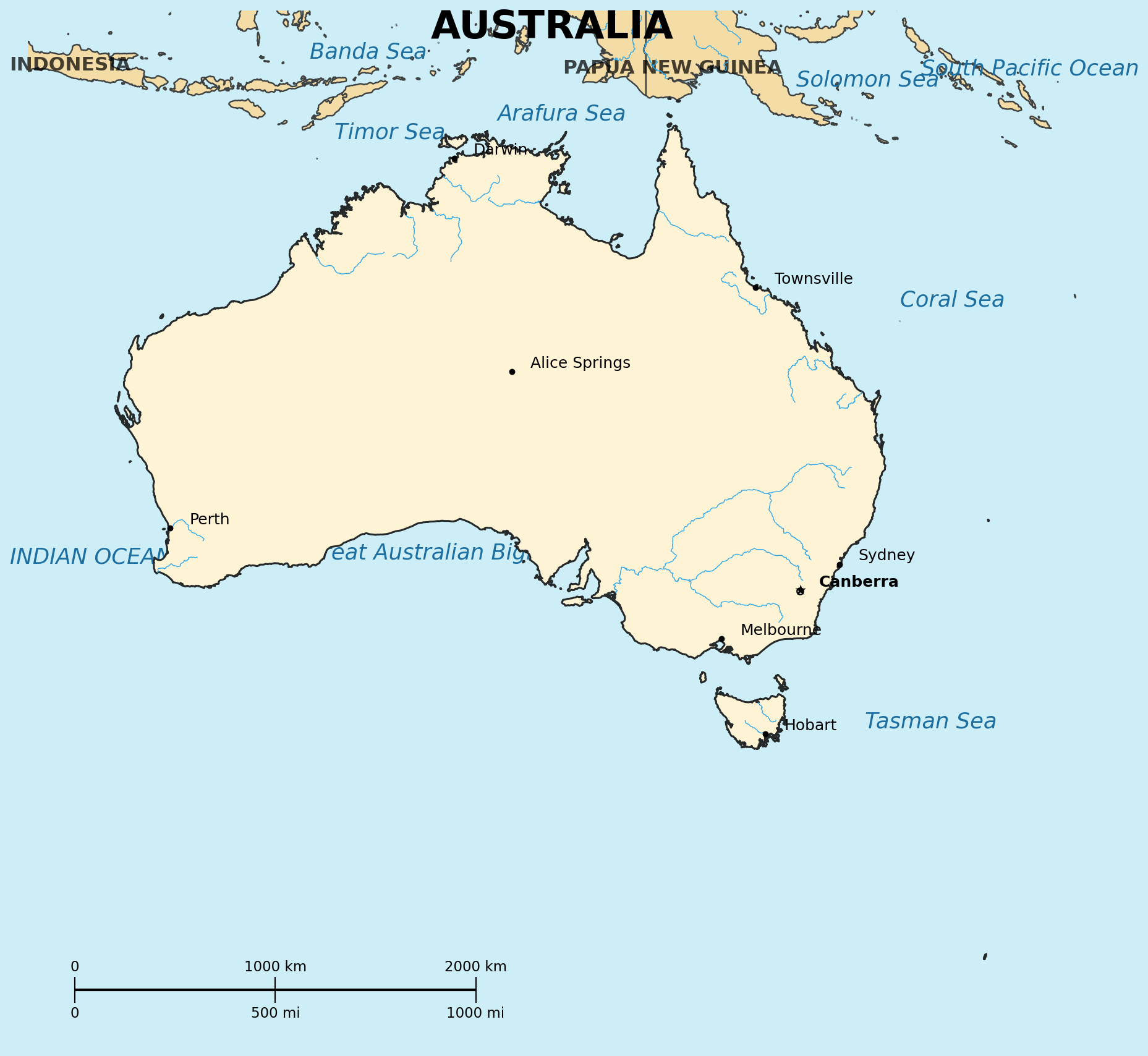
Location: Oceania, continent between the Indian Ocean and the South Pacific Ocean
Map references: Oceania
Area:
total: 7,741,220 sq km (6th largest country in the world)
Coastline: 25,760 km
Climate: generally arid to semiarid; temperate in south and east; tropical in north
Terrain: mostly low plateau with deserts; fertile plain in southeast
Natural resources: bauxite, coal, iron ore, copper, tin, gold, silver, uranium, nickel, tungsten, rare earth elements, mineral sands, lead, zinc, diamonds, natural gas, petroleum
| People |
Population: 27,490,921 (2025 est.)
Age structure:
0-14 years: 17.75%
15-64 years: ~65.8%
65 years and over: 16.44%
Life expectancy at birth:
total population: 83.5 years
male: 81.3 years
female: 85.7 years (2024 est.)
Infant mortality rate: 3 deaths/1,000 live births (2025 est.)
Nationality:
noun: Australian(s)
adjective: Australian
Ethnic groups: English 33%, Australian 29.9%, Irish 9.5%, Scottish 8.6%, Chinese 5.5%, Italian 4.4%, German 4%, other 7.7%, unspecified 4.7% (2021 est.)
Religions: Protestant 23.1%, Roman Catholic 22.6%, other Christian 4.2%, Muslim 2.6%, Buddhist 2.4%, Orthodox 2.3%, Hindu 1.9%, other 1.3%, none 30.1%, unspecified 9.6% (2016 est.)
Languages: English 72.7%, Mandarin 2.5%, Arabic 1.4%, Cantonese 1.2%, Vietnamese 1.2%, Italian 1.2%, Greek 1%, other 14.8%, unspecified 6.5% (2016 est.; language spoken at home)
| Government |
Country name:
conventional short form: Australia
Data code: AS
Government type: federal parliamentary constitutional monarchy (also a Commonwealth realm)
National capital: Canberra
Independence: 1 January 1901 (federation of UK colonies)
Executive branch:
chief of state: King Charles III, represented by Governor-General Sam Mostyn
head of government: Prime Minister Anthony Albanese
| Economy |
Economy - overview: internationally competitive, advanced market economy, due in large part to economic reforms adopted in the 1980s and its location in one of the fastest-growing regions of the world; long-term concerns include an aging population, pressure on infrastructure, and environmental issues such as floods, droughts, and bushfires
GDP (purchasing power parity): $2.060 trillion (2025 est.)
GDP - real growth rate: 1.6% (2025 est.)
GDP - per capita: $73,360 PPP (2026 est.)
Inflation rate: 1.4% (March 2025)
Unemployment rate: 4.1-4.3% (2025-2026 est.)
Labor force: 14.5 million (September 2024)
Industries: financial and insurance services, construction, healthcare and social assistance, mining, professional/scientific/technical services, manufacturing
Exports: A$644.4 billion (2024); iron ore, wine, coal, natural gas, gold, aluminium, beef, crude petroleum, copper
Exports - partners: China 30.4%, Japan 11.7%, South Korea 6.5%, United States 6.2%, India 5.5% (2024)
Currency: Australian dollar (AUD)
| Military |
Military branches: Australian Defence Force (ADF): Australian Army, Royal Australian Navy, Royal Australian Air Force (2025)
Military service age and obligation: 17 years of age (with parental consent; 18 to deploy) for voluntary service, men and women; no conscription (abolished 1972)