
About Mongolia
Mongolian - the sole official language, spoken by ~90% of the population; the Khalkha dialect is predominant, written in the Cyrillic script.
Turkic languages and Russian are also spoken by smaller communities.
Mongolian is the sole official language of Mongolia.
| Geography |
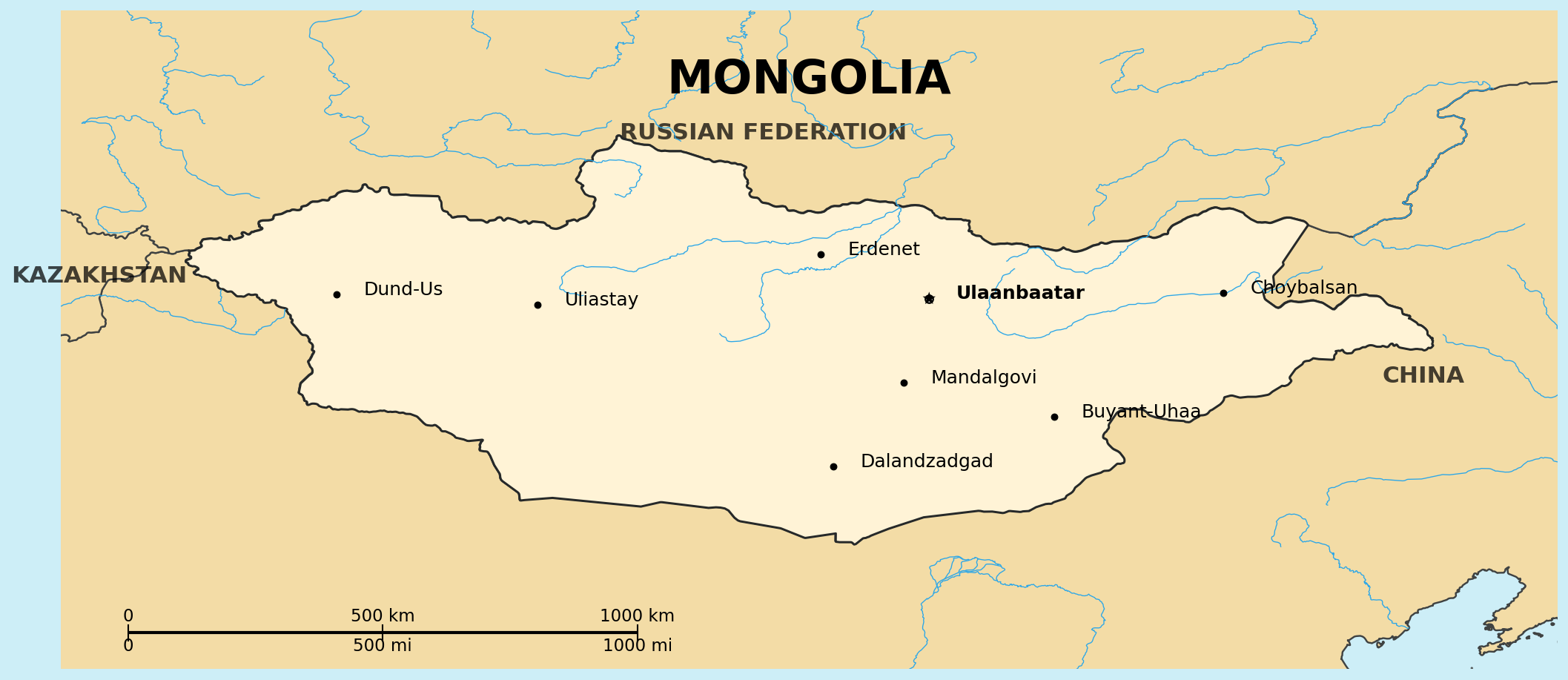
Location: Eastern Asia, between China and Russia; the world's second-largest landlocked country
Map references: Asia
Area:
total: 1,564,110-1,564,116 sq km
Land boundaries:
border countries: China, Russia
Terrain: vast steppes and the Gobi Desert
| People |
Population: 3.28-3.59 million (2024-2025 est.); sparsely populated
Age structure:
0-14 years: 25.7-26.95%
15-64 years: 68.4%
65 years and over: 4.29-5.9%
Median age: 28.8 years (2025 est.)
Life expectancy at birth: total population 72.1 years (World Bank, 2025)
Infant mortality rate: 11.4 deaths/1,000 live births
Nationality:
noun/adjective: Mongolian(s)
Ethnic groups: approximately 95% Mongol, with Kazakh, Tuva, and other minorities
Religions: Buddhist 51.8-53%, no religion 38.6-40.6%, Muslim 3.2%, Shamanist 2.5-2.9%, Christian 1.3-2.2% (2010-2020 est.)
Languages: Mongolian (official) 90%, Turkic, Russian
Literacy: total population 98.6% (male 98.3%, female 98.9%) (2023 est.)
Population distribution: sparsely distributed throughout the country; the capital, Ulaanbaatar, and the northern city of Darhan support the highest population densities
| Government |
Country name:
conventional short form: Mongolia; the name comes from the Mongol people, whose name derives from the root word mengu/mongu, meaning "brave" or "unconquered"; the Mongolian name Mongol Uls translates as "Mongol State"
Data code: MG
Government type: semi-presidential republic
National capital: Ulaanbaatar; the name means "red hero," honoring national hero Damdin Sukhbaatar, leader of the partisan army that liberated Mongolia from Chinese occupation in the early 1920s with Soviet help
Independence: 26 November 1924 (Mongolian People's Republic established); adopted a new constitution in 1992
Background: the Mongol Empire once stretched across much of Asia and beyond under Genghis Khan; came under strong Soviet and Chinese influence in the 20th century, marked by purges, political repression, and economic stagnation; peacefully transitioned to an independent democracy in 1990, establishing a free-market economy in 1992
| Economy |
Economy - overview: upper-middle-income economy primarily driven by mining (especially coal and copper) and agriculture, including traditional pastoral herding; growing tourism potential; heavily dependent on trade with China
GDP (purchasing power parity): $73.28-73.28 billion (2025 est.)
GDP - real growth rate: 5.5% (2025)
GDP - per capita: $20,380-20,450 PPP (2025 est.)
Inflation rate: 6.2-9.0% (2025)
Unemployment rate: 5.2% (2025 est.)
Population below poverty line: 27.1% (2022)
Currency: Mongolian togrog (MNT)
| Military |
Military branches: Mongolian Armed Forces (MAF): Land Force, Air Force, Cyber Security Forces, Special Forces, Construction-Engineering Forces (2025)