
Country information
Morocco
- Capital
- Rabat
- Population
- 36,828,330
Languages spoken
About Morocco
Arabic - an official language, spoken by the majority of the population.
Tamazight (Berber) - also an official language, encompassing several dialects including Tachelhit and Tarifit; the proportion of Tamazight speakers is disputed.
French - often the language of business, government, and diplomacy, though it holds no official status.
English is also popular among schools and youth.
Arabic and Tamazight are both official languages of Morocco.
| Geography |
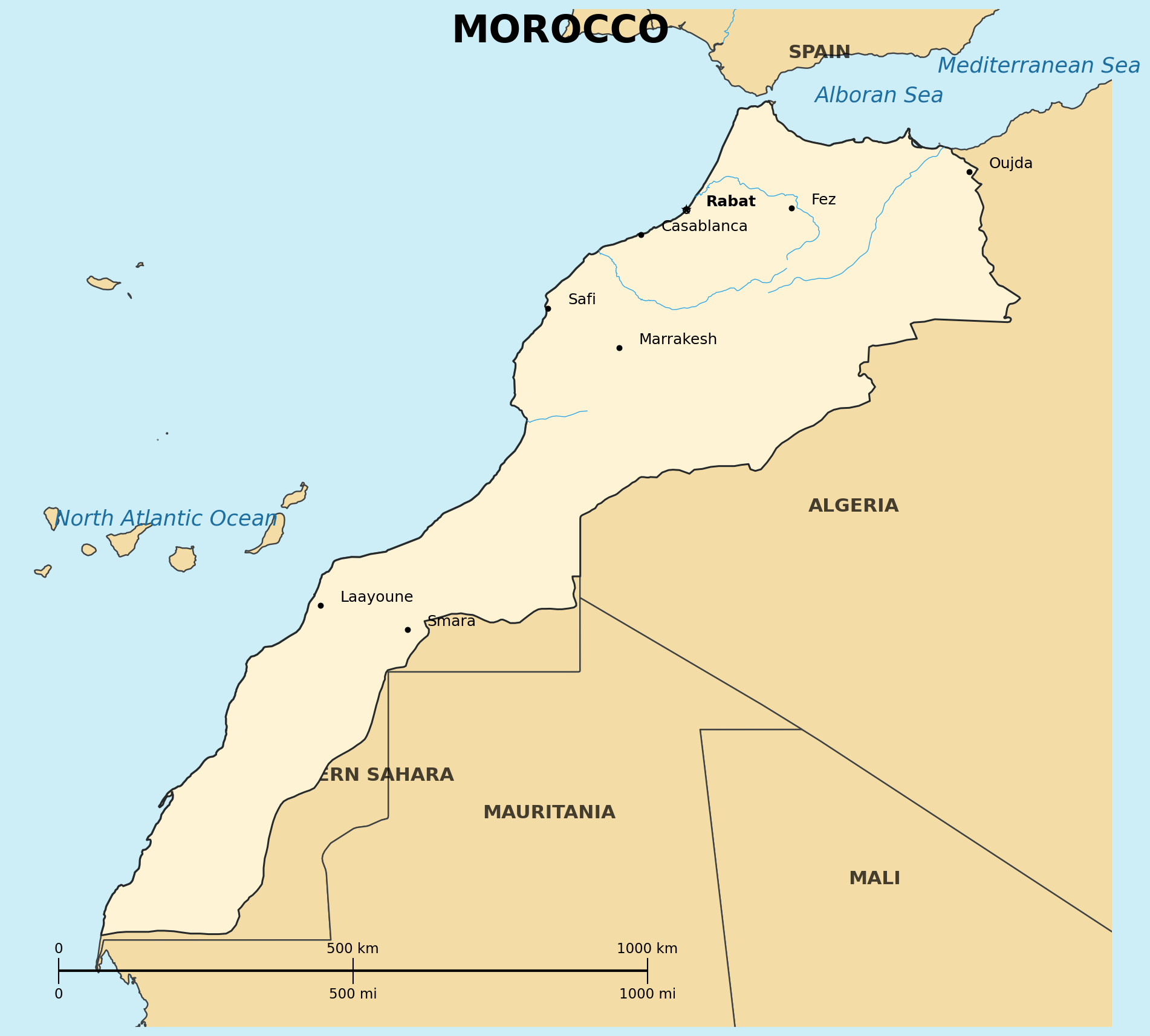
Location: Northern Africa, bordering the North Atlantic Ocean and the Mediterranean Sea, between Algeria and Western Sahara
Map references: Africa
Area:
total: 446,550 sq km (excludes Western Sahara)
Land boundaries:
border countries: Algeria, Western Sahara
Terrain: the Atlas Mountains (highest peak Jebel Toubkal, 4,167 m) run through the center; the Rif Mountains characterize the northeast; the Sahara extends to the south and southeast
| People |
Population: 36.7-38.8 million (2024-2026 est.)
Age structure:
0-14 years: 25.7%
15-64 years: 65.9%
65 years and over: 8.4% (2024 est.)
Median age: 30.9 years (2025 est.)
Life expectancy at birth:
total population: 74.2-75.3 years
male: 72.5 years
female: 76 years
Nationality:
noun/adjective: Moroccan(s)
Ethnic groups: nearly the entire population (99%) is a mix of Arab and indigenous Amazigh (Berber) ethnic groups
Religions: Muslim 99% (official; virtually all Sunni), other 1% (Christian, Jewish, Baha'i); Jewish population about 3,000-3,500 (2020 est.)
Languages: Arabic (official), Tamazight languages (official: Tamazight, Tachelhit, Tarifit), French (business, government, diplomacy)
Population distribution: highest density along the Atlantic and Mediterranean coasts; densely populated agglomerations scattered through the Atlas Mountains; about 63.1% of the population lives in urban areas
Major urban areas: 3.893 million Casablanca, 1.959 million Rabat (capital), 1.314 million Tangier, 1.290 million Fes, 1.050 million Marrakech (2023)
| Government |
Country name:
conventional long form: Kingdom of Morocco
conventional short form: Morocco
Data code: MO
Government type: parliamentary constitutional monarchy
National capital: Rabat
Background: Morocco's location on the Mediterranean and Atlantic has made it critically important throughout history; the seafaring Phoenicians expanded trade networks to the region by the 12th century BCE; over centuries the population absorbed Amazigh (Berber), Arab, Roman, Portuguese, Spanish, Turkish, Phoenician, Jewish, and French influences
| Economy |
Economy - overview: lower-middle-income North African economy; recovering from recent drought and earthquake impacts; rebounding via tourism, manufacturing, and raw materials processing; significant trade and investment with the EU; pursuing fiscal rebalancing and state enterprise reforms; targeting 50% renewable electricity by 2030 and 100% by 2050
GDP (purchasing power parity): $469.39 billion (2026 est.)
GDP - real growth rate: 4.9% (2026f)
GDP - per capita: $12,340 PPP (2026 est.)
Inflation rate: 1.3% (2026)
Unemployment rate: 9.0% (2025)
Population below poverty line: 3% (2022)
Industries: automotive parts, phosphate mining and processing, aerospace, food processing, leather goods, textiles, construction, energy, tourism
Currency: Moroccan dirham (MAD)