
Country information
Mozambique
- Capital
- Maputo
- Population
- 34,090,466
Languages spoken
About Mozambique
Portuguese - the official language, spoken by ~16.6% of the population as a first language, and used in government and education.
Makhuwa (Emakhuwa) - the most widely spoken indigenous language, ~26.1%.
Tsonga (Xichangana), Nyanja (Cinyanja), Sena (Cisena), Lomwe (Elomwe), Chuwabo, Ndau, and Tswa are also spoken by significant populations.
Portuguese is the sole official language of Mozambique, though most of the population's first language is an indigenous Bantu language.
| Geography |
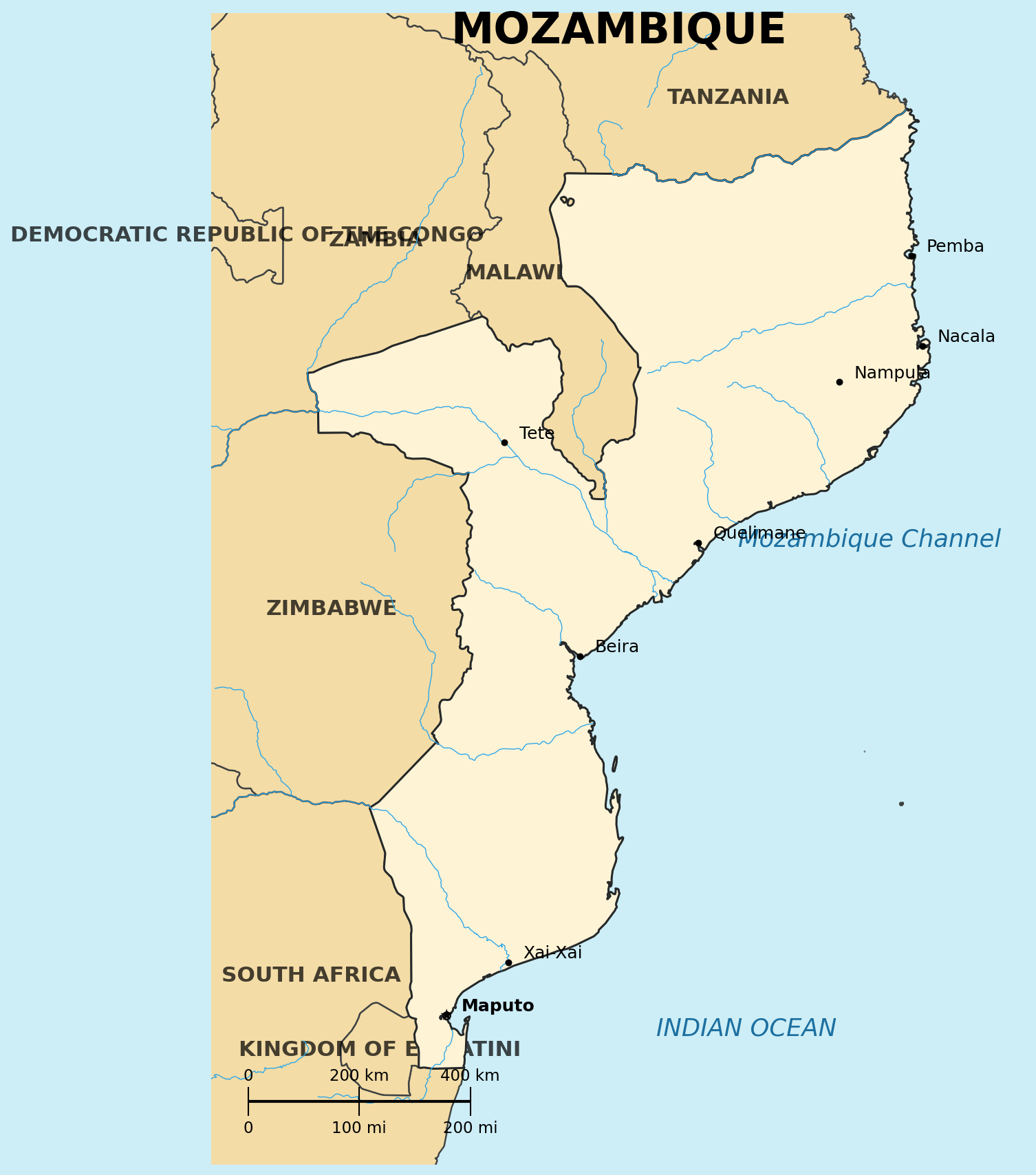
Location: Southeastern Africa, bordering the Mozambique Channel, between South Africa and Tanzania
Map references: Africa
Area:
total: 799,380-801,590 sq km
Land boundaries:
border countries: Eswatini, Malawi, South Africa, Tanzania, Zambia, Zimbabwe
Natural hazards: severe droughts; devastating cyclones and floods in central and southern provinces
Geography - note: the Zambezi River flows through the north-central and most fertile part of the country
| People |
Population: 34,206,144-34,881,007 (2024-2025 est.)
Age structure:
0-14 years: 45.57%
65 years and over: 2.93%
Life expectancy at birth: total population 57.1-63.6 years (varies by source)
Nationality:
noun/adjective: Mozambican(s)
Ethnic groups: African 99% (Makhuwa, Tsonga, Lomwe, Sena, and others), Mestizo 0.8%, other (European, Indian, Pakistani, Chinese) 0.2% (2017 est.)
Religions: Roman Catholic 27.2%, Muslim 18.9%, Zionist Christian 15.6%, Evangelical/Pentecostal 15.3%, Anglican 1.7%, none 13.9% (2017 est.)
Languages: Emakhuwa 26.1%, Portuguese (official) 16.6%, Xichangana 8.6%, Cinyanja 8.1%, Cisena 7.1%, Elomwe 7.1%, Echuwabo 4.7%, Cindau 3.8%, Xitswa 3.8%, other Mozambican languages 11.8% (2017 est.)
Population distribution: three large population clusters: along the southern coast between Maputo and Inhambane; the central area between Beira and Chimoio along the Zambezi River; and around the northern cities of Nampula, Cidade de Nacala, and Pemba; the northwest and southwest are least populated
| Government |
Country name:
conventional long form: Republic of Mozambique
conventional short form: Mozambique
Data code: MZ
Government type: presidential republic
National capital: Maputo
Independence: 25 June 1975 (from Portugal)
Background: almost five centuries as a Portuguese colony ended with independence in 1975; socialist policies, economic mismanagement, and a brutal civil war from 1977 to 1992 further impoverished the country; in 1987 the government began macroeconomic reforms to stabilize the economy; an active ISIS-affiliated insurgency in the northern province of Cabo Delgado since 2017 has claimed an estimated 6,000 lives and displaced roughly one million people
| Economy |
Economy - overview: low-income, least-developed economy; poor and sparsely populated with high fertility and mortality rates and a rapidly growing youthful population; economy heavily dependent on agriculture
GDP (purchasing power parity): $61.95 billion (2025 est.)
GDP - real growth rate: 2.5% (2025)
GDP - per capita: $1,730 PPP (2025 est.)
Inflation rate: 3.911% (2018)
Unemployment rate: 3.6% (2024 est.)
Labor force: 10.1 million (2012 est.)
Population below poverty line: 52% (2009 est.)
Currency: Mozambican metical (MZN)
| Military |
Military branches: Armed Forces for the Defense of Mozambique (FADM): Army, Navy, Air Force; Ministry of Interior: National Police, National Criminal Investigation Service, Border Security Force (2025)
Military - note: the FADM's primary focus is countering the ISIS-affiliated insurgency in Cabo Delgado; Rwanda has provided approximately 3,000 military and police personnel to assist since 2021, along with several hundred Tanzanian troops; SADC regional forces departed in 2024 (2025)