

Country information
Myanmar (Burma)
- Capital
- Naypyidaw
- Population
- 51,375,327
Languages spoken
About Myanmar (Burma)
Burmese - the sole official language, spoken by the majority of the population.
Chin, Kachin, Karen, Kayah, Mon, Rakhine, and Shan are recognized regional languages, spoken by Myanmar's major ethnic minorities.
English was the language of instruction during the colonial period but was replaced by Burmese after independence; it is now spoken by only about 5% of the population.
Burmese is the sole official language of Myanmar.
| Geography |
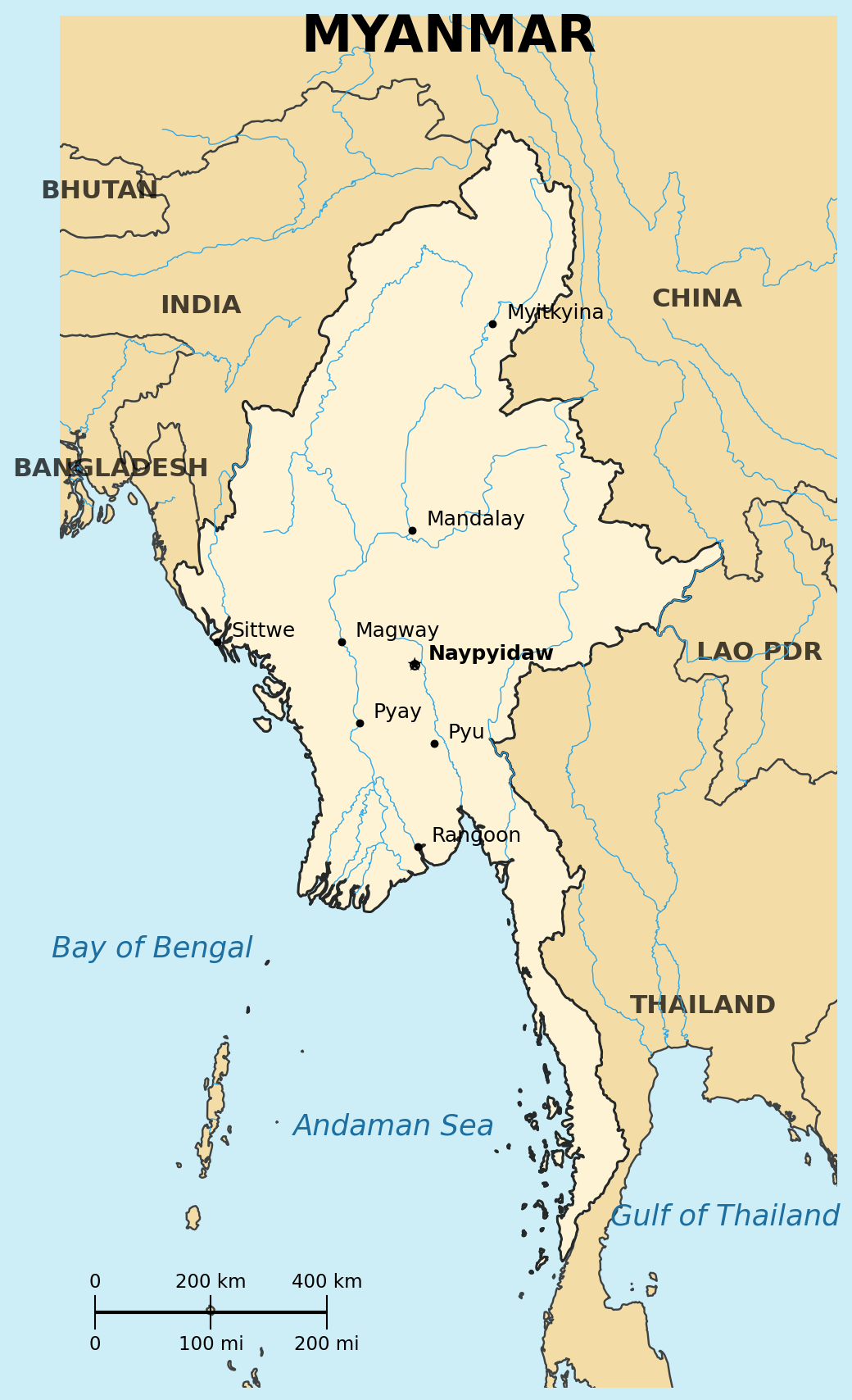
Location: Southeastern Asia, bordering the Andaman Sea and the Bay of Bengal, between Bangladesh and Thailand
Map references: Southeast Asia
Area:
total: 676,579 sq km
Land boundaries:
border countries: Bangladesh, China, India, Laos, Thailand
| People |
Population: 54.6-57.9 million (2024-2025 est.)
Age structure:
0-14 years: 26.93%
15-64 years: 66.49%
65 years and over: 6.58% (2022 est.)
Life expectancy at birth:
total population: 69.92 years
male: 68.27 years
female: 71.67 years
Infant mortality rate: 32.94 deaths/1,000 live births
Nationality:
noun/adjective: Burmese
Ethnic groups: Bamar (Burman) 68.78%, Karen 6.69%, Rakhine 4.61%, Shan 4.51%, Mon 2.19%, Chin 2.09%, Kachin 1.50%, Karenni 0.39% (2019 est.)
Religions: Buddhism (official) 87.9%, Christianity 6.2%, Islam 4.3%, folk religion 0.8%, Hinduism 0.5% (2014 est.)
Languages: Burmese (official), Chin, Kachin, Karen, Kayah, Mon, Rakhine, Shan (recognized regional languages)
Literacy: total population 93.5% (male 94.7%, female 92.7%) (2020 est.)
| Government |
Country name:
conventional long form: Republic of the Union of Myanmar
conventional short form: Burma/Myanmar; both names derive from the same root
Data code: BM
Government type: unitary assembly-independent republic, currently under military rule
National capital: Naypyidaw; Yangon (Rangoon) remains the largest city and commercial center
Executive branch:
chief of state: Min Aung Hlaing (military leader, since the 2021 coup)
Independence: 4 January 1948 (from the UK)
Background: Burma served as a major trade route between China and India since 100 BC; the Pagan era began in 849, followed by the Taungoo and Konbaung eras; became British Burma in 1886, gaining independence in 1948; experienced coups in 1962 and 1988; after a period of civilian rule and reform beginning in 2011, a military coup on 1 February 2021 overthrew the elected government, plunging the country into a severe political and economic crisis with ongoing armed conflict between the military and resistance/ethnic armed groups
| Economy |
Economy - overview: least-developed, lower-middle-income economy; one of the poorest countries in Asia; agriculture, forestry, and fishing employ about two-thirds of the workforce; significant shadow economy in illicit drugs, gemstones, and trafficking; severely contracted following the 2021 coup and slow to recover, with high inflation and a weakened currency; roughly half the population lived below the poverty line as of 2024
GDP (purchasing power parity): $273.2-293.31 billion (2025-2026 est.)
GDP - real growth rate: -2% (2025)
GDP - per capita: $1,110-1,519 (2024-2026 est.)
Unemployment rate: 42.2% (2025 est.; note: figure may reflect broader labor underutilization)
Currency: Myanmar kyat (MMK)
| Military |
Military branches: Burmese Defense Services (Tatmadaw): Army, Navy, Air Force; People's Militia; Ministry of Home Affairs: Burma Police Force, Border Guard Forces (2025)