

About Nauru
Nauruan - the official language, a distinct Pacific Island language spoken by ~93-95% of the population; it does not clearly resemble any other language in the Pacific region, having developed in relative isolation.
English - also official, widely understood and used for most government and commercial purposes.
Gilbertese and Chinese are also spoken by smaller communities.
Nauruan and English are both official languages of Nauru.
| Geography |
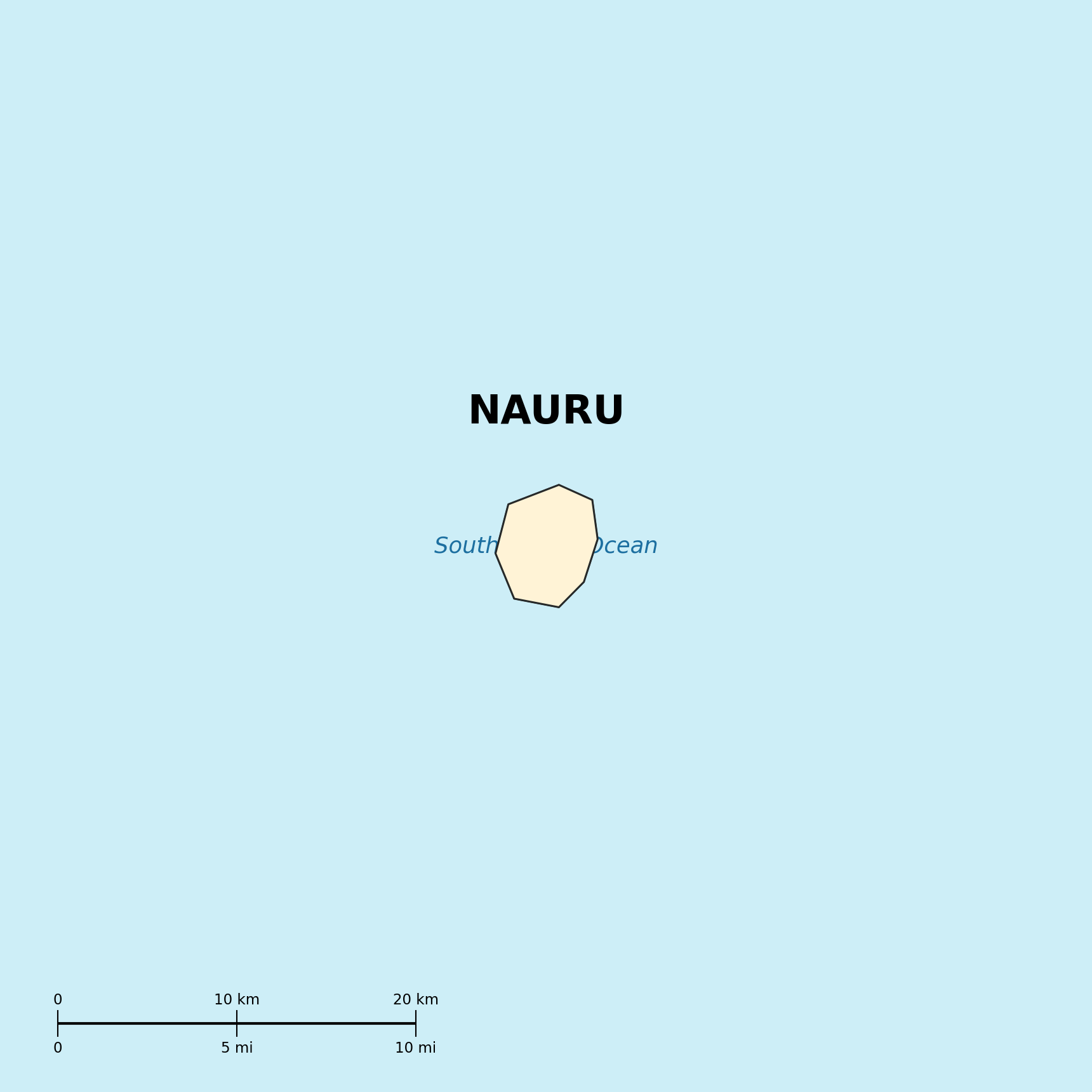
Location: Oceania, a single island in the central Pacific Ocean, south of the Marshall Islands; the third-smallest country in the world
Map references: Oceania
Area:
total: 21 sq km
Climate: tropical, monsoonal pattern with a rainy season from November to February
Natural resources: phosphates, fish
Environment - current issues: limited natural freshwater resources; effects of intensive phosphate mining have left much of the island's interior uninhabitable
| People |
Population: 9,892-12,511 (varies significantly by source; 2021-2025 est.)
Age structure:
0-14 years: 29.6%
15-64 years: 66%
65 years and over: 4.4% (2024 est.)
Life expectancy at birth: total population 62.1 years (World Bank, 2025)
Infant mortality rate: 8.3 deaths/1,000 live births
Nationality:
noun/adjective: Nauruan(s)
Ethnic groups: Nauruan 94.6%, I-Kiribati 2.2%, Fijian 1.3%, other 1.9% (2021 est.)
Religions: Protestant 60.4% (Nauruan Congregational, Assemblies of God, and others), Roman Catholic 33.9% (2021 est.)
Languages: Nauruan (official) 93%, English (official) 2%, other 5% (includes Gilbertese, Chinese) (2011 est.)
Literacy: total population 96.6% (male 93.4%, female 99.7%) (2023 est.)
| Government |
Country name:
conventional short form: Nauru; the name may derive from the Nauruan word "anaoero," meaning "I go to the beach"; formerly known as Pleasant Island
Data code: NR
Government type: parliamentary republic
National capital: no official capital; government offices are located in the Yaren District
Executive branch:
chief of state and head of government: President David Adeang (since 30 October 2023)
Independence: 31 January 1968 (from Australia, under the Nauru Independence Act 1967)
Background: Micronesian and Polynesian settlers inhabited Nauru by 1000 BC, and the island was divided among 12 clans; developed in relative isolation because ocean currents made landfall difficult; a British mariner became the first European to sight the island in 1798
| Economy |
Economy - overview: upper-middle-income Pacific island economy; historically reliant on phosphate mining, now largely exhausted, leaving much of the island's interior uninhabitable; income now also derives from fishing license fees and hosting Australia's Regional Processing Centre for asylum seekers
GDP (purchasing power parity): $132-151 million (2023-2025 est.)
GDP - real growth rate: 1.4-2.0% (2025)
GDP - per capita: $11,150-13,609 (varies by source; 2025 est.)
Inflation rate: 1.7% (2021 est.)
Unemployment rate: 25% (2011)
Currency: Australian dollar (AUD)