
About Netherlands (Holland)
Dutch - the sole national official language.
Frisian - also official, specifically in Fryslan province.
Low Saxon, Limburgish, Romani, and Yiddish hold protected status under the European Charter for Regional or Minority Languages; Papiamento is recognized on Bonaire and English on Sint Eustatius and Saba, reflecting the special Caribbean municipalities.
Dutch is the official national language of the Netherlands, with Frisian holding official status in Fryslan province.
| Geography |
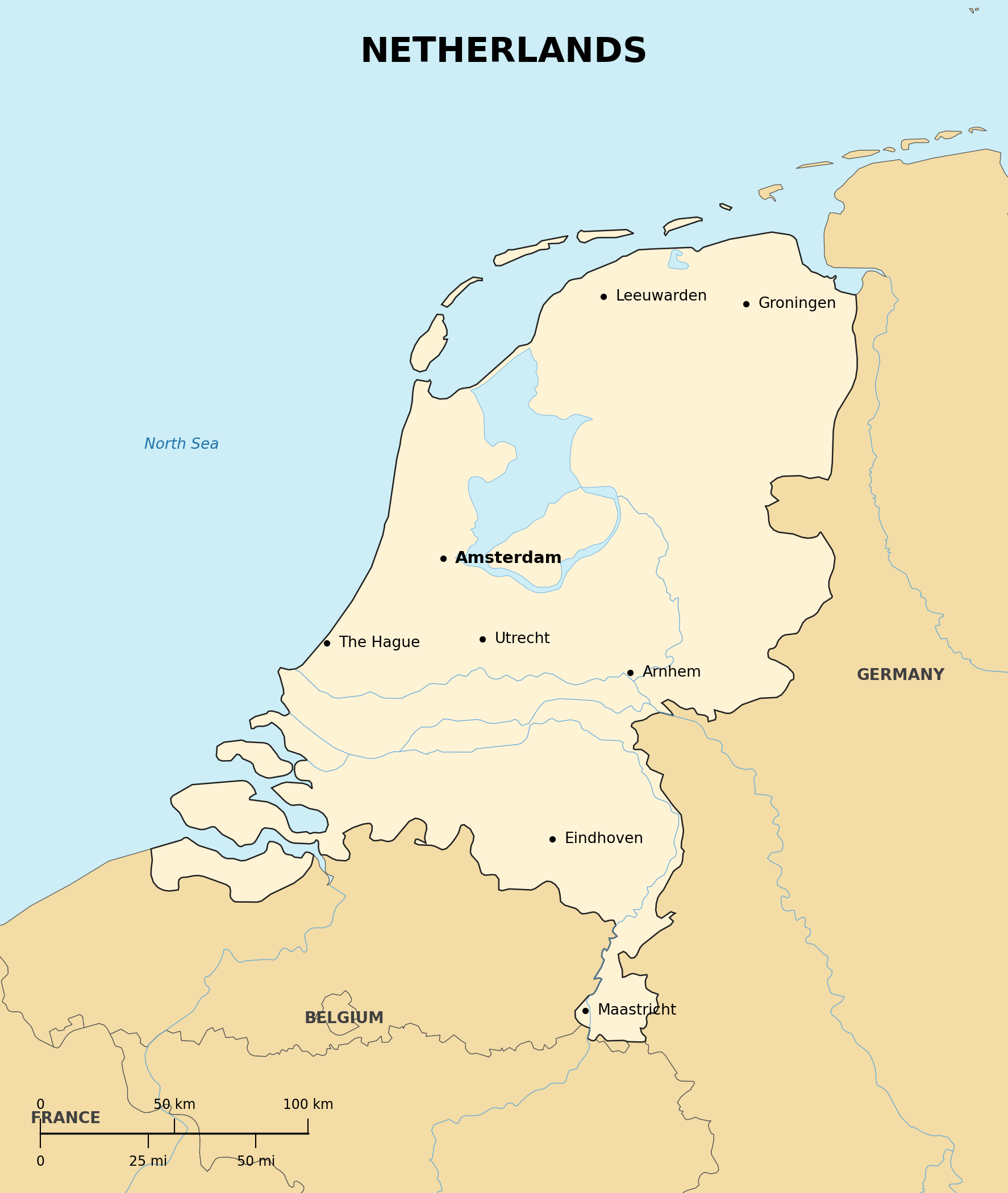
Location: Western Europe, bordering the North Sea, between Belgium and Germany
Map references: Europe
Area:
total: 41,543 sq km
Land boundaries:
border countries: Belgium, Germany
Population distribution: the Randstad, anchored by Amsterdam, Rotterdam, The Hague, and Utrecht, is the most densely populated region; the north is less dense, though sizeable communities exist throughout the country
| People |
Population: 17.83-18.13 million (2025-2026 est.)
Nationality:
noun: Dutchman(men), Dutchwoman(women)
adjective: Dutch
Ethnic groups: Dutch 75.4%, EU (excluding Dutch) 6.4%, Turkish 2.4%, Moroccan 2.4%, Surinamese 2.1%, Indonesian 2%, other 9.3% (2021 est.)
Religions: Roman Catholic 20.1-23.6%, Protestant 14.8-14.9%, Muslim 5-5.1%, other 5.6-5.9% (Hindu, Buddhist, Jewish), none 50.7-54.1% (2017-2019 est.)
Languages: Dutch (official), Frisian (official in Fryslan province)
| Government |
Country name:
conventional short form: Netherlands; commonly known informally as "Holland"
Data code: NL
Government type: parliamentary constitutional monarchy
National capital: Amsterdam (official constitutional capital); The Hague (seat of government)
Executive branch:
chief of state: King Willem-Alexander (since 30 April 2013)
Background: the Dutch United Provinces declared independence from Spain in 1581; during the 17th century became a leading seafaring and commercial power, with settlements and colonies around the world; after 18 years of French domination, regained independence in 1813; Belgium seceded in 1830, forming a separate kingdom; remained neutral in WWI but suffered German invasion and occupation in WWII; a modern, industrialized nation and large exporter of agricultural products
| Economy |
Economy - overview: advanced, high-income EU and Eurozone economy; sixth-largest economy in the EU; important European transportation hub with consistently high trade surplus, stable industrial relations, and low unemployment; highly mechanized agricultural sector employs only 2% of the labor force but makes the country the world's second-largest agricultural exporter by value; Dutch financial sector is highly concentrated, roughly four times the size of GDP
GDP (purchasing power parity): $1.581 trillion (2026f)
GDP - real growth rate: 1.7% (2025f)
GDP - per capita: $87,173 PPP (2026f)
Inflation rate: 2.3% (2025f)
Unemployment rate: 3.9% (2025 est.)
Population below poverty line: 5% (2017 est.); 17.0% at risk of poverty or social exclusion (2023)
Industries: food processing, chemicals, petroleum refining, electrical machinery
Currency: Euro (EUR)
| Military |
Military branches: Netherlands (Dutch) Armed Forces: Royal Netherlands Army, Royal Netherlands Navy (includes Marine Corps), Royal Netherlands Air Force, Royal Netherlands Marechaussee (Military Constabulary) (2025)
Military - note: deploys forces including approximately 350 personnel to Lithuania and 150 to Romania as part of NATO's Enhanced Forward Presence, plus roughly 800 deployed to Dutch Caribbean territories (2025)