

About Oman
Arabic - the sole official language.
English - widely spoken, particularly in business.
Baluchi, Swahili, Urdu, and various Indian dialects are also spoken, reflecting Oman's large expatriate population and historical Indian Ocean trade ties.
Arabic is the sole official language of Oman.
| Geography |
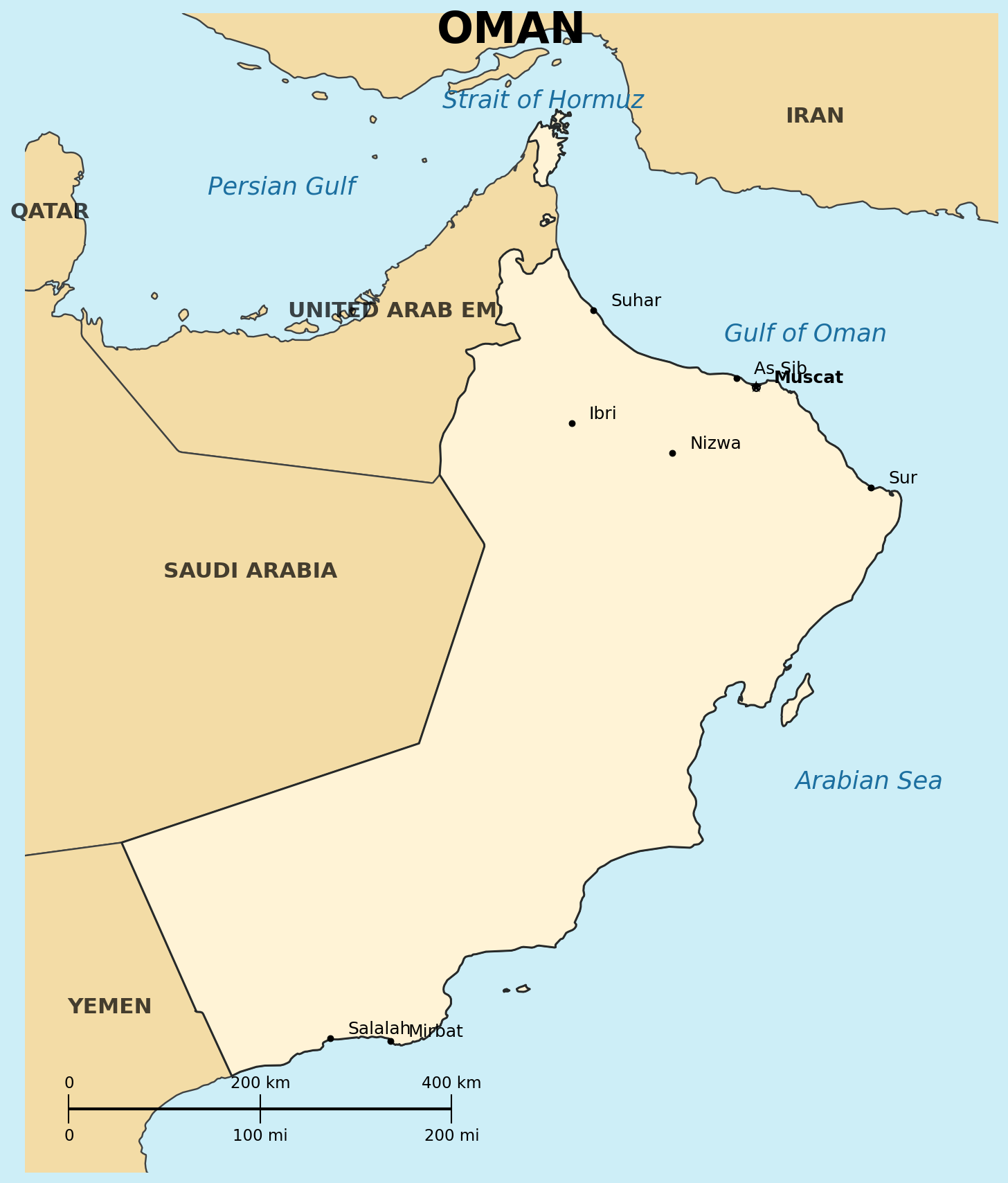
Location: Middle East, bordering the Arabian Sea, Gulf of Oman, and Persian Gulf, between Yemen and UAE
Map references: Middle East
Area:
total: 309,500-315,331 sq km
Land boundaries:
border countries: Saudi Arabia, UAE, Yemen
Geography - note: consists of Oman proper and two northern exclaves, Musandam and Al Madhah; Musandam occupies a strategic peninsula adjacent to the Strait of Hormuz
| People |
Population: 3.97-5.49 million (varies significantly by source, reflecting citizen vs. total resident population; 2025 est.)
Age structure:
0-14 years: 29.8-29.9%
15-64 years: 66.17-66.2%
65 years and over: 3.95-4%
Life expectancy at birth:
total population: 76.9 years
male: 74.96 years
female: 78.93 years
Infant mortality rate: 13.6-14.45 deaths/1,000 live births
Nationality:
noun/adjective: Omani(s)
Religions: Muslim 85.9% (Ibadhi and Sunni sects each about 45% among citizens, Shia about 5%), Christian 6.4%, Hindu 5.7%, other 2% (2020 est.); Omani citizens represent about 56.4% of the total population
Languages: Arabic (official), English, Baluchi, Swahili, Urdu, Indian dialects
Literacy: total population 95.7% (male 97%, female 92.7%) (2018)
Population distribution: vast majority located in and around the Al Hajar Mountains in the north; a smaller cluster around the city of Salalah in the far south; most of the country remains sparsely populated
| Government |
Country name:
conventional long form: Sultanate of Oman
conventional short form: Oman
Data code: MU
Government type: absolute monarchy (sultanate); organized political parties are banned, and loyalties tend to form around tribal affiliations
National capital: Muscat
Background: the inhabitants of present-day Oman have long prospered from Indian Ocean trade; in the late 18th century, the nascent sultanate in Muscat signed the first of a series of friendship treaties with Britain; over time Oman's dependence on British political and military advisors increased, though the sultanate never became a British colony; in 1970 Qaboos bin Said Al Said overthrew his father and ruled as sultan for the next five decades, launching an extensive modernization program that opened the country to the outside world while maintaining a moderate, independent foreign policy
| Economy |
Economy - overview: high-income, developing Gulf economy; historically dependent on oil and gas, pursuing diversification into tourism, logistics, and manufacturing under Oman Vision 2040
GDP (purchasing power parity): $220.05-231.16 billion (2024-2025 est.)
GDP - real growth rate: 3.1% (2025f)
GDP - per capita: $41,664-42,010 PPP (2024-2025 est.)
Inflation rate: 1.3% (2024)
Unemployment rate: 2.6% (April 2024)
Currency: Omani rial (OMR)
| Military |
Military branches: Sultan's Armed Forces (SAF): Royal Army of Oman, Royal Navy of Oman, Royal Air Force of Oman, Royal Guard of Oman, Sultan's Special Forces; Royal Oman Police (ROP): Civil Defense, Immigration, Coast Guard Police, Special Task Force (2025)