
Country information
Pakistan
- Capital
- Islamabad
- Population
- 241,499,431
Languages spoken
About Pakistan
Punjabi - the most widely spoken mother tongue, ~38.8% of the population.
Pashto (~18.2%), Sindhi (~14.6%), Saraiki (a Punjabi variant, ~12.2%), and Balochi (~3%) are also major regional languages.
Urdu - the national language and official lingua franca, though the mother tongue of only ~7.1%; it is widely understood as a second language nationwide.
English - the other official language, serving as the lingua franca of Pakistan's elite and most government ministries.
Urdu and English are Pakistan's two official languages; Urdu is also the national language.
| Geography |
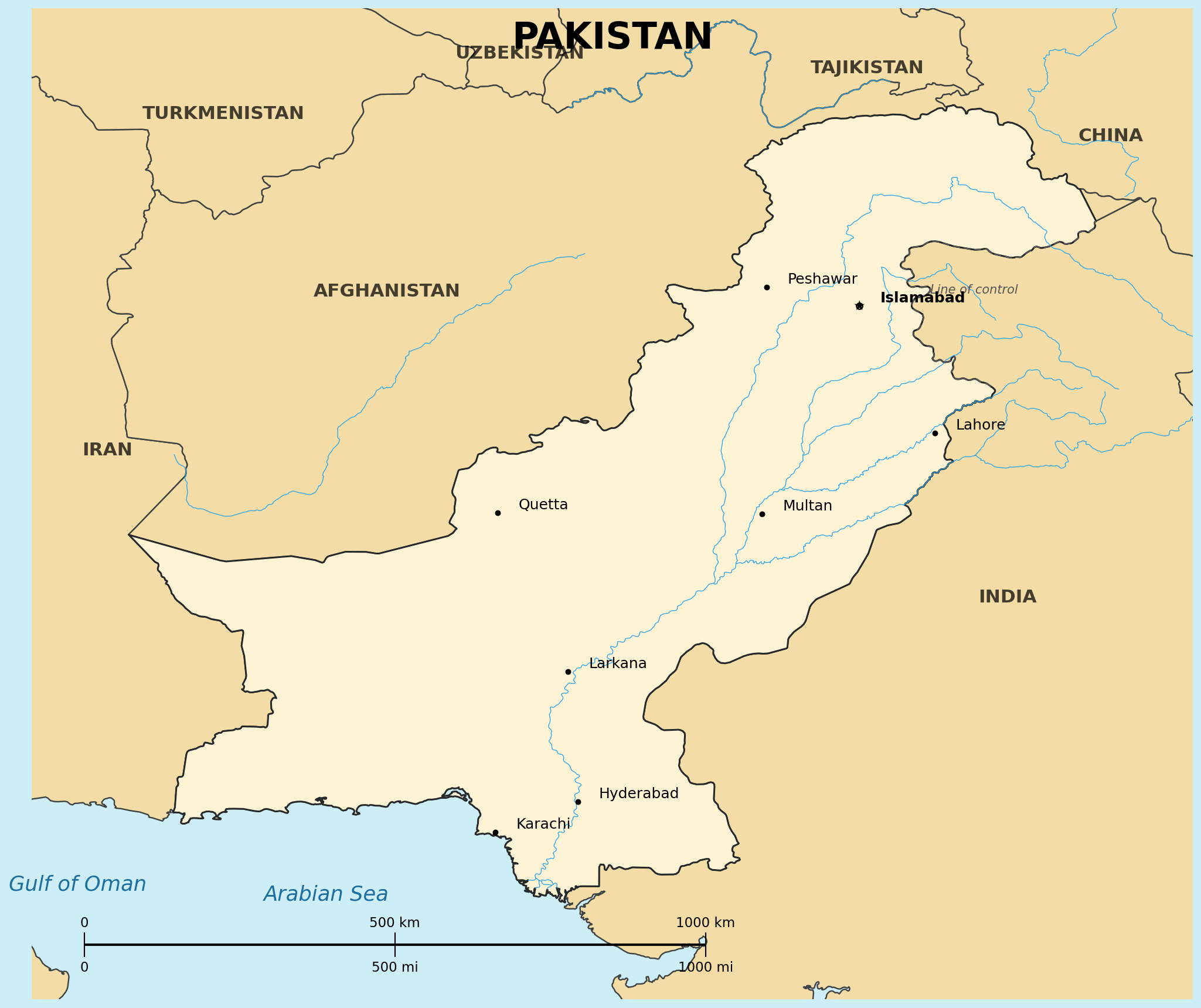
Location: Southern Asia, bordering the Arabian Sea, between India on the east and Iran and Afghanistan on the west, and China in the north
Map references: Asia
Area:
total: 796,095 sq km
Land boundaries:
border countries: Afghanistan, China, India, Iran
| People |
Population: 241,499,431-257,047,044 (2023 census-2025 est.) - 5th most populous country in the world
Age structure:
0-14 years: 37.2%
15-64 years: 58.6%
65 years and over: 4.2%
Life expectancy at birth:
total population: 69.1 years
male: 66.8 years
female: 71.6 years (2022 est.)
Nationality:
noun/adjective: Pakistani(s)
Religions: Muslim 96.4%, Hindu 1.6%, Christian 1.4%, other (scheduled castes, Qadiani/Ahmadi, Sikh) less than 1%
Languages: Punjabi 38.8%, Pashto 18.2%, Sindhi 14.6%, Saraiki 12.2%, Urdu (national/official) 7.1%, Balochi 3%, Hindko 2.4%, Brahui 1.2%, other 2.4%; note - data represent mother tongue; English (official) is the lingua franca of Pakistan's elite and most government ministries
Literacy: total population 60.7% (2023 census)
| Government |
Country name:
conventional long form: Islamic Republic of Pakistan
conventional short form: Pakistan
Data code: PK
Government type: federal parliamentary republic
National capital: Islamabad
Administrative divisions: most populous province Punjab (127,688,922); least populous Balochistan (14,894,402) (2023 census)
Background: gained independence from British rule in 1947; a complex history marked by political challenges alongside periods of strong economic growth; relationship with neighboring India remains adversarial, with tensions heightened following the 2008 Mumbai terrorist attacks by Pakistan-based militants
| Economy |
Economy - overview: lower-middle-income, developing economy; decades of internal political disputes and low foreign investment have contributed to underdevelopment; agriculture accounts for roughly one-fifth of output and two-fifths of employment; textiles and apparel represent more than half of export earnings, leaving the country vulnerable to shifts in global demand; challenges include electricity shortages, a burdensome investment climate, and a narrow tax base
GDP (purchasing power parity): $2.166 trillion (2026 est.)
GDP - real growth rate: 3.1% (2025)
GDP - per capita: $8,415 PPP (2026 est.)
Inflation rate: 3% (2026)
Unemployment rate: 6.9% (2025)
Labor force: 78,863,000 (2025)
Population below poverty line: 44.7% (2026)
Industries: textiles, apparel, food processing, chemicals, cement, fertilizer, steel
Exports: $40.79 billion (2025); textiles ($16.3 billion), food, chemicals and pharmaceuticals
Exports - partners: United States 17.5%, China 8.7%, UAE 6.7%, UK 6.5% (2024)
Currency: Pakistani rupee (PKR)
| Military |
Military branches: Pakistan Armed Forces: Pakistan Army (includes National Guard), Pakistan Navy (includes Marines, Maritime Security Agency), Pakistan Air Force; Ministry of Interior: Frontier Constabulary, Frontier Corps, National Police, Coast Guard, Punjab and Sindh Rangers (2025)
Military service age and obligation: 16-28 years of age for voluntary service, men and women, varying by branch; personnel cannot deploy for combat until age 18 (2025)