

About Palau (Republic of)
Palauan - the official language on most islands, spoken by ~65.2% of the population.
English - also official, spoken by ~19.1%.
Sonsorolese is official in Sonsoral state, Tobian in Tobi state, and Angaur and Japanese are official in Angaur state (though Japanese is no longer commonly spoken there).
Filipino (~9.9%) and Chinese are also spoken, reflecting Palau's expatriate community.
Palauan and English are the official languages of Palau, with several other languages holding official status in specific states.
| Geography |
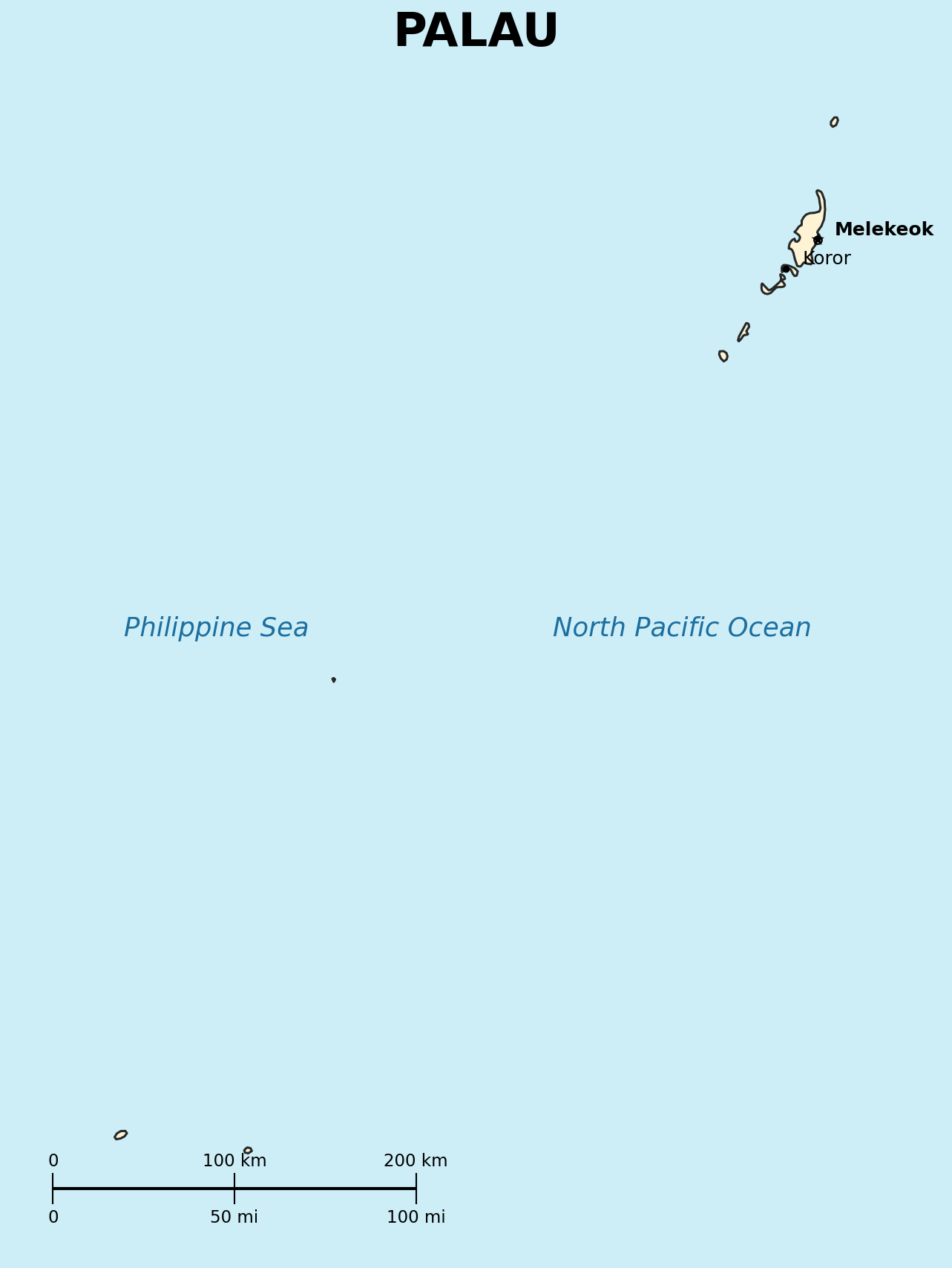
Location: Oceania, group of islands in the North Pacific Ocean, southeast of the Philippines; westernmost archipelago in the Caroline chain, consisting of six island groups and more than 300 islands, including the world-famous Rock Islands
Map references: Oceania
Area:
total: 459 sq km
Climate: tropical; hot and humid; wet season May to November
Terrain: varying topography from the high, mountainous main island of Babelthuap to low, coral islands usually fringed by large barrier reefs
Natural resources: forests, minerals (especially gold), marine products, deep-seabed minerals
| People |
Population: 17,663-21,947 (varies by source; 2025 est.)
Age structure:
0-14 years: 17.5-19.69%
15-64 years: 71.3%
65 years and over: 8.08-11.2%
Life expectancy at birth: total population 75.2 years (male 72, female 78.5)
Infant mortality rate: 10.6 deaths/1,000 live births
Nationality:
noun/adjective: Palauan(s)
Ethnic groups: Palauan (Micronesian with Malayan and Melanesian admixtures) 70.6%, Carolinian 1.2%, Asian 26.5%, other 1.7% (2020 est.)
Religions: Roman Catholic 45.3%, Protestant 34.9%, Modekngei 5.7% (indigenous to Palau), Muslim 3%, Mormon 1.5%, other 9.7% (2015 est.)
Languages: Palauan (official on most islands) 65.2%, other Micronesian 1.9%, English (official) 19.1%, Filipino 9.9%, Chinese 1.2%, other 2.8% (2015 est.); Sonsorolese official in Sonsoral, Tobian official in Tobi, Angaur and Japanese official in Angaur
Literacy: total population 100% (2020 est.)
| Government |
Country name:
conventional short form: Palau; from the Palauan name Belau, likely deriving from beluu ("village")
Data code: PS
Government type: presidential republic in free association with the US
National capital: Ngerulmud; the name comes from a Palauan term meaning "place of fermented angelfish"
Executive branch:
chief of state and head of government: President Surangel Whipps Jr. (since 21 January 2021)
Independence: 1 October 1994 (from the US-administered UN Trusteeship)
Background: after three decades as part of the UN Trust Territory of the Pacific under US administration, this westernmost cluster of the Caroline Islands opted for independence in 1978 rather than joining the Federated States of Micronesia; a Compact of Free Association with the US was approved in 1986 but not ratified until 1993, taking effect in 1994; Palau has been an environmental leader, banning commercial shark fishing in 2011, creating the Palau Pledge for responsible tourism in 2017, and banning reef-toxic sunscreens while expanding marine protections in 2020
| Economy |
Economy - overview: high-income Pacific island economy; environmentally fragile; dominated by tourism, fishing, and subsistence agriculture; government is a major employer, relying on financial assistance from the US under the Compact of Free Association; very high living standard and low unemployment
GDP (purchasing power parity): $308-323 million (2023-2024 est.)
GDP - real growth rate: 2.2% (2023)
GDP - per capita: $18,209-18,230 PPP (2023-2024 est.)
Inflation rate: 1.574% (2018)
Currency: United States dollar (USD)
| Military |
Military - note: no regular military forces; under the Compact of Free Association, the US is responsible for Palau's defense and its military is granted access to the islands; Palau has a "shiprider" agreement allowing local maritime law enforcement officers to embark on US Coast Guard and Navy vessels (2025)