

About Azerbaijan
Azerbaijani - spoken by ~96.1% of the population and the sole official language.
Minority languages spoken by less than 1% each include Russian, Avar, Talyshi, Turkish, Tatar, Sakhur, Tat, Ukrainian, Georgian, and Hebrew.
Azerbaijan has over 80 recognized ethnic groups, though the vast majority speak Azerbaijani as their primary language.
Azerbaijani is the sole official language of Azerbaijan.
| Geography |
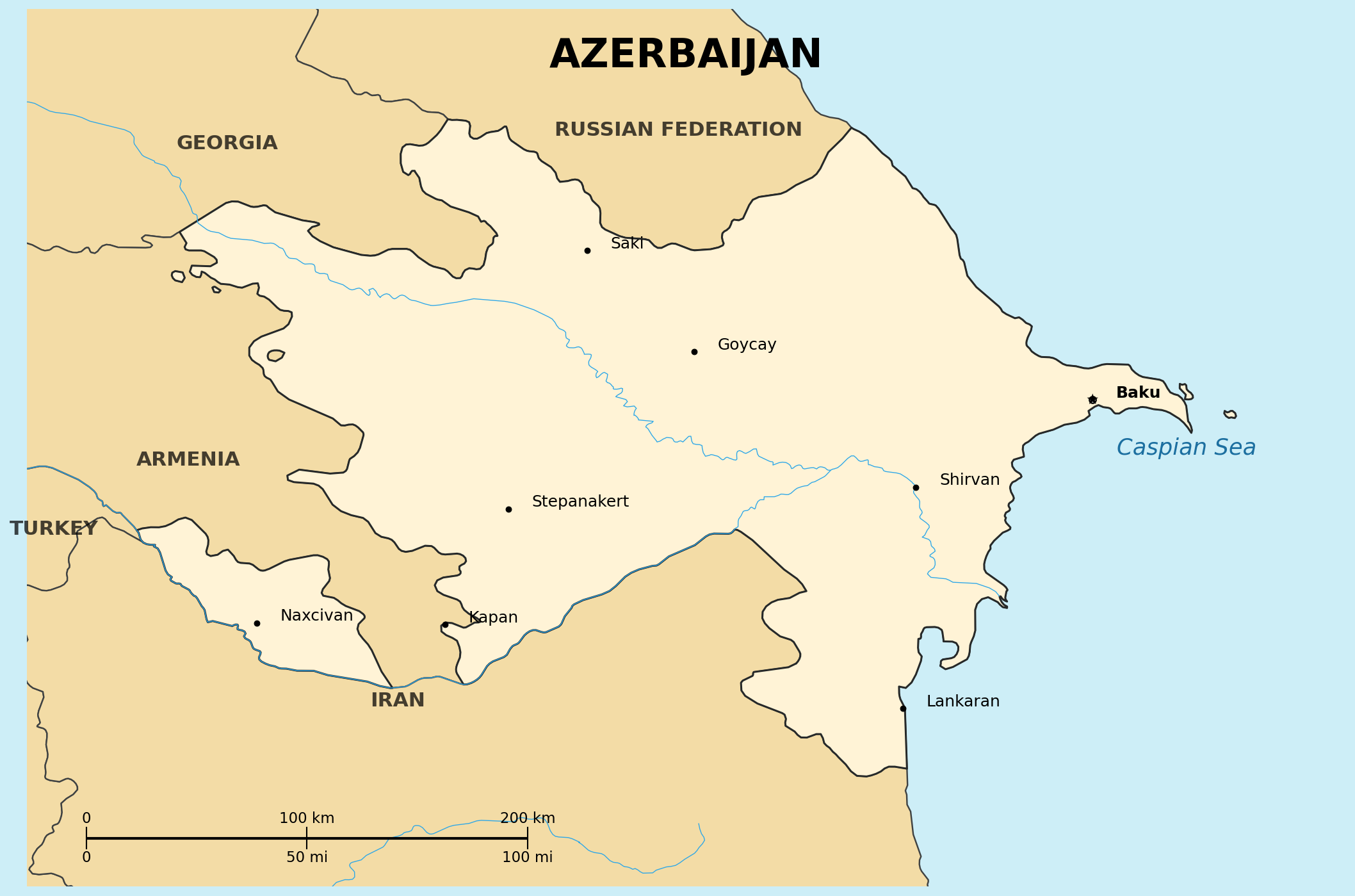
Location: Southwestern Asia, bordering the Caspian Sea, between Iran and Russia, with a small European portion north of the Caucasus range
Map references: Asia
Area:
total: 86,600 sq km
Land boundaries:
border countries: Armenia, Georgia, Iran, Russia, Turkey
Climate: dry, semiarid steppe
Terrain: large, flat Kur-Araz Lowland (much of it below sea level) with Great Caucasus Mountains to the north, Karabakh Upland in west; Caspian Sea coastline
Natural resources: petroleum, natural gas, iron ore, nonferrous metals, alumina
| People |
Population: 10,694,370 (2025 est.)
Age structure:
0-14 years: 22.3%
15-64 years: 68.7%
65 years and over: 9% (2024 est.)
Population growth rate: 0.43% (2024 est.)
Life expectancy at birth:
total population: 75.9 years
male: 73.5 years
female: 78.6 years (2024 est.)
Infant mortality rate: 10.9 deaths/1,000 live births (2024 est.)
Nationality:
noun/adjective: Azerbaijani(s)
Ethnic groups: Azerbaijani 94.8%, Lezgin 1.7%, Talysh 0.9%, Russian 0.7%, other 1.9%; over 80 ethnic groups total
Religions: Muslim 97.3% (predominantly Shia), Christian 2.6%, other/unaffiliated <0.1% (2020 est.)
Languages: Azerbaijani (official) 96.1%, other 1.4% (including Russian, Avar, Talyshi, Turkish, Tatar, Sakhur, Tat, Ukrainian, Georgian, Hebrew) (2019 est.)
Literacy: total population 99.8%
| Government |
Country name:
conventional short form: Azerbaijan
local short form: Azarbaycan
Data code: AJ
Government type: presidential republic
National capital: Baku (Baki, Baky)
Independence: 30 August 1991 (from the Soviet Union)
Background: Nagorno-Karabakh, populated historically by ethnic Armenians though internationally recognized as part of Azerbaijan, was the subject of a decades-long conflict; after renewed fighting in 2020 and a further Azerbaijani military action in September 2023, nearly the entire ethnic Armenian population of Nagorno-Karabakh fled to Armenia
| Economy |
Economy - overview: oil- and gas-driven economy; since independence in 1991, Azerbaijan has significantly reduced poverty and directed oil/gas revenue toward infrastructure development, though economic diversification remains a challenge
GDP (purchasing power parity): $281.3 billion (2026 est.)
GDP - real growth rate: 1.4% (2025 est.)
GDP - per capita: $26,800 PPP (2026 est.)
Inflation rate: 6.3% (May 2025)
Unemployment rate: 5.4% (2024 est.)
Labor force: 5,536,769 (2023)
Population below poverty line: 4.9% (2015 est.)
Industries: petroleum and natural gas, petroleum products, oilfield equipment, steel, iron ore, cement, chemicals, petrochemicals, textiles, machinery, cotton, foodstuffs
Exports: $27.1 billion (2024); oil and gas, machinery, foodstuffs, cotton
Exports - partners: Italy 31.9%, Turkey 18.9%, Russia 4.35%, Greece 4.24%, Czechia 4.07% (2024)
Currency: Azerbaijani manat (AZN)
| Communications |
Broadcast media: TV is the most popular medium; state-owned AzTV runs three national channels; state-funded iTV is a national public service broadcaster; 4 national privately-owned stations; Turkish, Russian, and western TV available on cable (2023)
| Military |
Military branches: Azerbaijan Armed Forces: Land Forces, Air Forces, Navy Forces, Special Forces, State Border Service, Coast Guard; Ministry of Internal Affairs: Internal Troops, local police forces; Special State Protection Service: National Guard (2025)