
About Paraguay
Spanish and Guarani - both official languages, spoken together by ~46.3% of the population as the predominant household language.
Guarani only - spoken by ~34% of the population, an Indigenous language with an unusually strong national presence, spoken by both Indigenous and non-Indigenous Paraguayans alike.
Spanish only is spoken by ~15.2%, and Portuguese and German are also spoken by smaller communities.
Spanish and Guarani are both official languages of Paraguay.
| Geography |
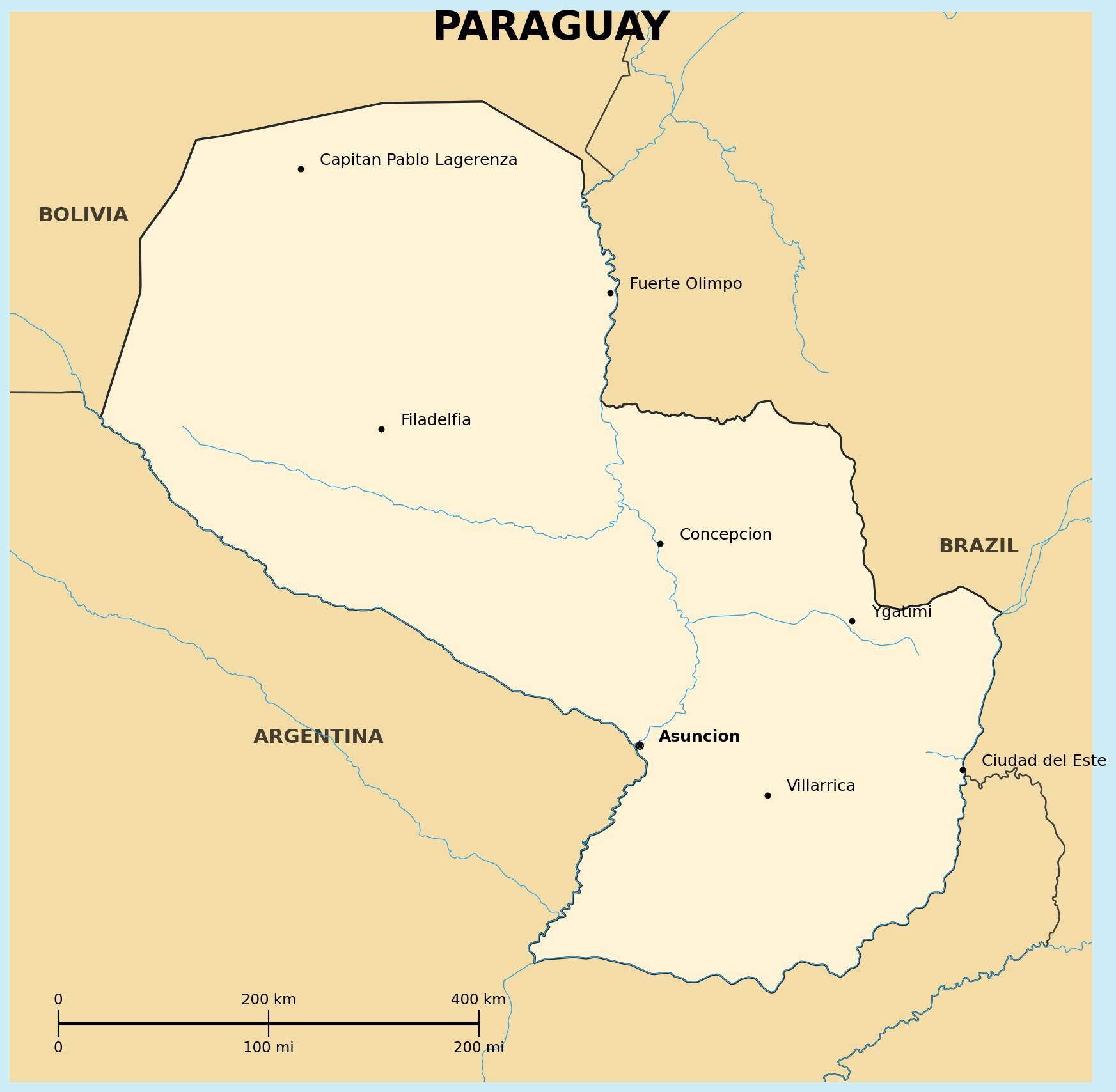
Location: Central South America, landlocked, between Argentina, Bolivia, and Brazil
Map references: South America
Geography - note: most of the population resides in the eastern half of the country; to the west lies the Gran Chaco, a semiarid lowland region
| People |
Population: 6.11-7.6 million (2022-2025 est.)
Age structure:
0-14 years: 25.4%
15-64 years: 66.3%
65 years and over: 8.3%
Life expectancy at birth: total population 78.37 years
Infant mortality rate: 14.4-21.4 deaths/1,000 live births
Nationality:
noun/adjective: Paraguayan(s)
Ethnic groups: Mestizo 74.5%, White approximately 20% (Spanish, Italian, German, Arab, and other descent), Indigenous approximately 1.5-2.3% (Guarani, Nivacle, Enxet, and others), East Asian approximately 0.5%
Religions: Roman Catholic 89.6%, Protestant 6.2%, other Christian 1.1%, other/unspecified 1.9%, none 1.1% (2002 census)
Languages: Spanish and Guarani (both official) 46.3%, Guarani only 34%, Spanish only 15.2%, other (Portuguese, German, other Indigenous languages) 4.1%, no response 0.4% (2012 est.)
Literacy: total population 94.9% (male 95.4%, female 94.3%) (2024 est.)
| Government |
Country name:
conventional long form: Republic of Paraguay
conventional short form: Paraguay
Data code: PA
Government type: presidential republic
National capital: Asuncion; the name means "assumption" in Spanish, founded by the Spanish on 15 August 1537, the Catholic feast day for the Assumption of the Virgin Mary
Independence: 14-15 May 1811 (from Spain)
Background: several Indigenous groups, principally of the Guarani language family, inhabited the area before the Spanish arrived in the early 16th century; achieved independence in 1811 with the help of neighboring states; during the disastrous War of the Triple Alliance (1864-70) against Argentina, Brazil, and Uruguay, Paraguay lost two-thirds of its adult males and much of its territory, followed by decades of economic stagnation; gained a large part of the Chaco lowland region following the Chaco War (1932-35) with Bolivia
| Economy |
Economy - overview: upper-middle-income South American economy with a large informal sector, featuring re-export of imported consumer goods to neighboring countries and thousands of microenterprises and urban street vendors; a large share of the rural population derives its living from subsistence agriculture; a global hydroelectricity leader; significant income inequality and a notable locale for corruption and money laundering
GDP (purchasing power parity): $150.84 billion (2026 est.)
GDP - real growth rate: 3.5% (2026f)
GDP - per capita: $23,350 PPP (2026 est.)
Inflation rate: 3.7% (2020 est.)
Unemployment rate: 4.8% (2025 est.)
Population below poverty line: 16.0% (2025)
Currency: Paraguayan guarani (PYG)
| Military |
Military branches: Armed Forces of Paraguay (Fuerzas Armadas de Paraguay): Paraguayan Army, Paraguayan Navy (includes marines), Paraguayan Air Force (2025)