
About Peru
Spanish - the most widely spoken official language, ~82.9% of the population.
Quechua - also official, ~13.6%, the language of the Inca Empire and still widely spoken in the Andean highlands.
Aymara - also official, ~1.6%, spoken mainly around Lake Titicaca.
Ashaninka and numerous minor Amazonian languages are also spoken among Peru's Indigenous communities.
Spanish, Quechua, and Aymara are all official languages of Peru.
| Geography |
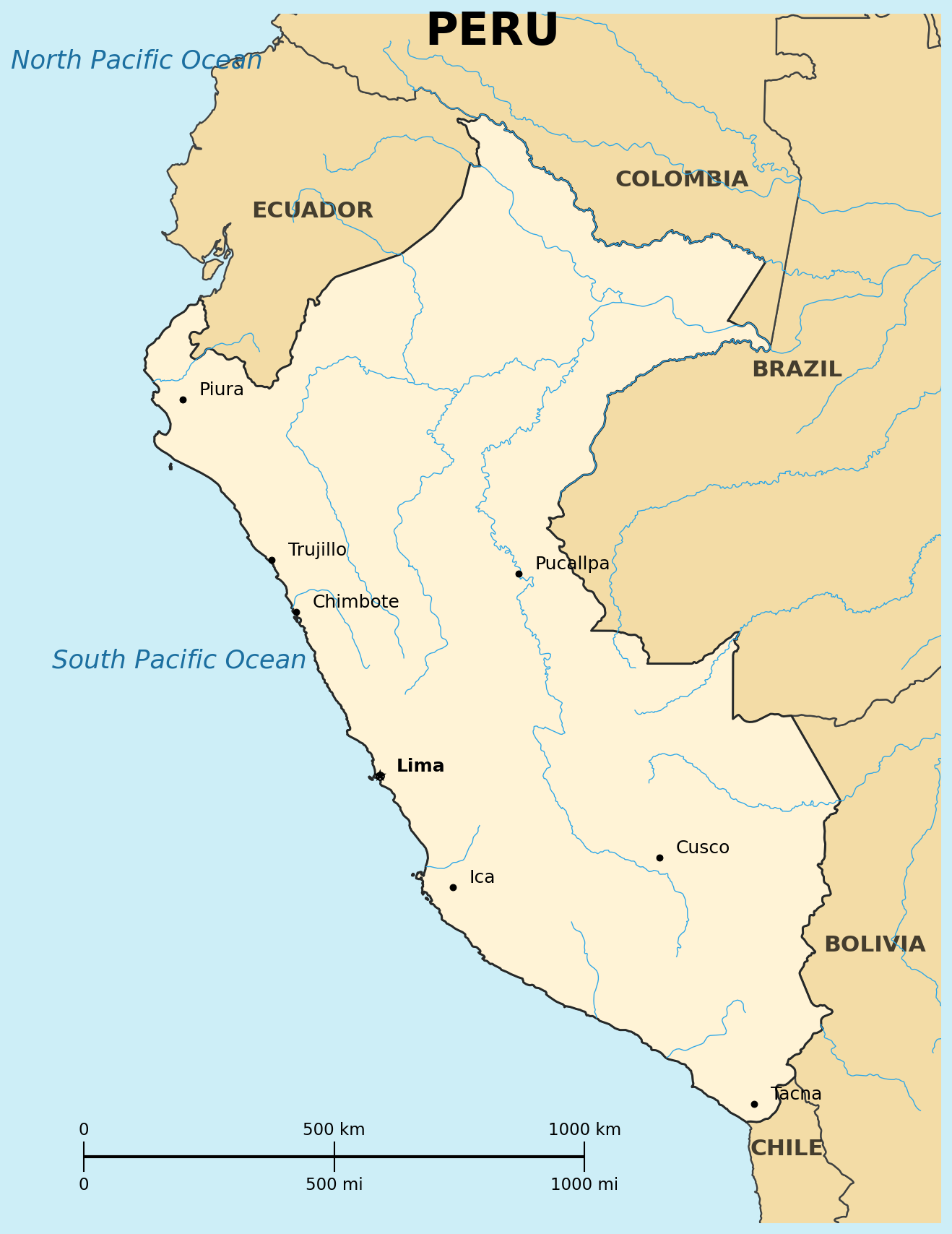
Location: Western South America, bordering the South Pacific Ocean, between Chile and Ecuador
Map references: South America
Land boundaries:
border countries: Bolivia, Brazil, Chile, Colombia, Ecuador
| People |
Population: 32.8-34.9 million (2024-2026 est.)
Nationality:
noun/adjective: Peruvian(s)
Religions: Roman Catholic 60%, Christian 14.6% (Evangelical 11.1%, other 3.5%), unspecified 21.1%, none 4% (2017 est.)
Languages: Spanish (official) 82.9%, Quechua (official) 13.6%, Aymara (official) 1.6%, Ashaninka 0.3%, other native languages 0.8%, other 0.2% (2017 est.)
Population distribution: approximately one-third of the population resides along the desert coastal belt in the west, with a strong focus on the capital, Lima; the Andean highlands (sierra) contain roughly half the population; the eastern slopes of the Andes and adjoining rainforest are sparsely populated
| Government |
Country name:
conventional long form: Republic of Peru
conventional short form: Peru
Data code: PE
Government type: presidential republic
National capital: Lima; the name is an early Spanish mispronunciation of the Quechua name Rimak, referring to a god and deriving from rima ("to speak") - Quechua priests used to speak to worshippers from inside statues of their gods
Executive branch:
chief of state and head of government: President Jose Enrique Jeri Ore (since 10 October 2025, following the removal of President Dina Boluarte)
Background: ancient Peru was the seat of several prominent Andean civilizations, most notably the Inca Empire; Peru has experienced significant recent political instability at the presidential level, with several rapid leadership transitions in the 2020s
| Economy |
Economy - overview: upper-middle-income South American economy; recovering from the COVID-19 pandemic, though the rebound is tempered by ongoing political uncertainty; urban and coastal communities have benefited far more from economic growth than rural, Afro-Peruvian, Indigenous, and Amazon/mountain-region populations; poverty has declined substantially over the past decade but remains high, around 30% nationally and over 55% in rural areas
Population below poverty line: approximately 30% nationally, over 55% in rural areas
Currency: Peruvian sol (PEN)
| Military |
Military branches: Armed Forces of Peru (Fuerzas Armadas del Peru): Peruvian Army, Peruvian Navy (includes naval infantry and Coast Guard directorate), Air Force of Peru; Ministry of the Interior: Peruvian National Police (2025)
Military manpower: approximately 85,000 active-duty Armed Forces (50,000 Army, 25,000 Navy, 10,000 Air Force); approximately 75,000 National Police (2025)