
About Poland
Polish - the sole official language, spoken by ~98.2% of the population; a West Slavic language.
Silesian - spoken by ~1.4%, a regional dialect/language in the south.
Poland also recognizes Kashub as a regional language, and Czech, Hebrew, Yiddish, Belarusian, Lithuanian, German, Armenian, Russian, Slovak, and Ukrainian as national minority languages, plus Karaim, Lemko, Romani, and Tatar as ethnic minority languages.
Polish is the sole official language of Poland.
| Geography |
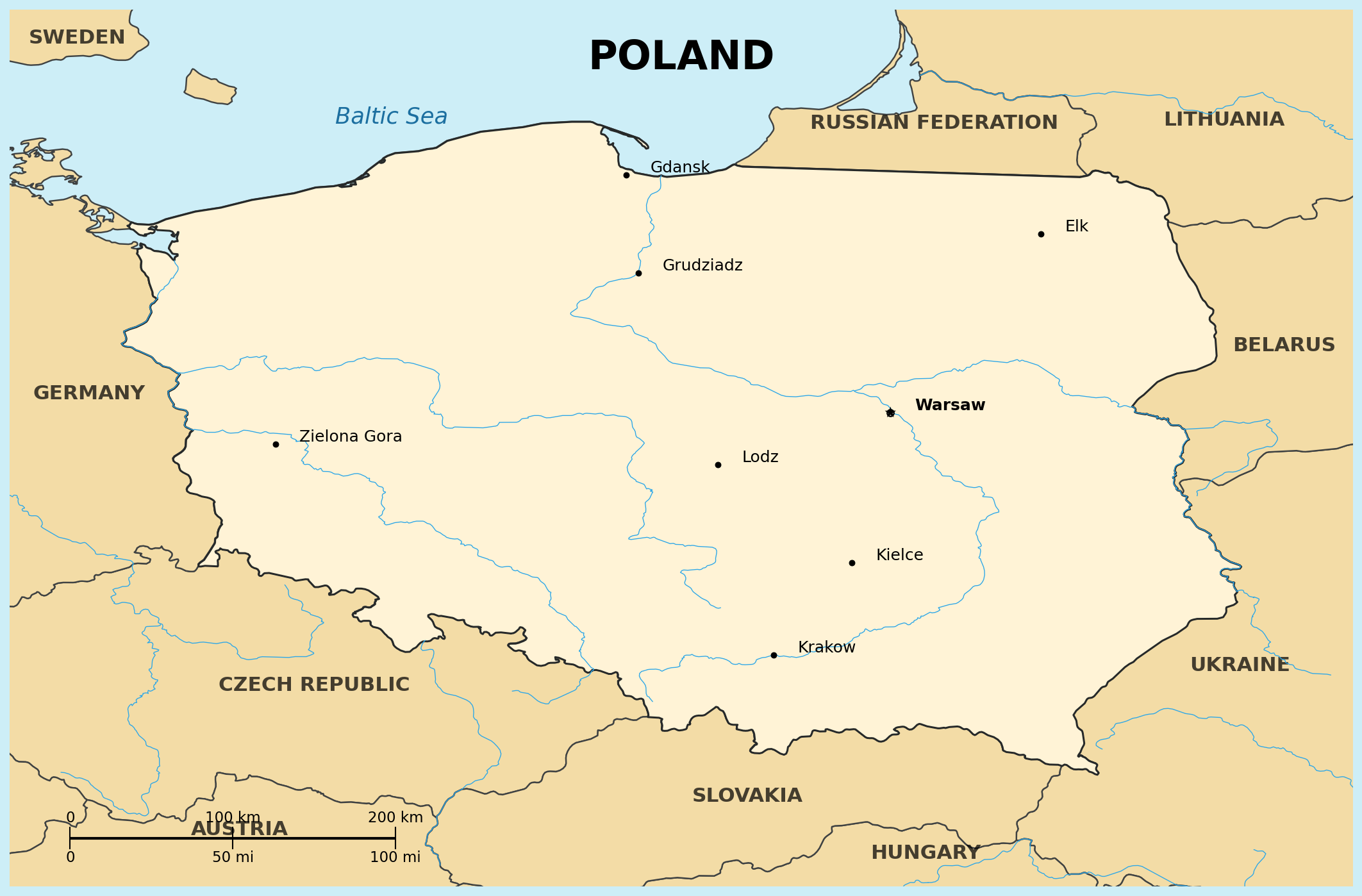
Location: Central Europe, bordering the Baltic Sea, between Germany and Russia (Kaliningrad)
Map references: Europe
Area:
total: 312,685 sq km
Land boundaries:
border countries: Belarus, Czech Republic, Germany, Lithuania, Russia (Kaliningrad), Slovakia, Ukraine (7 countries)
Geography - note: the Wisla (Vistula) River, shared with Belarus and Ukraine, is Poland's longest river at 1,213 km
| People |
Population: 36.5-38.7 million (2024-2025 est.)
Age structure:
0-14 years: 14.2%
15-64 years: 65.9%
Nationality:
noun/adjective: Pole(s)/Polish
Religions: Roman Catholic 70.7%, refused to answer 20.9%, no religion 6.9%, small minorities of Orthodox, Protestant, and other faiths (2021 est.)
Languages: Polish (official) 98.2%, Silesian 1.4%, other 1.1%, unspecified 1.2% (2011 est.); Kashub recognized as a regional language; Czech, Hebrew, Yiddish, Belarusian, Lithuanian, German, Armenian, Russian, Slovak, and Ukrainian recognized as national minority languages; Karaim, Lemko, Romani, and Tatar recognized as ethnic minority languages
Population distribution: concentrated in the southern area around Krakow and the central area around Warsaw and Lodz, with an extension to the northern coastal city of Gdansk
| Government |
Country name:
conventional long form: Republic of Poland
conventional short form: Poland
Data code: PL
Government type: parliamentary republic
National capital: Warsaw
Background: Poland's history traces back to early Slavic tribes that settled the region around the 6th century AD; a powerful medieval kingdom and later commonwealth with Lithuania; partitioned among Austria, Prussia, and Russia in the late 18th century, disappearing as an independent state for over a century; re-emerged after WWI; suffered enormous losses in WWII (including the Holocaust) and fell under Soviet-imposed communist rule afterward; the Solidarity movement led to the peaceful fall of communism in 1989; joined NATO in 1999 and the EU in 2004
| Economy |
Economy - overview: advanced, high-income EU economy (not yet in the Eurozone); diversified manufacturing, agriculture, and services sectors; one of the strongest-performing economies in the EU in recent years
GDP (purchasing power parity): $2.16 trillion (2026 est.)
GDP - real growth rate: 3.6% (2025)
GDP - per capita: $59,790 PPP (2026 est.)
Inflation rate: 4.3% (2025)
Unemployment rate: 3.0% (2025 est.)
Population below poverty line: 11.8% (2022); 16.3% at risk of poverty or social exclusion (2023)
Currency: Polish zloty (PLN)
| Military |
Military - note: Poland has significantly boosted defense spending in recent years, a NATO member since 1999; military inventory is a mix of Soviet-era and growing NATO-compatible equipment, with recent arms purchases from Finland, South Korea, and the US; maintains a domestic defense sector producing tanks and other ground systems (2025)