

About Portugal
Portuguese - the official language, spoken by the vast majority of the population.
Mirandese - a locally used official regional language spoken in the northeastern part of the country.
Portuguese is one of the most widely spoken languages in the world, with almost 267 million speakers globally, giving Portugal strong cultural and economic ties to Brazil and other Portuguese-speaking nations.
Portuguese and Mirandese are both official languages of Portugal.
| Geography |
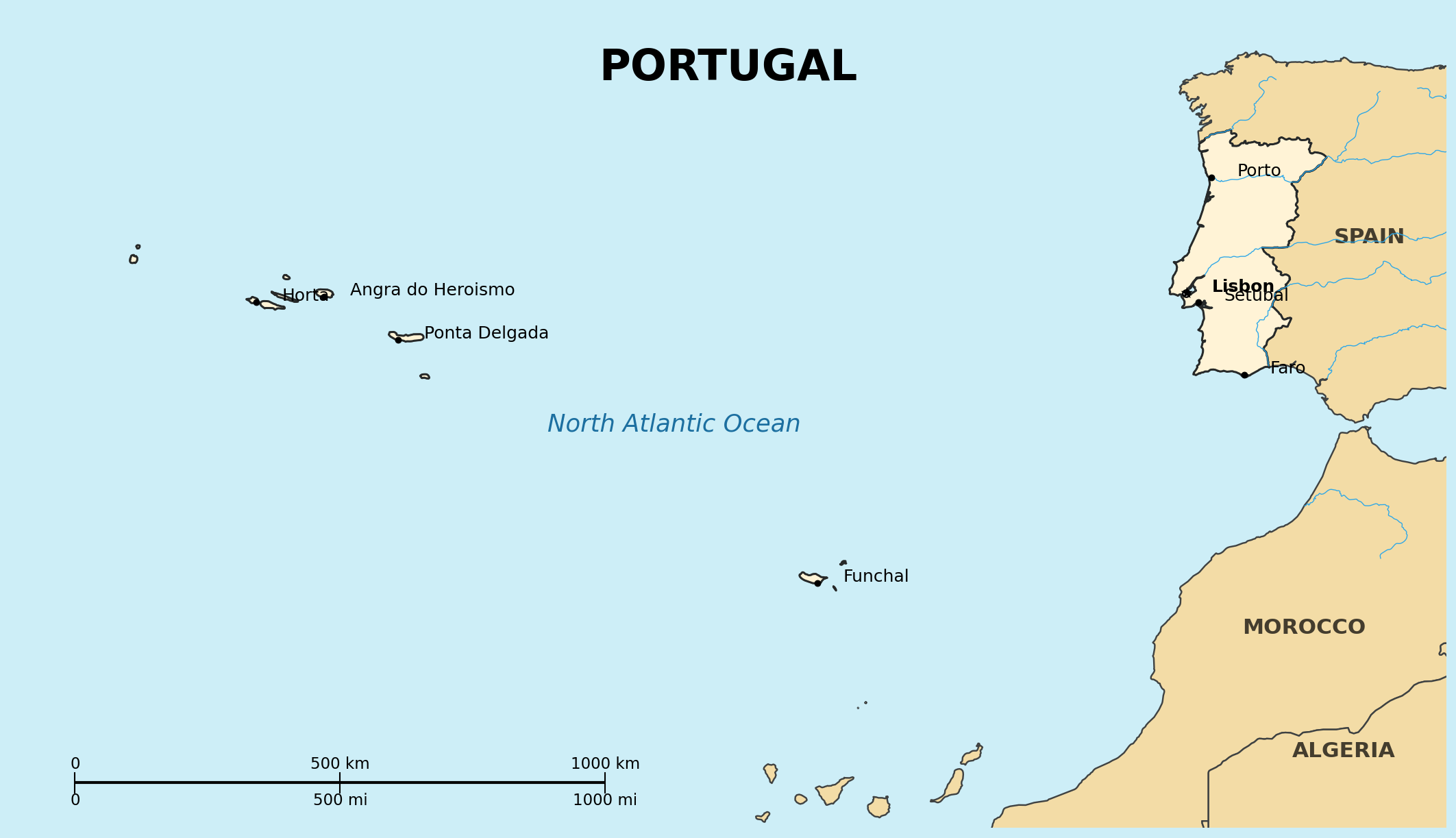
Location: Southwestern Europe, bordering the North Atlantic Ocean, west of Spain
Map references: Europe
Area:
total: 92,090 sq km
Coastline: 1,793 km
Land boundaries:
border countries: Spain
Climate: maritime temperate; cool and rainy in north, warmer and drier in south
Terrain: the west-flowing Tagus River divides the country: the north is mountainous toward the interior, while the south is characterized by rolling plains
Natural resources: fish, forests (cork), iron ore, copper, zinc, tin, tungsten, silver, gold, uranium, marble, clay, gypsum, salt, arable land, hydropower
| People |
Population: 10,194,277-10,749,635 (2024-2025 est.)
Age structure:
0-14 years: 12.7%
15-64 years: 63-65%
65 years and over: 22.3-24.3% (2024 est.)
Median age: 46.8-47.3 years
Life expectancy at birth:
total population: 82.7 years
male: 79.8 years
female: 85.4 years (2024)
Infant mortality rate: 2.8 deaths/1,000 live births (2025)
Nationality:
noun/adjective: Portuguese
Ethnic groups: Portuguese 95%; citizens from Portugal's former colonies in Africa, Asia, and South America (notably Brazilian), and other foreign-born 5%
Religions: Catholic 68.1%, no religion 12.0%, Protestant 1.8%, other 1.0% (2021 est.)
Languages: Portuguese (official), Mirandese (official, locally used in the northeast)
Population distribution: mostly concentrated along the coastal strip, with emphasis on the metropolitan areas of Lisbon and Porto
| Government |
Country name:
conventional long form: Portuguese Republic
conventional short form: Portugal
Data code: PO
Government type: semi-presidential republic
National capital: Lisbon
Background: a global maritime power during the 15th and 16th centuries; lost much of its wealth and status following the destruction of Lisbon in a 1755 earthquake, occupation during the Napoleonic Wars, and the independence of Brazil (its wealthiest colony) in 1822
| Economy |
Economy - overview: advanced, high-income EU and Eurozone economy; strong tourism, agriculture, and technology sectors
GDP (purchasing power parity): $567.632 billion (2026 est.)
GDP - real growth rate: 1.9% (2025)
GDP - per capita: $52,841 PPP (2026 est.)
Inflation rate: 2.3-3.3% (2025-2026)
Unemployment rate: 6.2% (2025 est.)
Population below poverty line: 15.4% (2024)
Currency: Euro (EUR)
| Military |
Military branches: Portuguese Armed Forces: Portuguese Army, Portuguese Navy (includes Marine Corps), Portuguese Air Force; Ministry of Internal Administration: Public Security Police, National Republican Guard (2025)