

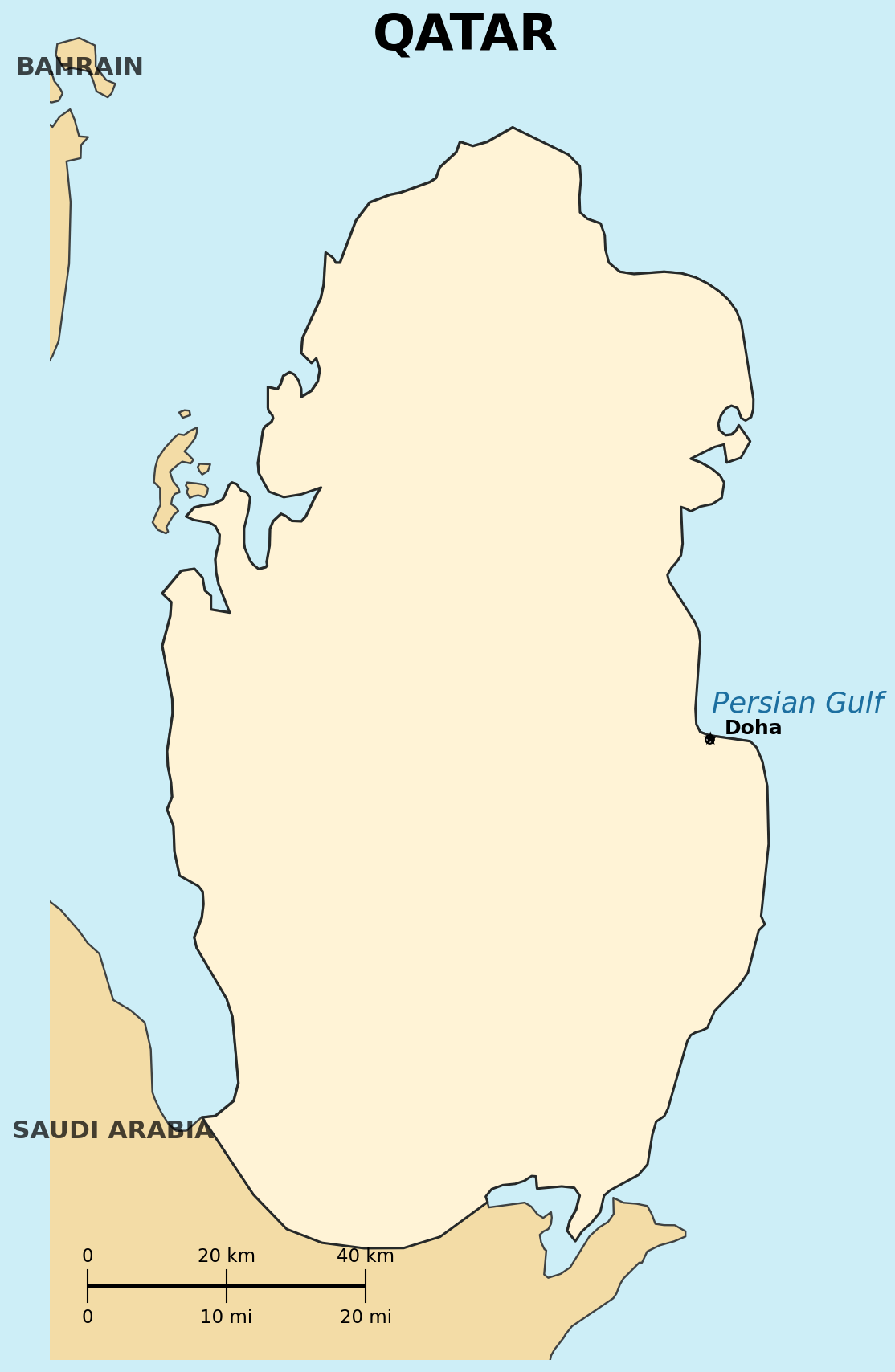

About Qatar
Arabic - the sole official language.
English - commonly used as a second language, particularly in business and among Qatar's large expatriate population.
Hindi-Urdu and Malayalam are also widely spoken among foreign workers, who make up the large majority of Qatar's population.
Arabic is the sole official language of Qatar.
| Geography |
Location: Middle East, a peninsula bordering the Persian Gulf and Saudi Arabia
Map references: Middle East
Area:
total: 11,581-11,586 sq km
Land boundaries:
border countries: Saudi Arabia
Geography - note: the peninsula occupies a strategic location in the central Persian Gulf near major petroleum deposits
| People |
Population: 2.57-3.37 million (varies significantly by source, reflecting citizen vs. total resident population; 2025-2026 est.)
Age structure:
0-14 years: 14.23%
15-64 years: 84.61%
65 years and over: 1.16%
Life expectancy at birth:
total population: 79.81 years
male: 77.7 years
female: 81.96 years
Infant mortality rate: 6.62 deaths/1,000 live births
Nationality:
noun/adjective: Qatari(s)
Religions: Muslim 65.2%, Hindu 15.9%, Christian 13.7%, Buddhist 3.8%, other minority faiths (2020 est.)
Languages: Arabic (official), English commonly used as a second language
Population distribution: most of the population is clustered in or around the capital, Doha, on the eastern side of the peninsula; urban population 99.4% of total (2023)
| Government |
Country name:
conventional long form: State of Qatar
conventional short form: Qatar
Data code: QA
Government type: absolute monarchy
National capital: Doha
Background: ruled by the Al Thani family since the mid-1800s, Qatar transformed within the last 60 years from a poor British protectorate noted mainly for pearling into an independent state with significant hydrocarbon revenues; former Amir Hamad bin Khalifa Al Thani, who overthrew his father in a bloodless coup in 1995, ushered in sweeping political and media reforms, unprecedented economic investment, and a growing Qatari regional leadership role, including creating the pan-Arab satellite news network Al-Jazeera; by 2007 Doha had attained the highest per capita income in the world; gained international attention hosting the 2022 World Cup and 2024 Asian Cup
| Economy |
Economy - overview: high-income economy rooted in petroleum and natural gas extraction and export; among the highest per capita incomes in the world; natural gas, particularly from the offshore North Field (one of the world's largest gas fields), has surpassed oil as the largest contributor to government revenue and GDP
GDP (purchasing power parity): $369.24-378.08 billion (2025 est.)
GDP - real growth rate: 1.5% (2024f)
GDP - per capita: $118,760-121,610 PPP (2025 est.) - among the highest in the world
Inflation rate: 2.6% (2024f)
Unemployment rate: 0.1-0.2% (2024-2025); among the lowest in the world
Currency: Qatari riyal (QAR)
| Military |
Military branches: Qatar Armed Forces (QAF): Qatari Amiri Land Force (includes Emiri Guard), Qatari Amiri Navy (includes Coast Guard), Qatari Amiri Air Force; Ministry of Interior: General Directorate of Public Security, General Directorate of Coasts and Border Security, Internal Security Force (Lekhwiya) (2025)