
About Serbia
Serbian - the official language, spoken by ~88.1% of the population.
Hungarian (~3.4%), Bosnian (~1.9%), and Romani (~1.4%) are also spoken.
Serbian, Hungarian, Slovak, Romanian, Croatian, and Ruthenian (Rusyn) are all official in the Autonomous Province of Vojvodina.
Serbian is the sole official language of Serbia nationally.
| Geography |
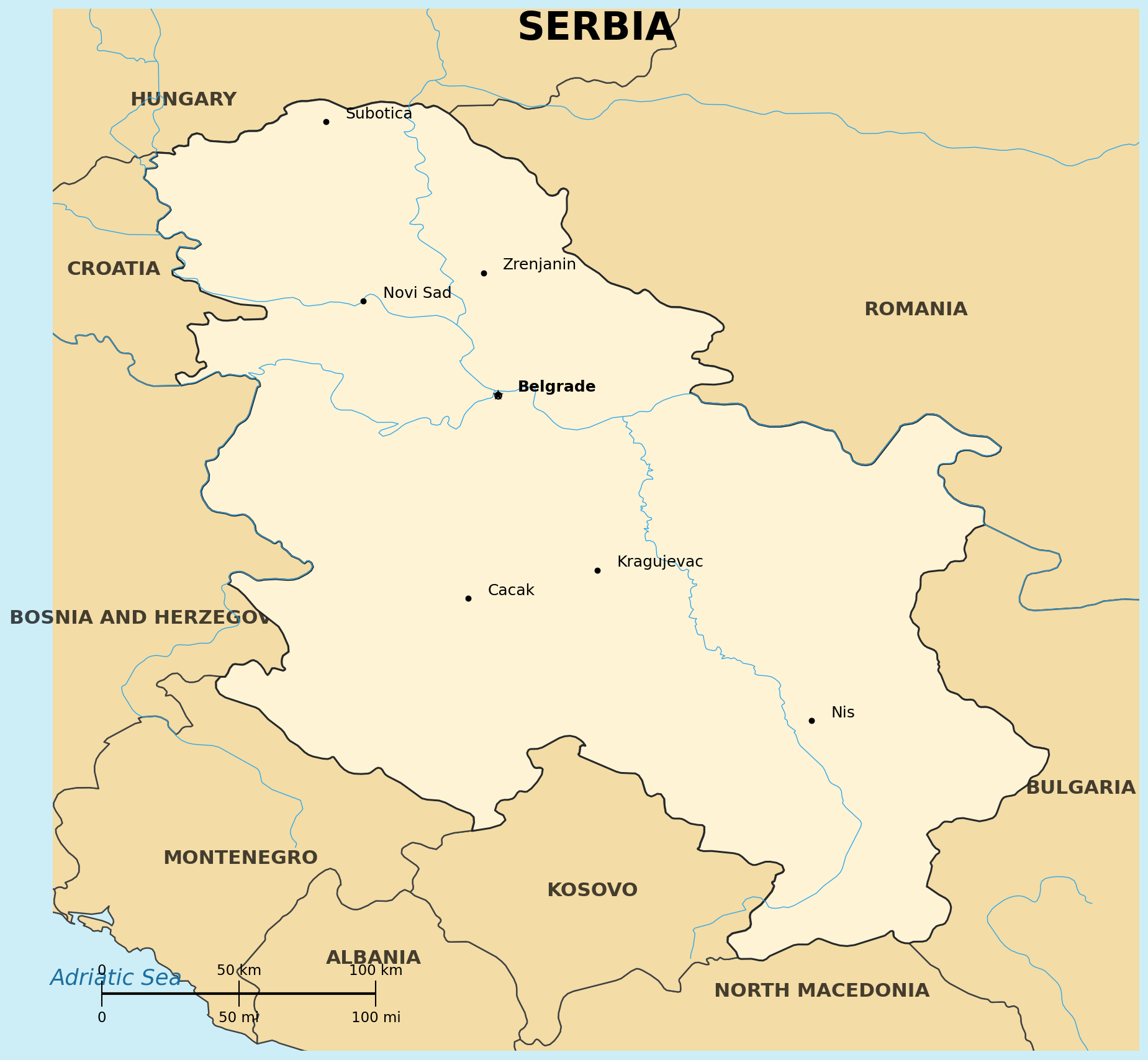
Location: Southeastern Europe, in the Balkans, landlocked, between Kosovo and Hungary
Map references: Europe
Area:
total: 77,589-88,499 sq km (varies depending on treatment of Kosovo)
Land boundaries:
border countries: Bosnia and Herzegovina, Bulgaria, Croatia, Hungary, North Macedonia, Montenegro, Romania (and Kosovo, whose independence Serbia does not recognize)
| People |
Population: 6.57-6.65 million (2024-2025 est.)
Age structure:
0-14 years: 14.4%
15-64 years: 63-65.6%
65 years and over: 20-22.6%
Median age: 44.1 years (2025 est.)
Life expectancy at birth:
total population: 75.4 years
male: 73.7 years
female: 78.3 years
Infant mortality rate: 4.6 deaths/1,000 live births (2024)
Nationality:
noun/adjective: Serbian(s)
Ethnic groups: Serbs 80.6-83.3%, Hungarians 2.7-3.5%, Bosniaks 2-2.3%, Roma 2%, other 5.5-5.7%, undeclared/unknown 3.4-6.9% (2011-2022 est.); most ethnic Albanians boycotted the census
Religions: Serbian Orthodox 81.1-84.6%, Islam 3.1-4.2%, Catholic 3.9-5%, Protestant 1%, unknown/no response 4.5-5.3% (2011-2022 est.)
Languages: Serbian (official) 88.1%, Hungarian 3.4%, Bosnian 1.9%, Romani 1.4%, other 3.4%, undeclared 1.8% (2011 est.)
Literacy: total population 99.3% (2022 est.)
| Government |
Country name:
conventional long form: Republic of Serbia
conventional short form: Serbia
Data code: RI
Government type: semi-presidential republic
National capital: Belgrade
Executive branch:
chief of state: President Aleksandar Vucic (re-elected 2022)
head of government: Prime Minister Djuro Macut (since 28 January 2025)
Background: in 1998, an ethnic Albanian insurgency in the formerly autonomous Serbian province of Kosovo resulted in a brutal Serbian counterinsurgency campaign; Serbia rejected a proposed international settlement, and NATO responded with a bombing campaign that ended Serbian military operations in Kosovo in 1999; Serbia and Montenegro dissolved their union in 2006, and Kosovo declared independence in 2008, which Serbia does not recognize; Serbia is currently an EU accession candidate
| Economy |
Economy - overview: upper-middle-income Balkan economy; current EU accession candidate; pursuing green growth development; manageable public debt; new anti-corruption efforts; historically close Russian relations; energy import-dependent
GDP (purchasing power parity): $226.38 billion (2026 est.)
GDP - real growth rate: 2.8% (2026f)
GDP - per capita: $34,860 PPP (2026 est.)
Inflation rate: 3.3% (April 2026)
Unemployment rate: 7.1-8.9% (2025-2026)
Population below poverty line: 19.6% (2025)
Industries: automobiles, base metals, furniture, food processing, machinery, chemicals, sugar, tires, clothes, pharmaceuticals
Currency: Serbian dinar (RSD)
| Military |
Military branches: Serbian Armed Forces (Vojska Srbije, VS): Army/Land Forces (includes Riverine Component with a naval flotilla on the Danube), Air and Air Defense Forces, Serbian Guard; Ministry of Internal Affairs: Police Directorate (2025)