
Country information
Solomon Islands
- Capital
- Honiara
- Population
- 750,325
Languages spoken
About Solomon Islands
Melanesian Pidgin - the lingua franca in much of the country, used across its many ethnic and linguistic communities.
English - the official language, though spoken by only 1-2% of the population.
Around 120 indigenous languages are also spoken, including Roviana and Kwara'ae, reflecting the islands' extraordinary linguistic diversity.
English is the sole official language of Solomon Islands.
| Geography |
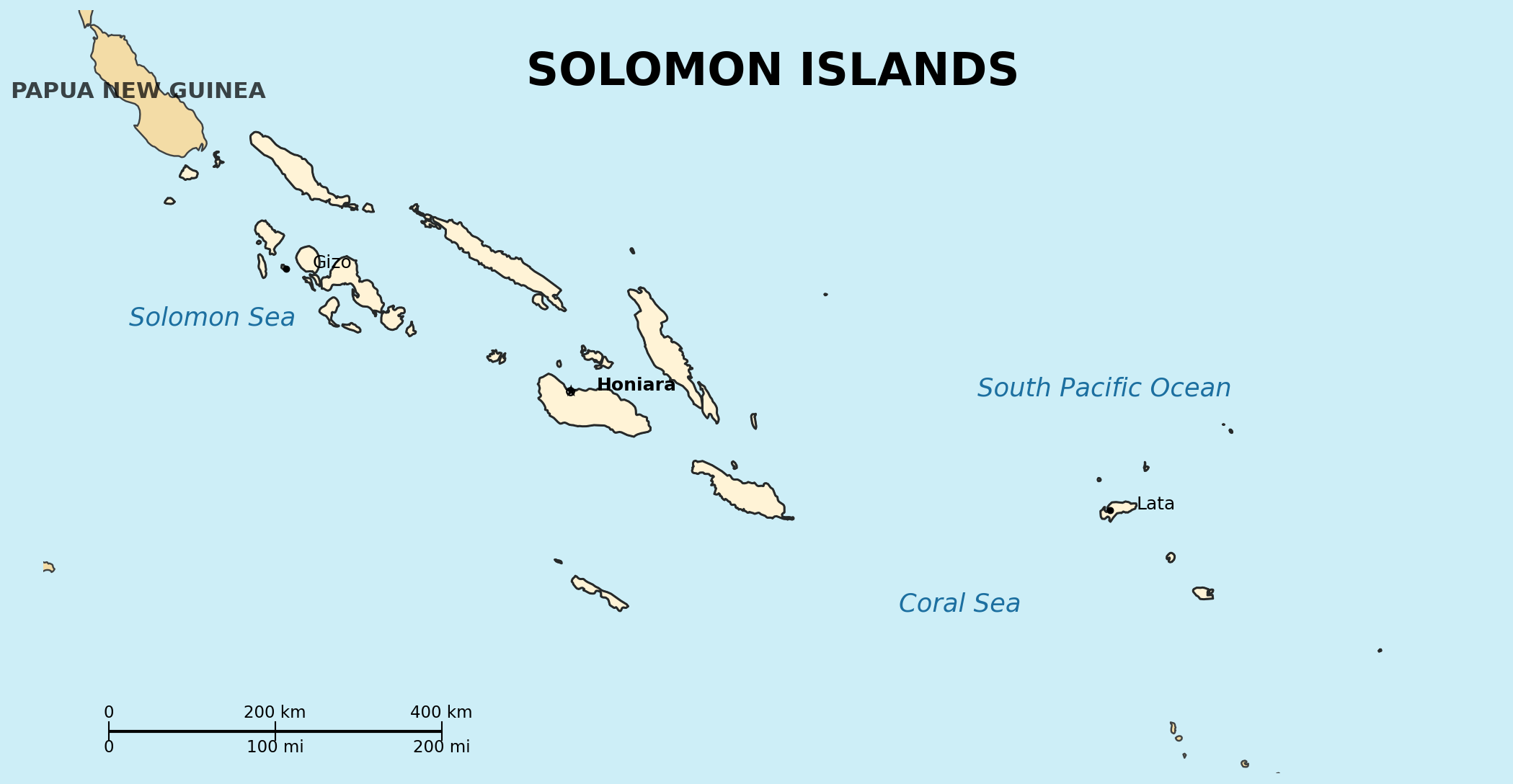
Location: Oceania, a group of islands in the South Pacific Ocean, east of Papua New Guinea; consists of nearly 1,000 islands and atolls
Map references: Oceania
| People |
Population: 702,694-858,093 (2022-2026 est.)
Age structure:
0-14 years: 31.06-32.99%
15-64 years: 63.82%
65 years and over: 4.51-5.12%
Median age: 24.8 years (2023 est.)
Nationality:
noun/adjective: Solomon Islander(s)
Ethnic groups: Melanesian 95.3%, Polynesian 3.1%, Micronesian 1.2%, other 0.3% (2009 est.); over 80 distinct ethnic groups
Religions: Protestant 73.4% (Church of Melanesia, South Sea Evangelical, Seventh Day Adventist, United Church, and others), Roman Catholic 19.6%, other Christian 2.9%, other 4% (2009 est.)
Languages: Melanesian pidgin (lingua franca in much of the country), English (official, spoken by only 1-2% of the population), 120 indigenous languages
Population distribution: most of the population lives along coastal regions; about one in five live in urban areas, with roughly two-thirds of those residing in Honiara, the largest town and chief port
| Government |
Country name:
conventional short form: Solomon Islands
Data code: BP
Government type: parliamentary constitutional monarchy; a Commonwealth realm
National capital: Honiara, on Guadalcanal
Background: the Regional Assistance Mission to the Solomon Islands (RAMSI), which ended in June 2017, was generally effective in restoring law and order and rebuilding government institutions following earlier ethnic tensions; in 2017 Solomon Islands and Australia signed a security treaty allowing rapid deployment of Australian police and defense personnel by mutual consent, first activated in November 2021 following civil unrest in Honiara, when Australia, Fiji, Papua New Guinea, and New Zealand personnel helped restore order; in 2022 the Solomon Islands government also signed a police and security agreement with China
| Economy |
Economy - overview: lower-middle-income Pacific island economy; natural resource rich but environmentally fragile; key agrarian sector, with over 75% of the labor force engaged in subsistence farming and fishing; growing Chinese economic relationship; infrastructure damage from past social unrest; active metal mining operations
GDP (purchasing power parity): $2.17 billion (2025 est.)
GDP - real growth rate: 2.7% (2025)
GDP - per capita: $2,710 PPP (2025 est.)
Inflation rate: 2.664% (2018)
Currency: Solomon Islands dollar (SBD)
| Military |
Military - note: no standing military; Ministry of Police, National Security and Correctional Services (MPNSCS): Royal Solomon Islands Police Force (RSIPF) (2025)
| Transnational Issues |
Trafficking in persons - tier rating: Tier 2 Watch List (2025)