
About Spain
Castilian Spanish - the official language nationwide, spoken by ~74% of the population as a home language.
Catalan - co-official in Catalonia, the Balearic Islands, and the Valencian Community (where it is known as Valencian), spoken by ~17%.
Galician and Basque are also official regional languages, and Aragonese, Aranese, Asturian, and Calo are recognized regional languages.
Castilian Spanish is the sole official national language of Spain, with Catalan, Galician, and Basque holding official status regionally.
| Geography |
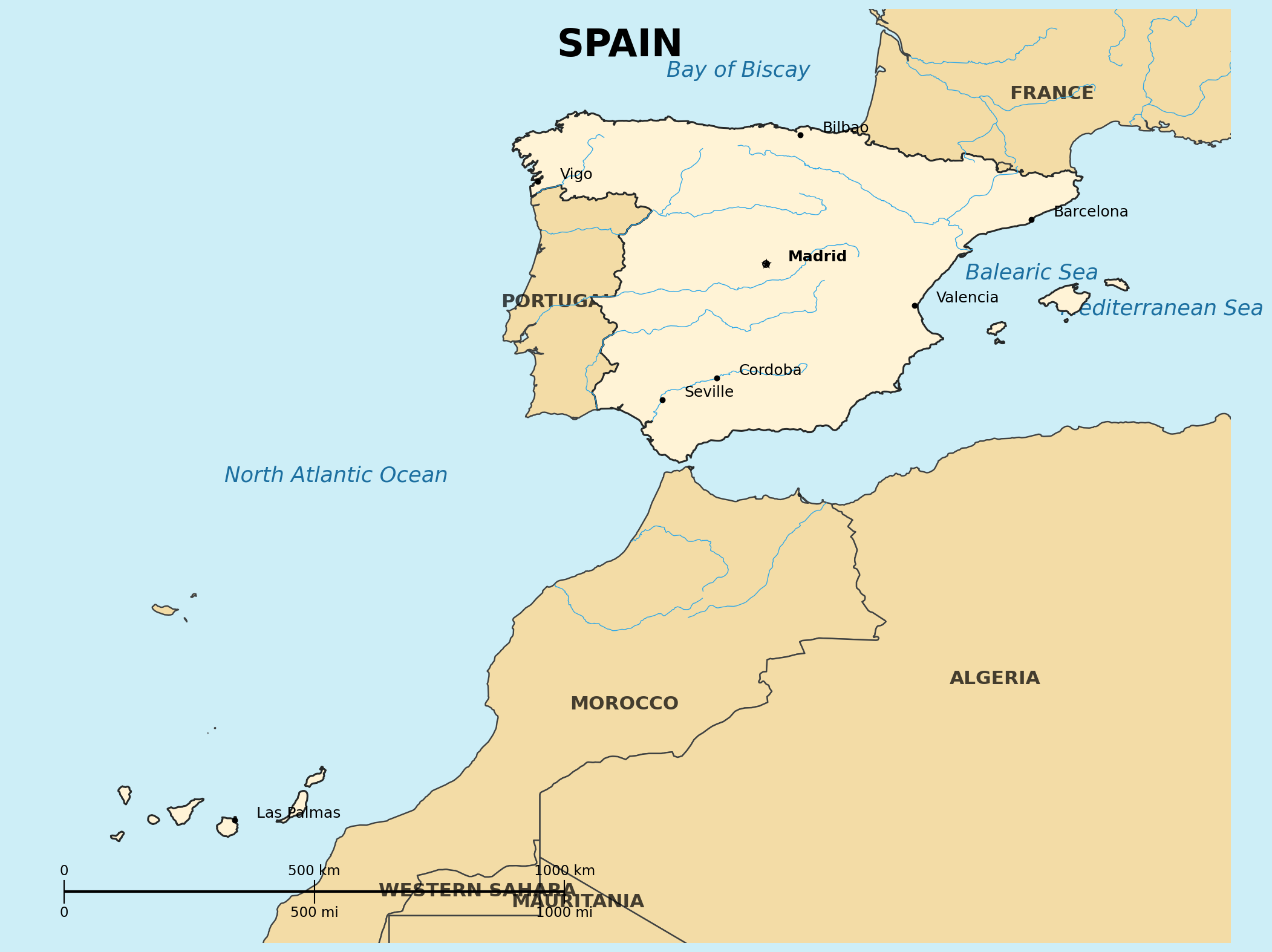
Location: Southwestern Europe, bordering the Bay of Biscay, Mediterranean Sea, North Atlantic Ocean, and Pyrenees Mountains, southwest of France
Map references: Europe
Area:
total: 505,370 sq km
Land boundaries:
border countries: Andorra, France, Gibraltar, Portugal, Morocco (Ceuta and Melilla exclaves)
| People |
Population: 47.28-49.69 million (2024-2026 est.)
Age structure:
0-14 years: 12.7-13%
15-64 years: 66.1-66.4%
65 years and over: 20.9%
Median age: 47.2 years (2025 est.)
Life expectancy at birth:
total population: 84 years
male: 81.4 years
female: 86.5 years
Infant mortality rate: 2.4 deaths/1,000 live births (2024)
Nationality:
noun/adjective: Spaniard(s)/Spanish
Ethnic groups: White European 81.3%, Latin American 7.8%, Mixed 1.6%, Romani 1.3%, Arab 1.0%, Black 0.3%, not stated 6.7% (2024)
Religions: Roman Catholic 58.2%, atheist 16.2%, agnostic 10.8%, non-believer 10.5%, other 2.7% (2021 est.)
Languages: Castilian Spanish (official nationwide) 74%, Catalan/Valencian (official in Catalonia, Balearic Islands, Valencian Community) 17%, Galician and Basque (also official regionally); Aragonese, Aranese, Asturian, and Calo also recognized as regional languages
Population distribution: with the exception of Madrid, Sevilla, and Zaragoza, the largest urban agglomerations are found along the Mediterranean and Atlantic coasts; very dense settlement around the capital, Madrid
| Government |
Country name:
conventional long form: Kingdom of Spain
conventional short form: Spain; the derivation of Espana is uncertain, possibly from Basque words for "edge," or the Punic word span, meaning "rabbit"
Data code: SP
Government type: parliamentary constitutional monarchy
National capital: Madrid; the city grew from a small Moorish fort called Majerit, first recorded in 932 AD
| Economy |
Economy - overview: advanced, high-income EU and Eurozone economy; the 14th largest economy in the world by nominal GDP; strong tourism, manufacturing, and services sectors; recovered from the 2008 financial crisis with sustained growth since 2014, though public debt remains elevated
GDP (purchasing power parity): $2.936 trillion (2026f)
GDP - real growth rate: 2.0% (2026f)
GDP - per capita: $58,348 PPP (2026f)
Inflation rate: 2.0% (2026f)
Unemployment rate: 10.4-10.83% (2025-2026)
Population below poverty line: 25.7% at risk of poverty or social exclusion (2025)
Industries: machinery, electronics, medical equipment, chemicals, motor vehicles, clothing, food processing, tourism, shipbuilding
Currency: Euro (EUR)
| Military |
Military - note: Spain has up to 3,000 military personnel deployed on 17 missions supporting the EU, NATO, and the UN across four continents, including naval missions in the Mediterranean and off the Horn of Africa (2025)