
About Bangladesh
Bengali (Bangla) - the sole official and national language, spoken as a first language by ~99% of the population.
English - widely used as a second language in business, education, and government.
A number of small indigenous minority languages are spoken by tribal groups such as the Chakma, Garo, Marma, and Santal peoples.
Bengali is the sole official language of Bangladesh.
| Geography |
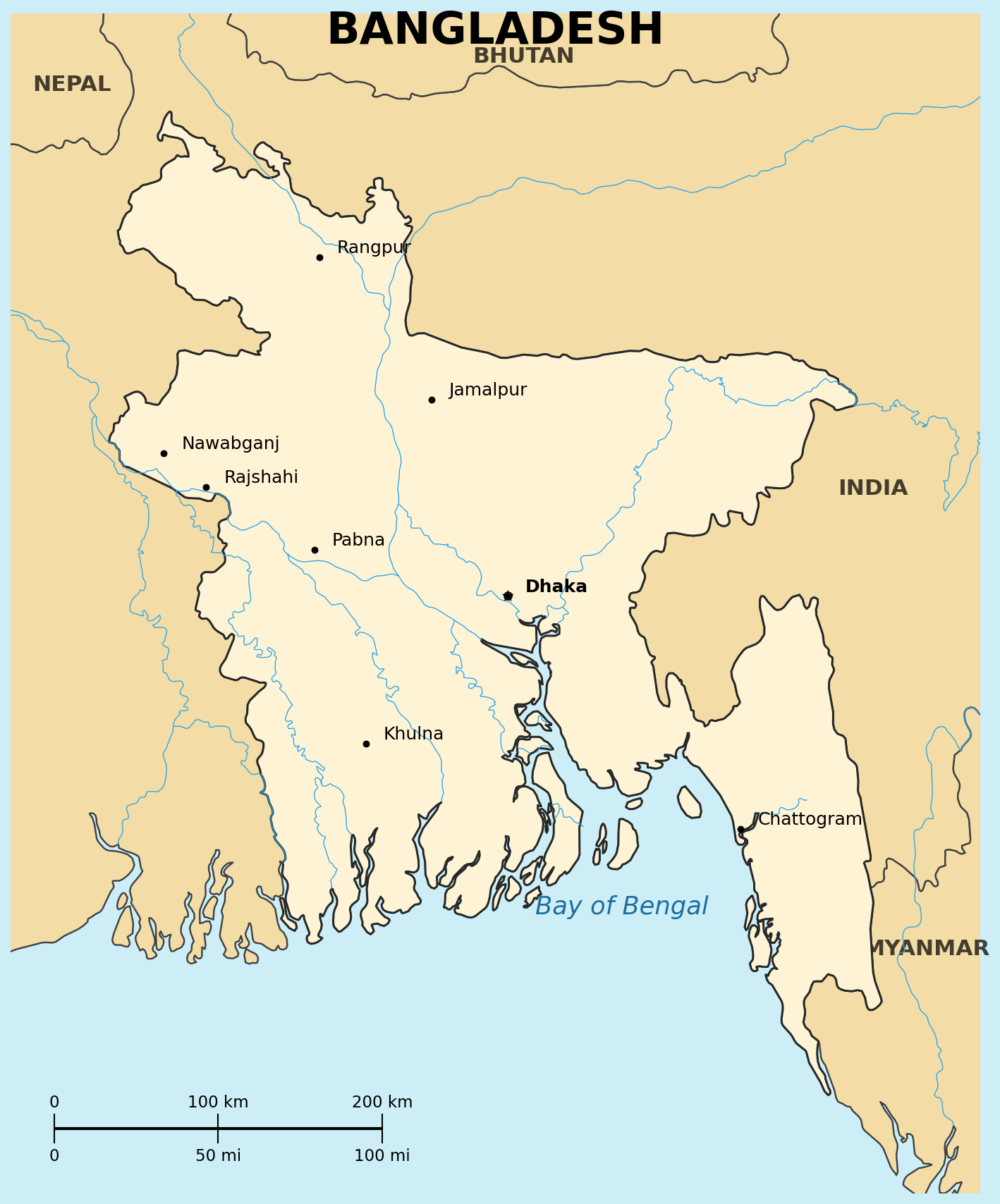
Location: Southern Asia, bordering the Bay of Bengal, between Burma (Myanmar) and India
Map references: Asia
Area:
total: 148,460 sq km
land: 130,170 sq km
water: 18,290 sq km
Climate: tropical; mild winter; hot, humid summer; humid, warm rainy monsoon (June to October)
Terrain: mostly flat alluvial plain; hilly in southeast
Natural resources: natural gas, arable land, timber, coal
Natural hazards: droughts; cyclones; much of the country routinely inundated during the summer monsoon season
| People |
Population: 173,562,364 (2024 est.) - 8th most populous country in the world; one of the highest population densities globally
Population growth rate: 1.22% (2024 est.)
Life expectancy at birth:
total population: 74.9 years
male: 73.3 years
female: 76.7 years (2024 est.)
Infant mortality rate: 16.9 deaths/1,000 live births (2024 est.)
Total fertility rate: 2.1 children born/woman (2024 est.)
Nationality:
noun/adjective: Bangladeshi(s)
Ethnic groups: Bengali 99%, other (including tribal groups such as Chakma, Garo, Khasi, Khumi, Manipuri, Marma, Mizo, Mru, Santal, Tanchangya, Tripuri) 1% (2022 census)
Religions: Islam (official) 91.04%, Hinduism 7.94%, Buddhism 0.60%, Christianity 0.30%, other 0.12% (2022)
Languages: Bengali/Bangla (official, national) ~99%, other (indigenous minority languages) ~1%
| Government |
Country name:
conventional long form: People's Republic of Bangladesh
conventional short form: Bangladesh
Data code: BG
Government type: unitary parliamentary republic (government in political transition following 2024 unrest; national elections held under an interim arrangement)
National capital: Dhaka
Independence: 16 December 1971 (from Pakistan; proclaimed 26 March 1971)
Legislative branch: unicameral National Parliament (Jatiya Sangsad), 350 seats, most directly elected
National anthem: "Amar Shonar Bangla" (My Golden Bengal)
| Economy |
Economy - overview: heavily agrarian roots (rice, jute) alongside a large and growing garments/textiles manufacturing sector, the country's leading export industry; made significant gains in poverty reduction, food security, and maternal health since the 2000s, though remains a least-developed economy
GDP (purchasing power parity): $1.9 trillion (2026 est.)
GDP - real growth rate: 3.5% (2025 est.)
GDP - per capita: $10,850 PPP (2026 est.)
Inflation rate: 9.04% (May 2026)
Unemployment rate: 3.6% (2024)
Labor force: 77,355,168 (2024)
Population below poverty line: 19.2% (2025)
Industries: textiles, pharmaceutical products, electronics, shipbuilding, automotive, bicycle, leather, jute, glass, paper, plastic, food and beverages, cement, tea, rice, natural gas and crude petroleum, iron and steel, ship breaking
Exports: $48.28 billion (2025)
Currency: Bangladeshi taka (BDT)