

About Sudan
Arabic - one of two official languages, spoken by the majority of the population.
English - the other official language.
Nubian, Ta Bedawie, and Fur are also spoken by significant ethnic minorities.
Arabic and English are both official languages of Sudan.
| Geography |
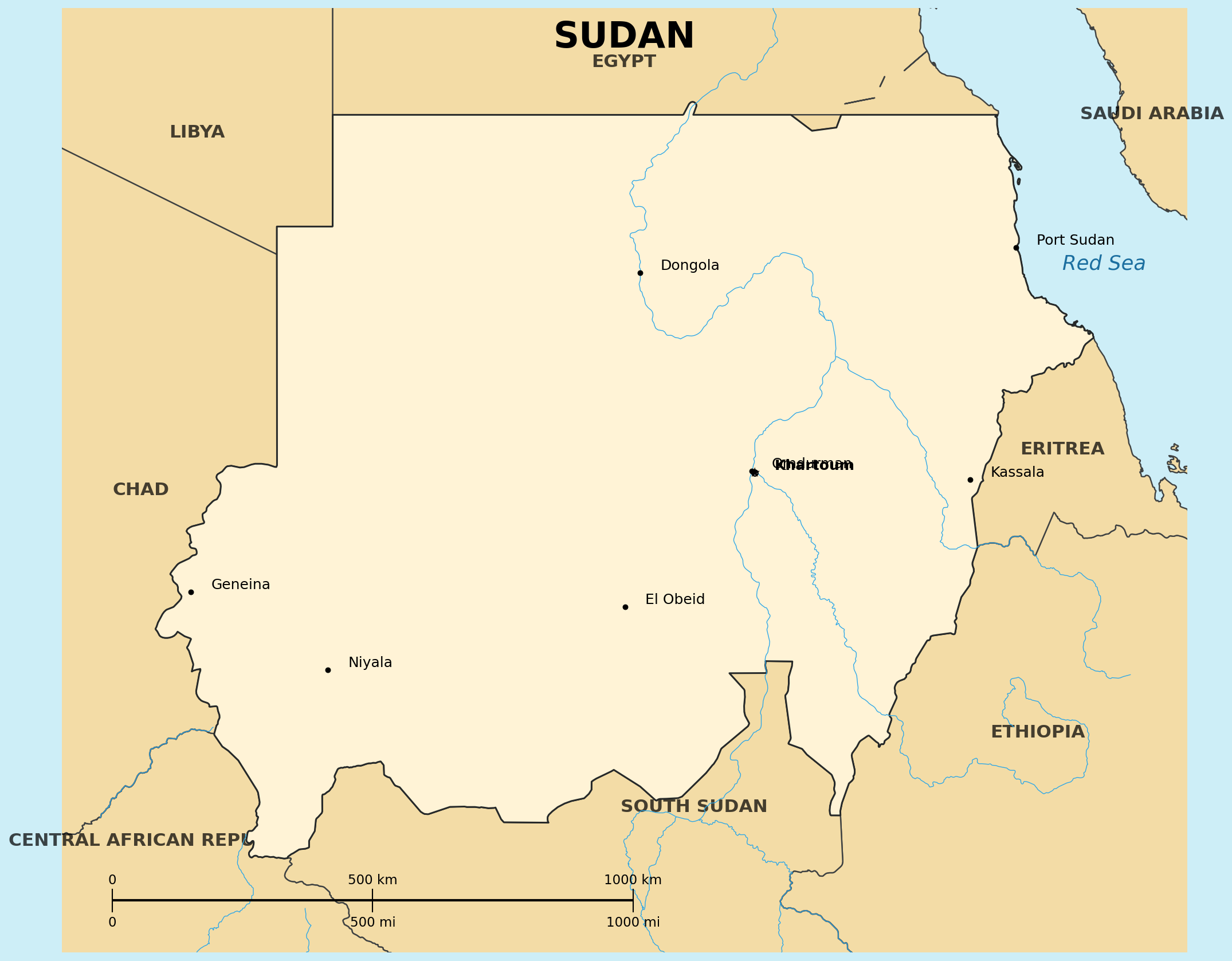
Location: Northern Africa, bordering the Red Sea, between Egypt and Eritrea
Map references: Africa
Land boundaries:
border countries: Central African Republic, Chad, Egypt, Eritrea, Ethiopia, Libya, South Sudan
| People |
Population: 45.6-48.1 million (2023 est., though displacement from the civil war makes current figures highly uncertain)
Age structure:
0-14 years: 40.1%
15-64 years: 56.7%
65 years and over: 3.2% (2024 est.)
Median age: 19.5 years (2025 est.)
Life expectancy at birth: total population 67.8 years (male 65.5, female 70.2) (2024 est.)
Infant mortality rate: 39.7 deaths/1,000 live births
Nationality:
noun/adjective: Sudanese
Languages: Arabic (official), English (official), Nubian, Ta Bedawie, Fur
Population distribution: concentrated along the Nile and its tributaries, particularly where the White and Blue Niles meet; the northern reaches are the least populated region; about 36.3% of the population lives in urban areas, with Khartoum the largest city at around 6.3 million
| Government |
Country name:
conventional long form: Republic of the Sudan
conventional short form: Sudan; Khartoum's name derives from the Arabic words ras (head/end) and al-khurtum (elephant's trunk), referring to the narrow strip of land between the Blue and White Niles where the city is located
Data code: SU
Government type: in transition; nominally a transitional military-led government amid ongoing civil war
National capital: Khartoum
Background: the Sudanese military has been a dominant force in ruling the country since independence in 1956, with a large role in the economy, reportedly controlling over 200 commercial companies; since April 2023, a devastating civil war has raged between the Sudanese Armed Forces (SAF) and the paramilitary Rapid Support Forces (RSF), particularly around Khartoum and in Darfur, following disputes over an internationally backed transition to civilian rule; the conflict has caused an estimated 150,000-400,000+ deaths, displaced nearly 9 million people internally, and created over 3.5 million refugees, with reports of atrocities, ethnic cleansing, and severe food insecurity affecting nearly 25 million people; foreign powers including Russia, Turkey, Saudi Arabia, Iran, and Egypt have reportedly provided support to various parties
| Economy |
Economy - overview: low-income Sahel economy devastated by the ongoing civil war; major impacts on rural income, basic commodity prices, industrial production, agricultural supply chains, and communications; hyperinflation and currency depreciation are worsening food access and humanitarian conditions; economic activity fell by more than a third in the first three weeks of the 2023 conflict alone
GDP (purchasing power parity): $117.77 billion (2025f)
GDP - real growth rate: -0.4% (2025f)
GDP - per capita: $2,341 PPP (2025)
Inflation rate: 56.39% (2026)
Population below poverty line: 46.5% (2009)
Industries: oil, cotton ginning, textiles, cement, edible oils, sugar, soap distilling, shoes, petroleum refining, pharmaceuticals, armaments, automobile/light truck assembly, milling
Currency: Sudanese pound (SDG)
| Military |
Military branches: Sudanese Armed Forces (SAF): Ground Force, Navy, Air Force; Rapid Support Forces (RSF); Border Guards; Ministry of Interior: Sudan Police Forces, Central Reserve Police (2025)