
About Sweden
Swedish - the sole official language, a North Germanic language spoken by the vast majority of the population.
Finnish, Sami, Romani, Yiddish, and Meankieli hold official minority language status, protecting the languages of Sweden's recognized national minorities, including the indigenous Sami people.
Swedish is the sole official language of Sweden.
| Geography |
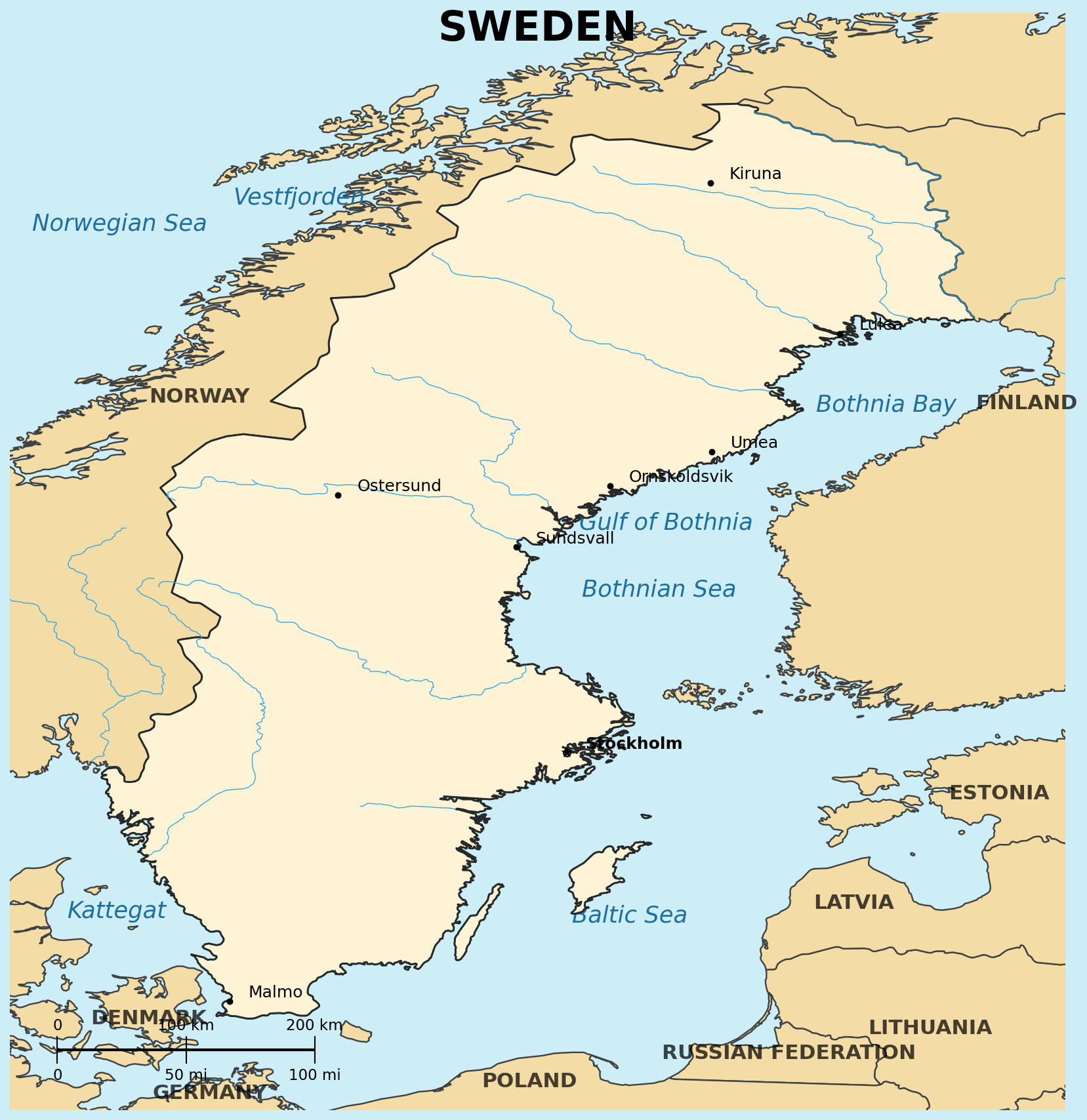
Location: Northern Europe, bordering the Baltic Sea, Gulf of Bothnia, Kattegat, and Skagerrak, between Finland and Norway, on the Scandinavian Peninsula
Map references: Europe
Area:
total: 450,295 sq km
Land boundaries:
border countries: Finland, Norway
| People |
Population: 10.6-10.64 million (2025 est.); 15th-most populous country in Europe
Age structure:
0-14 years: 17.71%
15-64 years: 62.18%
65 years and over: 20.12%
Median age: 41.2 years (2025 est.)
Life expectancy at birth:
total population: 82.8 years
male: 82.29 years
female: 85.35 years
Infant mortality rate: 2.3 deaths/1,000 live births
Nationality:
noun/adjective: Swede(s)/Swedish
Ethnic groups: predominantly Swedish; minorities include Finns, Arabs, Persians, Africans, Turks, Assyrians, Germans, Kurds, Poles, and others; the indigenous Sami people are estimated to number between 20,000 and 40,000
Religions: Church of Sweden (Lutheran) 53.9%, other 8.9% (Roman Catholic, Orthodox, Baptist, Muslim, Jewish, Buddhist), none/unspecified 37.2% (2021 est.)
Languages: Swedish (official); Finnish, Sami, Romani, Yiddish, and Meankieli are official minority languages
| Government |
Country name:
conventional long form: Kingdom of Sweden
conventional short form: Sweden
Data code: SW
Government type: parliamentary constitutional monarchy
National capital: Stockholm
Background: a military power during the 17th century, Sweden maintained a policy of military non-alignment until it applied to join NATO in 2022, following Russia's invasion of Ukraine; has not participated in any war for over two centuries
| Economy |
Economy - overview: advanced, high-income EU economy (not in the Eurozone); the largest Nordic economy; strong industry, technology, and manufacturing sectors; comprehensive welfare state with high living standards; known for renewable energy commitment and technology innovation
GDP (purchasing power parity): $829.54 billion (2026 est.)
GDP - real growth rate: 1.5-2.0% (2025-2026)
GDP - per capita: $77,090 PPP (2026 est.)
Inflation rate: 2.0% (2025)
Unemployment rate: 8.6-8.7% (2024-2025)
Population below poverty line: 17.5% at risk of poverty or social exclusion (2024)
Currency: Swedish krona (SEK)
| Military |
Military - note: Sweden joined NATO in 2024 (formally applying in 2022), ending its long-standing policy of military non-alignment following Russia's invasion of Ukraine (2025)