

About Syria
Arabic - the official language, spoken by the majority of the population.
Kurdish - spoken by the Kurdish minority (~10% of the population), mainly in the north.
Armenian, Aramaic, Circassian, French, and English are also spoken by smaller communities.
Arabic is the sole official language of Syria.
| Geography |
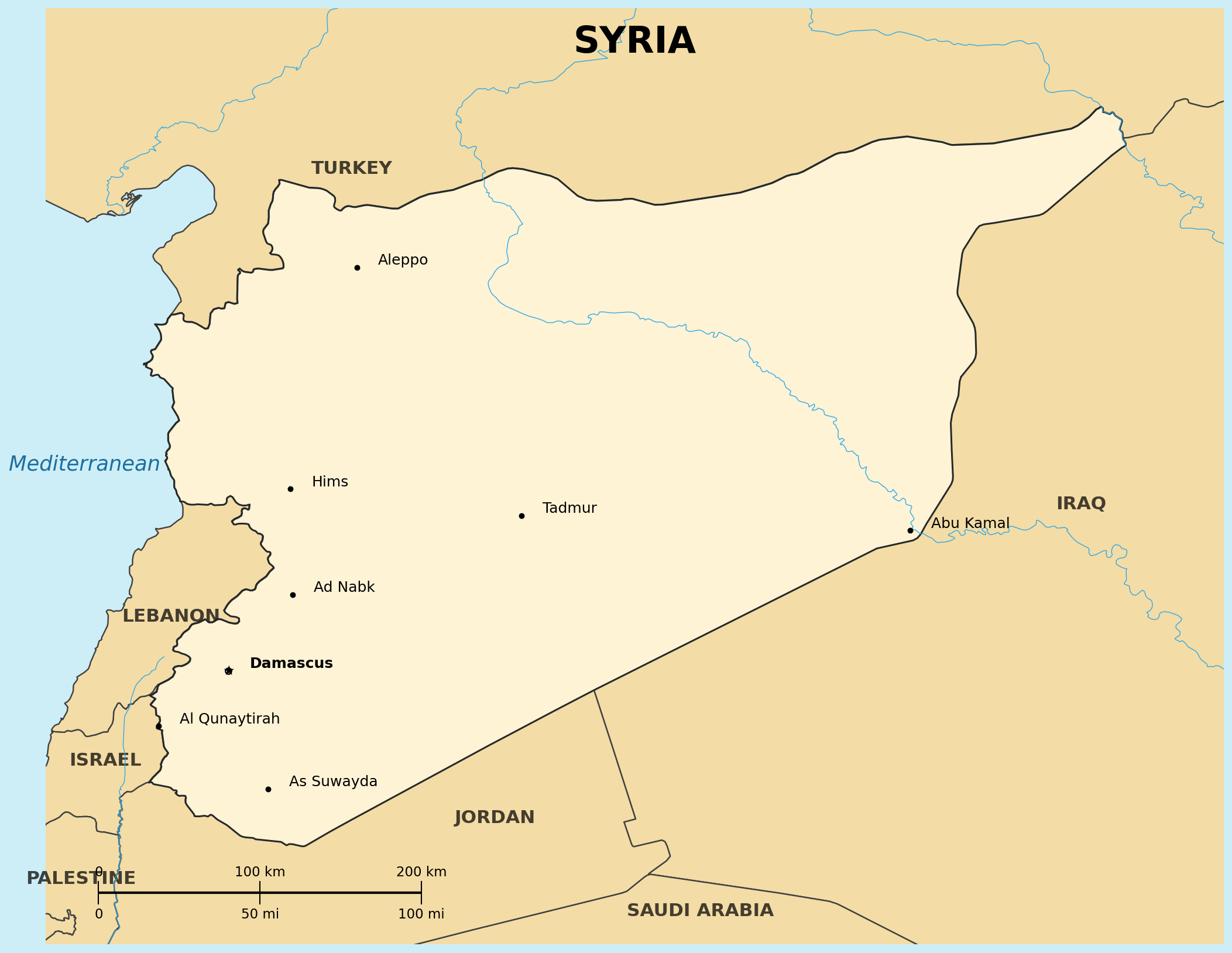
Location: Middle East, bordering the Mediterranean Sea, between Lebanon and Turkey
Map references: Middle East
Area:
total: 187,437 sq km
Land boundaries:
border countries: Iraq, Israel, Jordan, Lebanon, Turkey
Administrative divisions: 14 provinces (muhafazat), including Damascus, Aleppo, Homs, Latakia, and others
| People |
Population: 24,261,882-26,019,711 (2025 est.; figures vary given large refugee/displacement flows from the civil war)
Nationality:
noun/adjective: Syrian(s)
Ethnic groups: Arab ~50%, Alawite ~15%, Kurd ~10%, Levantine ~10%, other ~15% (Druze, Ismaili, Assyrian, Turkoman, Armenian)
Religions: Muslim 87% (official; Sunni 74%, Alawi/Ismaili/Shia 13%), Christian 10%, Druze 3%; note - the Christian population may be considerably smaller due to displacement during the civil war
Languages: Arabic (official), Kurdish, Armenian, Aramaic, Circassian, French, English
Literacy: total population 94.4% (male 97.2%, female 91.8%) (2021 est.)
| Government |
Country name:
conventional long form: Syrian Arab Republic
conventional short form: Syria
Data code: SY
Government type: in transition; interim authorities established a transitional constitution in March 2025, to remain in effect for up to five years
National capital: Damascus
Executive branch: Ahmad al-SHARA'; former President Bashar al-ASAD was overthrown by opposition forces on 8 December 2024, ending more than five decades of Assad family rule
Background: Syria's 2012 constitution was rescinded by the incoming government in January 2025 following the December 2024 overthrow of the Assad government amid the country's long civil war; interim authorities have since worked to establish new governing institutions, and reconstruction and reconciliation processes remain ongoing
| Economy |
Economy - overview: lower-income, developing economy significantly damaged by over a decade of civil war; economy showing signs of recovery amid political transition, though poverty remains extremely widespread
GDP (purchasing power parity): $127.5 billion (2026 est.)
GDP - real growth rate: 12% (2026)
GDP - per capita: $4,772 PPP (2026)
Inflation rate: 14.8% (2025 est.)
Unemployment rate: 14% (2026)
Labor force: 8,437,197 (2026)
Population below poverty line: 90.5% (2026 est.)
Industries: petroleum, textiles, food processing, beverages, tobacco, phosphate rock mining, cement, car assembly
Exports: $1.5 billion (2026); olive oil, spices, barley, nuts, cotton, tomatoes
Currency: Syrian pound (SYP)
| Transnational Issues |
Trafficking in persons - tier rating: Tier 3 (2025)