

About Tunisia
Arabic - the official language and one of the languages of commerce, spoken by over 99% of the population.
French - despite having no official status, plays a major role in the country and is spoken by about two-thirds of the population, particularly in commerce.
Tamazight (Berber) is also spoken by a small minority.
Arabic is the sole official language of Tunisia.
| Geography |
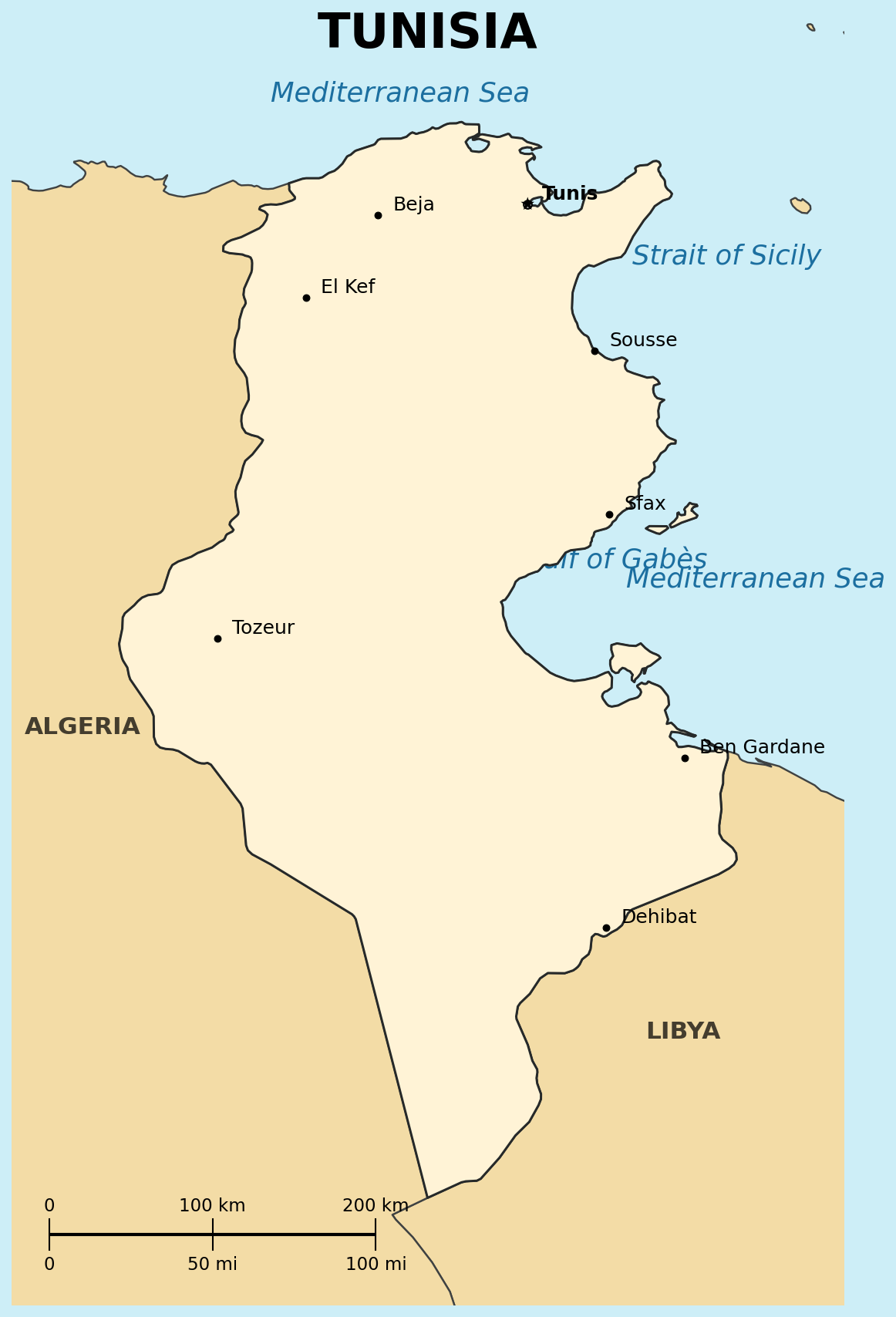
Location: Northern Africa, bordering the Mediterranean Sea, between Algeria and Libya
Map references: Africa
Area:
total: 163,610 sq km
Land boundaries:
border countries: Algeria, Libya
| People |
Population: 11.9-12.4 million (2022-2025 est.)
Age structure:
0-14 years: 24.4-25.28%
15-64 years: 65.2%
65 years and over: 8.86-10.4%
Median age: 34.1 years (2025 est.)
Life expectancy at birth: total population 76.82 years (male 75.14, female 78.6)
Infant mortality rate: 11.87 deaths/1,000 live births
Nationality:
noun/adjective: Tunisian(s)
Ethnic groups: Arab or Berber ancestry over 98%, European descent about 2%
Religions: Muslim (official; Sunni) 99%, other (Christian, Jewish, Shia Muslim, Baha'i) less than 1%
Languages: Arabic (official, language of commerce), French (commerce, no official status but spoken by about two-thirds of the population), Tamazight
Literacy: total population 86.2% (male 92.7%, female 80.1%) (2023 est.)
Population distribution: overwhelming majority located in the northern half of the country; the south remains largely underpopulated
| Government |
Country name:
conventional long form: Republic of Tunisia
conventional short form: Tunisia
Data code: TS
Government type: presidential republic
National capital: Tunis
Executive branch:
chief of state: President Kais Saied (since 2019)
Background: the birthplace of the Arab Spring in 2010-2011, Tunisia was long considered the region's sole democratic survivor with the strongest women's rights tradition in the region since the 1950s; Beji Caid Essebsi was elected as the first president under the country's post-revolution constitution, and after his death in office in 2019, Kais Saied was elected; in 2021 Saied used exceptional constitutional powers to dismiss the prime minister and suspend the legislature; Tunisians approved a new constitution by referendum in 2022, expanding presidential powers and creating a new bicameral legislature, a shift widely characterized as a democratic backslide
| Economy |
Economy - overview: lower-middle-income North African economy; olive oil (a top world exporter), textiles, auto components, and phosphates earn foreign exchange alongside tourism; chronic fiscal crises, debt-rating downgrades, and stalled IMF talks define a precarious economic balance; emigration of graduates and doctors has accelerated in recent years
GDP (purchasing power parity): $178.28-193.55 billion (2024-2026 est.)
GDP - real growth rate: 2.5% (2025)
GDP - per capita: $15,456 PPP (2026 est.)
Inflation rate: 6.53-7.2% (2022-2024)
Unemployment rate: 15.1-16.3% (2024-2025)
Population below poverty line: 15.2% (2015)
Currency: Tunisian dinar (TND)
| Military |
Military branches: Tunisian Armed Forces (Forces Armees Tunisiennes, FAT): Tunisian Army (includes Air Defense Force), Tunisian Navy, Tunisia Air Force; Ministry of Interior: Internal Security Forces (National Police, National Guard) (2025)
| Transnational Issues |
Trafficking in persons - tier rating: Tier 2 Watch List (2025)