
About Turkey
Turkish - the official language, spoken by the vast majority of the population.
Kurdish - spoken by the Kurdish minority (~19% of the population).
Other minority languages are also spoken across the country.
Turkish is the sole official language of Turkey (Turkiye).
| Geography |
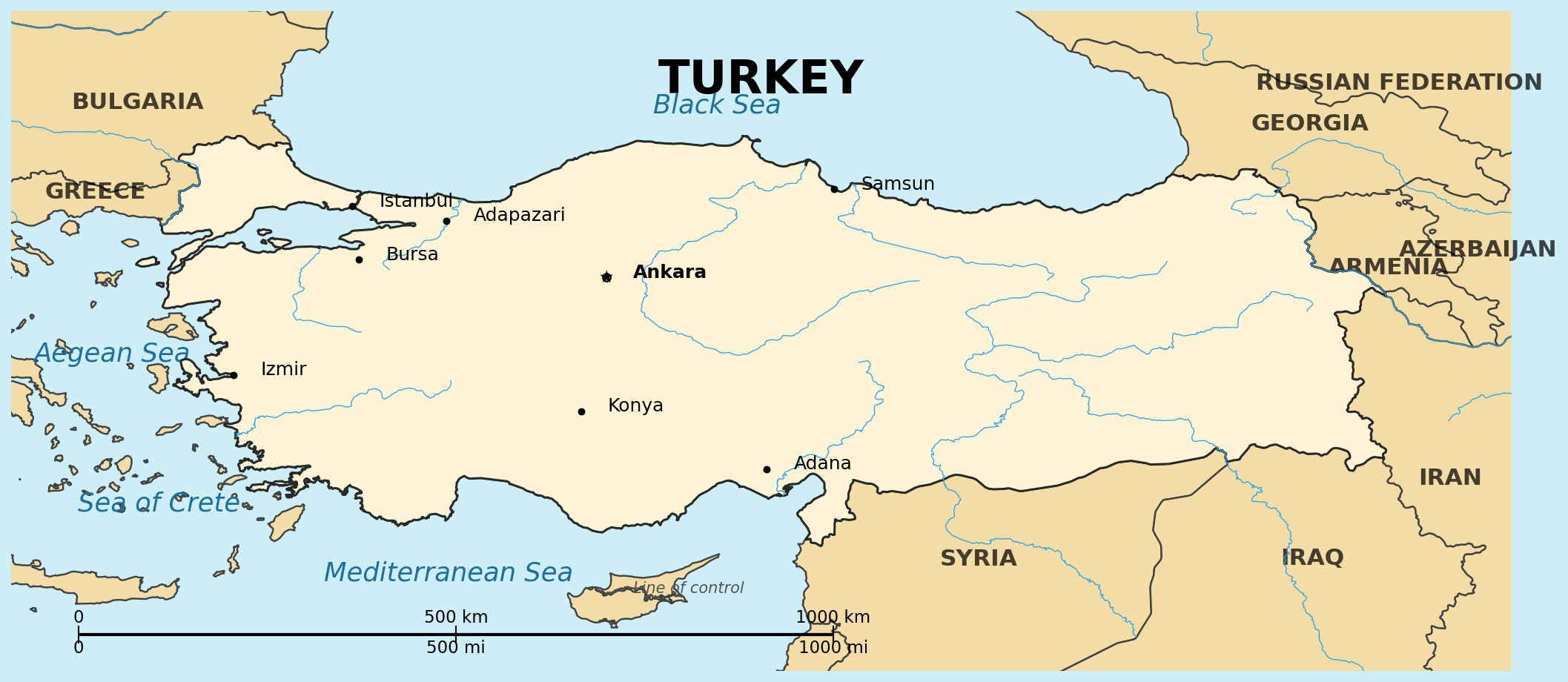
Location: a transcontinental country located primarily on the Anatolian peninsula in Western Asia, with a smaller region (Eastern Thrace) in Southeast Europe; bordering the Black Sea, the Aegean Sea, and the Mediterranean Sea
Map references: Middle East
Area:
total: 783,562 sq km
Land boundaries:
border countries: Armenia, Azerbaijan, Bulgaria, Georgia, Greece, Iran, Iraq, Syria
Geography - note: the most densely populated area is around the Bosporus in the northwest, where about 20% of the population lives in Istanbul; with the exception of Ankara, urban centers remain small and scattered throughout Anatolia's interior
| People |
Population: 84,119,531-86,092,168 (2024-2025 est.)
Nationality:
noun/adjective: Turk(s)/Turkish
Ethnic groups: Turkish 70-75%, Kurdish 19%, other minorities 6-11% (2016 est.)
Religions: Muslim 99.8% (predominantly Sunni)
Languages: Turkish (official), Kurdish, other minority languages
Literacy: total population 97.3% (male 99.3%, female 95.3%) (2021 est.)
Major urban areas: 15.848 million Istanbul, 5.397 million Ankara (capital), 3.088 million Izmir, 2.086 million Bursa (2023)
| Government |
Country name:
conventional long form: Republic of Turkey
conventional short form: Turkey
local long form: Turkiye Cumhuriyeti
local short form: Turkiye; note - "Turkiye" is an approved English short-form name for Turkey
Data code: TU
Government type: presidential republic
National capital: Ankara
Executive branch:
chief of state and head of government: President Recep Tayyip ERDOGAN (chief of state since 2014, head of government since the 2018 transition to the presidential system)
Background: modern Turkey was founded in 1923 from the remnants of the Ottoman Empire by Mustafa KEMAL (Ataturk, "Father of the Turks"); one-party rule ended in 1950, with periods of instability and military coups since (1960, 1971, 1980, 1997, and an attempted coup in 2016); Turkey joined the UN in 1945 and NATO in 1952
| Economy |
Economy - overview: upper-middle-income, diversified, industrializing economy that maintains a large agricultural base; key sectors include manufacturing, energy, tourism, and construction; has experienced persistently high inflation in recent years
GDP (purchasing power parity): $4.03 trillion (2026 est.)
GDP - real growth rate: 3.6% (2025)
GDP - per capita: $46,670 PPP (2026 est.)
Inflation rate: 31% (2025, official TUIK figure; independent estimates considerably higher)
Unemployment rate: 8.5% (2025 est.)
Labor force: 34,796,000 (2023); about 3.2 million Turks also work abroad
Population below poverty line: 14.4% (2022)
Natural resources: coal, iron ore, copper, gold, arable land, hydropower potential
Currency: Turkish lira (TRY)
| Military |
Military service age and obligation: compulsory for Turkish men aged 20-41 for 6-12 months; men and women may volunteer (2025)