
About Albania
Albanian - spoken by ~98.8% of the population (official language, derived from the Tosk dialect). It is understood and spoken by nearly the entire population.
Greek is spoken by a small minority (~0.5%), mainly in the south near the Greek border.
Other minority languages include Macedonian, Romani, Vlach, Turkish, Italian, and Serbo-Croatian.
Albanian is the sole official language of Albania.
| Geography |
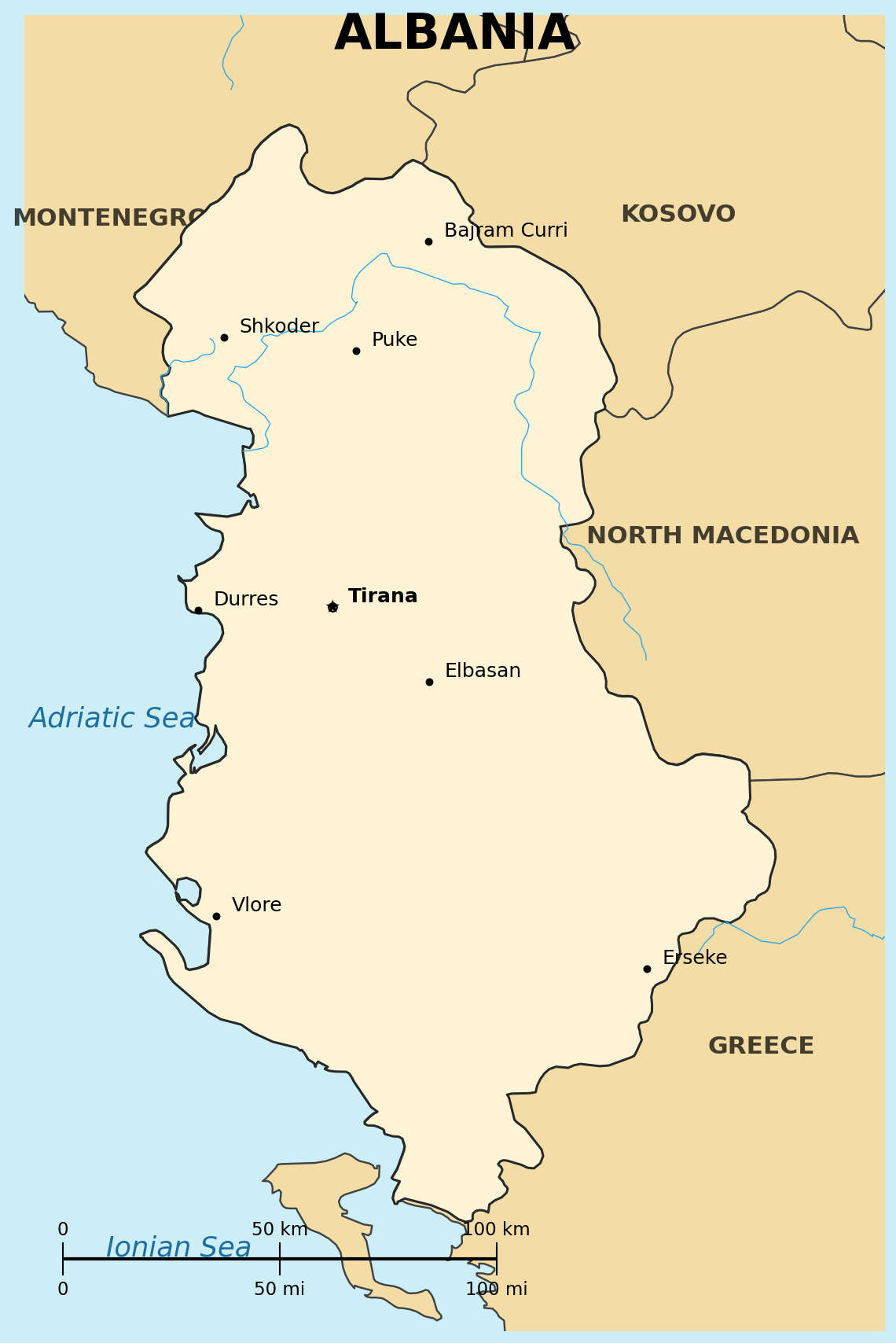
Location: Southeastern Europe, on the Adriatic Sea, between Greece and Montenegro
Map references: Europe
Area:
total: 28,748 sq km
land: 27,398 sq km
water: 1,350 sq km
Land boundaries:
border countries: Greece, Montenegro, North Macedonia, Kosovo
Coastline: 362 km
Climate: mild temperate; cool, cloudy, wet winters; hot, clear, dry summers; interior is cooler and wetter
Terrain: mostly mountains and hills; small plains along coast
Natural resources: petroleum, natural gas, coal, bauxite, chromite, copper, iron ore, nickel, salt, timber, hydropower, arable land
| People |
Population: 2,551,837 (2025 est.)
Population growth rate: declining (net outmigration; more Albanians live abroad than in Albania)
Life expectancy at birth: total population approximately 79 years
Nationality:
noun: Albanian(s)
adjective: Albanian
Ethnic groups: Albanian 82.6%, Greek 0.9%, other 1% (including Vlach, Romani, Macedonian, Montenegrin, and Egyptian), unspecified 15.5% (2011 est.)
Religions: Muslim 56.7%, Roman Catholic 10%, Orthodox 6.8%, atheist 2.5%, Bektashi (a Sufi order) 2.1%, other 5.7%, unspecified 16.2% (2011 est.)
Languages: Albanian 98.8% (official, derived from Tosk dialect), Greek 0.5%, other 0.6% (including Macedonian, Romani, Vlach, Turkish, Italian, and Serbo-Croatian), unspecified 0.1% (2011 est.)
Literacy:
total population: 97.7%
male: 98.2%
female: 97.2% (2023 est.)
| Government |
Country name:
conventional short form: Albania
local short form: Shqiperia
Data code: AL
Government type: parliamentary republic
National capital: Tirana (Tirane)
Independence: 28 November 1912 (from the Ottoman Empire)
| Economy |
Economy - overview: developing, upper-middle income economy; EU candidate country; tourism (the "Albanian Riviera"), remittances, construction, and textiles are key growth engines; close trade and banking ties with Greece and Italy create some vulnerability to eurozone conditions
GDP (purchasing power parity): $66.29 billion (2026 est.)
GDP - real growth rate: 3.8% (2025 est.)
GDP - per capita: $25,250 PPP (2026 est.)
Inflation rate: 1.9% (February 2025)
Unemployment rate: 10.9% (2025 est.)
Remittances: 8.4% of GDP (2024 est.)
Currency: lek (ALL)
| Communications |
Internet country code: .al
Broadcast media: over 65 TV stations including several national broadcasters; 2 public and roughly 78 private radio stations; cable and digital TV widely available (2024)
| Military |
Military branches: Republic of Albania Armed Forces (Land Forces, Naval Force including Coast Guard, Air Forces); Ministry of Interior forces (Guard of the Republic, State Police) (2025)
Military - note: Albania joined NATO in 2009; small, lightly armed force undergoing NATO-standard modernization; has contributed to NATO, EU, and UN peacekeeping missions