

About Belarus
Russian - spoken by ~71.4% of the population as a first/dominant language, and an official language.
Belarusian - spoken by ~26% of the population as a first language, and also an official language, though Russian dominates in daily practical use.
Small Polish- and Ukrainian-speaking minorities also exist.
Both Russian and Belarusian are official languages of Belarus.
| Geography |
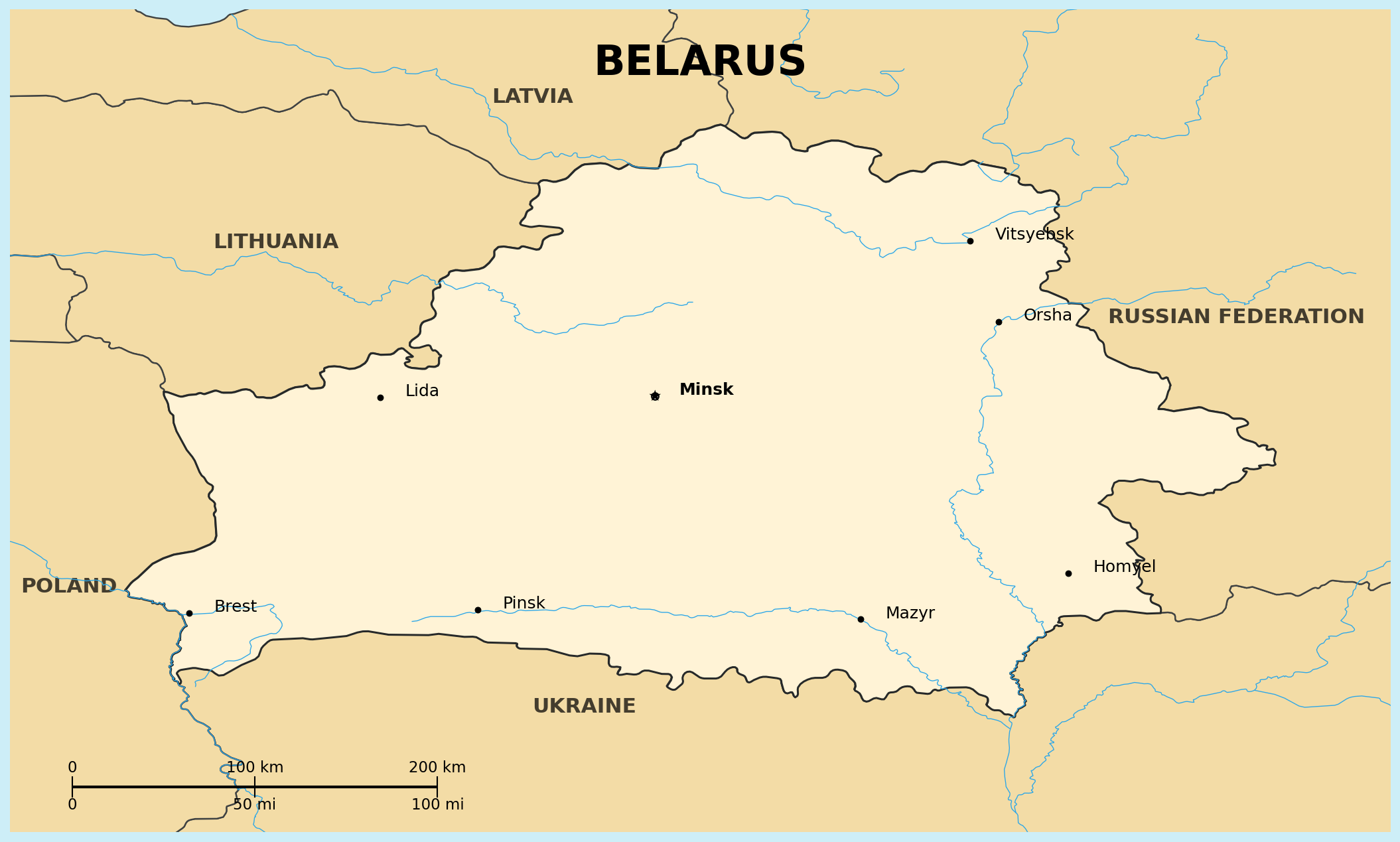
Location: Eastern Europe, east of Poland
Map references: Europe
Area:
total: 207,600 sq km
Land boundaries:
border countries: Latvia, Lithuania, Poland, Russia, Ukraine
Coastline: 0 km (landlocked)
Climate: cold winters, cool and moist summers; transitional between continental and maritime
Terrain: generally flat, with much marshland; glacial scouring accounts for the flatness of Belarusian terrain and for its roughly 11,000 lakes
Natural resources: forests, peat deposits, small quantities of oil and natural gas, granite, dolomite (limestone), marl, chalk, sand, gravel, clay
| People |
Population: 9,460,972 (2025 est.)
Population distribution: fairly even distribution throughout most of the country, with urban areas attracting larger and denser populations
Life expectancy at birth: total population approximately 74.2 years (2025 est.)
Nationality:
noun: Belarusian(s)
adjective: Belarusian
Ethnic groups: Belarusian 83.7%, Russian 8.3%, Polish 3.1%, Ukrainian 1.7%, other 2.4%, unspecified 0.9% (2009 est.)
Religions: predominantly Orthodox Christian, with Roman Catholic and Belarusian Greek Catholic minorities
Languages: Russian (official) 71.4%, Belarusian (official) 26%, other 0.3% (small Polish- and Ukrainian-speaking minorities), unspecified 2.3% (2019 est.)
| Government |
Country name:
conventional short form: Belarus
local short form: Belarus
Data code: BO
Government type: presidential republic (in name; power heavily concentrated in the presidency)
National capital: Minsk
Independence: 25 August 1991 (from the Soviet Union)
| Economy |
Economy - overview: heavily state-controlled economy with close economic and political ties to Russia; historically reliant on discounted Russian energy; facing growing public debt, currency pressures, and international sanctions
GDP (purchasing power parity): $319.505 billion (2026 est.)
GDP - real growth rate: 1.1% (2025 est.)
GDP - per capita: $35,338 PPP (2026 est.)
Inflation rate: 6.3% (2024 est.)
Unemployment rate: 3.4% (2025 est.)
Labor force: 4,835,456 (2024)
Population below poverty line: 5.6% (2018)
Industries: metal-cutting machine tools, tractors, trucks, earthmovers, motorcycles, synthetic fibers, fertilizer, textiles, refrigerators, washing machines and other household appliances
Agriculture - products: grain, potatoes, vegetables, sugar beets, flax, beef, milk
Currency: Belarusian ruble (BYN)
| Communications |
Broadcast media: 7 state-controlled national TV channels; Polish and Russian TV broadcasts available in some areas; state-run Belarusian Radio operates 5 national networks and an external service (2019)
| Military |
Military branches: Belarus Armed Forces: Army, Air and Air Defense Force, Special Operations Force, Special Forces (2025)
Military service age and obligation: 18-27 years of age for compulsory military or alternative service; conscript obligation 12-18 months, 24-36 months for alternative service
| Transnational Issues |
Trafficking in persons - tier rating: Tier 3 (2025) - Belarus does not fully meet the minimum standards for the elimination of trafficking and is not making significant efforts to do so