

About Tuvalu
Tuvaluan - an official language, a Polynesian language closely related to Samoan, spoken by the majority of the population.
English - also official, widely used in government and education.
Tuvaluan and English are both official languages of Tuvalu.
| Geography |
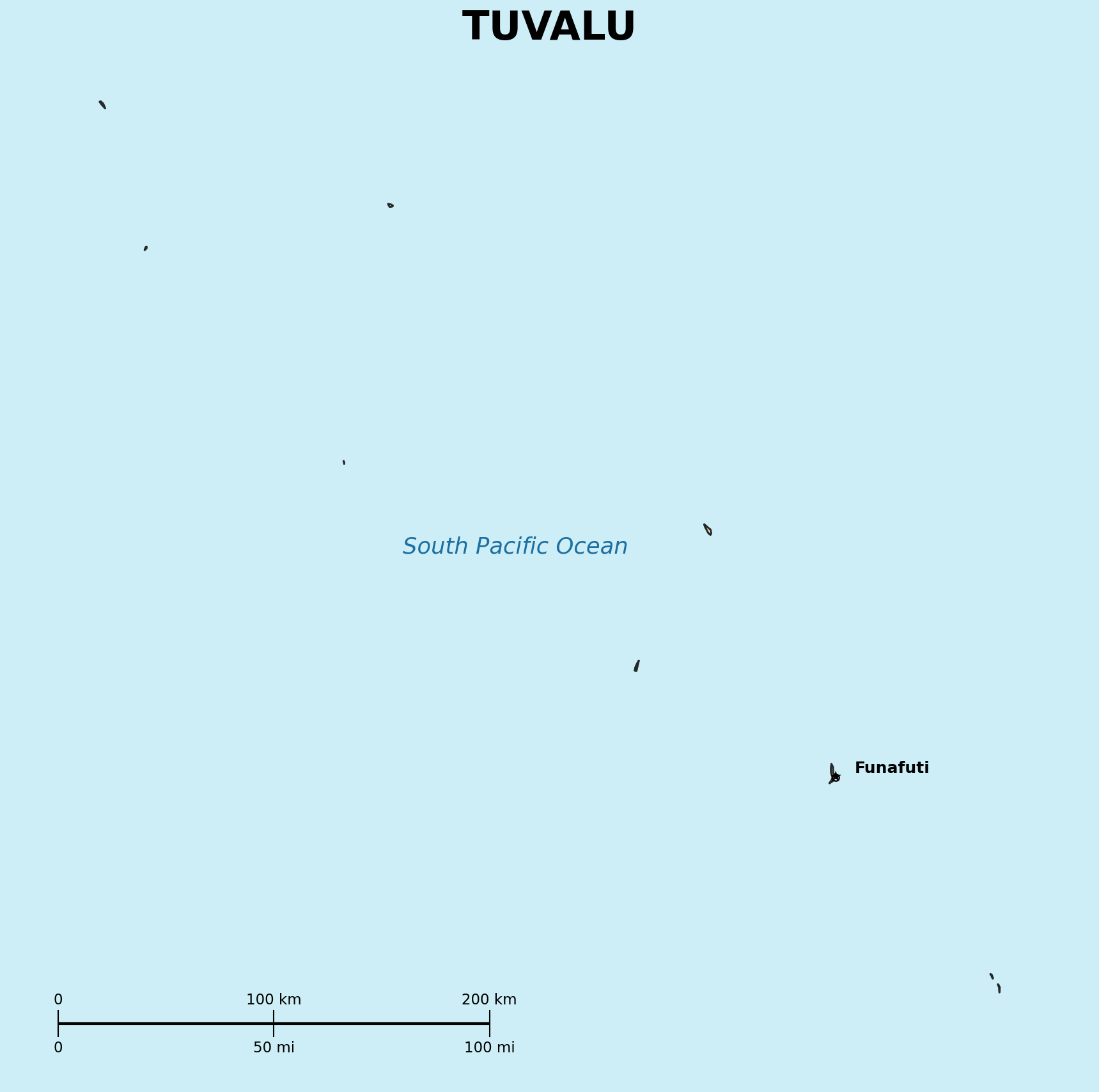
Location: Oceania, island group in the South Pacific Ocean, midway between Hawaii and Australia; consists of four reef islands and five atolls
Map references: Oceania
Area:
total: 26 sq km; the fourth-smallest country in the world
Geography - note: one of the most vulnerable countries in the world to climate change and rising sea levels
| People |
Population: 9,700-11,824 (varies by source; 2025 est.)
Nationality:
noun/adjective: Tuvaluan(s)
Ethnic groups: predominantly Polynesian; the first settlers came from Samoa, Tokelau, Tonga, and/or Uvea roughly 2,000 years ago; Nui atoll has a notable Micronesian influence
Religions: Protestant 92.7% (Congregational Christian Church of Tuvalu 85.9%, Brethren, Seventh Day Adventist, Assemblies of God), Baha'i 1.5%, Jehovah's Witness 1.5%, other 3.9% (2017 est.)
Languages: Tuvaluan (official), English (official)
Literacy: total population 100% (2022 est.)
| Government |
Country name:
conventional short form: Tuvalu; the name means "group of eight" or "eight standing together" in the local language; formerly known as the Ellice Islands
Data code: TV
Government type: parliamentary constitutional monarchy; a Commonwealth realm
National capital: Funafuti (de facto capital at the village of Vaiaku, on Fongafale islet)
Independence: 1 October 1978 (from the UK)
Background: voyagers from Samoa or Tonga first populated Tuvalu around 2,000 years ago, providing a stepping-stone for Polynesian communities that later settled in Melanesia and Micronesia; European ships visited in the late 1700s and early 1800s, and the islands were named the Ellice Islands in 1819; as part of the 2024 Falepili Union treaty, Australia committed to assist Tuvalu in response to major natural disasters, health pandemics, or military aggression, while Tuvalu agreed to consult Australia on security and defense arrangements with other states
| Economy |
Economy - overview: upper-middle-income Pacific island economy; extremely environmentally fragile; currency pegged to the Australian dollar; heavily dependent on fishing licensing revenue, remittances, foreign aid, and licensing income from the ".tv" internet domain; subsistence agrarian sector
GDP (purchasing power parity): $65-69 million (2025 est.)
GDP - real growth rate: 2.8-3% (2025)
GDP - per capita: $6,543-7,006 (2025 est.)
Inflation rate: 1.5% (2025f)
Currency: Tuvaluan dollar and Australian dollar (pegged 1:1)
| Military |
Military - note: no standing military forces; has a "shiprider" agreement with the US, allowing local maritime law enforcement officers to embark on US Coast Guard and Navy vessels to enforce laws within Tuvalu's exclusive economic zone (2025)