

About Ukraine
Ukrainian - the sole official language, spoken by ~67.5% of the population; a member of the East Slavic language group.
Russian - a regional language, spoken by ~29.6%, particularly in the eastern regions.
Crimean Tatar, Moldovan/Romanian, and Hungarian are also spoken by smaller communities.
Ukrainian is the sole official language of Ukraine.
| Geography |
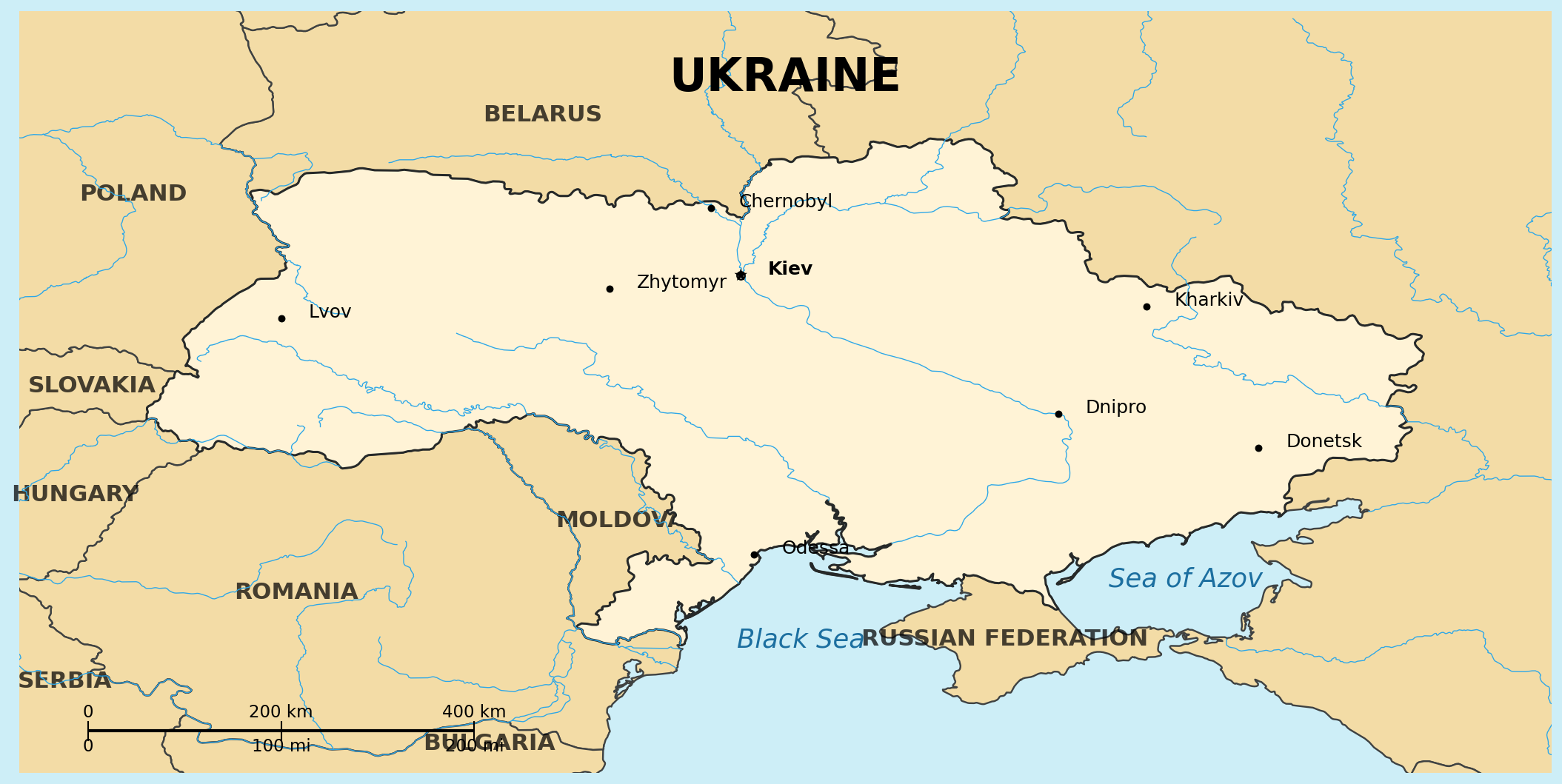
Location: Eastern Europe, bordering the Black Sea, between Poland, Romania, and Moldova to the west and Russia to the east
Map references: Europe
Land boundaries:
border countries: Belarus, Hungary, Moldova, Poland, Romania, Russia, Slovakia
Geography - note: strategic position at the crossroads between Europe and Asia; the second-largest country in Europe after Russia; often called the "breadbasket of Europe" for its fertile agricultural land
| People |
Population: 32.9-40.1 million (figures vary significantly and remain highly uncertain due to the ongoing war, mass displacement, and territory not under government control; 2024-2025 est.); researchers project the population could fall to around 35 million by 2040, roughly 20% below pre-war 2021 levels of 42.8 million, given continued conflict and outmigration
Nationality:
noun/adjective: Ukrainian(s)
Ethnic groups: majority ethnic Ukrainian, with significant Russian, Belarusian, and Crimean Tatar minorities
Languages: Ukrainian (official) 67.5%, Russian (regional language) 29.6%, other (Crimean Tatar, Moldovan/Romanian, Hungarian) 2.9% (2001 est.); note: the ongoing war with Russia has shifted significant portions of the population, particularly in the east, and has accelerated a wartime shift toward Ukrainian-language use
Population distribution: more than two-thirds of the population lives in towns and urban areas
| Government |
Country name:
conventional short form: Ukraine
Data code: UP
Government type: semi-presidential republic; under martial law since Russia's full-scale invasion in February 2022
National capital: Kyiv
Executive branch:
chief of state: President Volodymyr Zelenskyy (since 2019)
Background: Russia launched a full-scale invasion of Ukraine on 24 February 2022, following its 2014 annexation of Crimea and support for separatists in the eastern Donbas region; the war has caused massive civilian and military casualties, widespread destruction, and the largest refugee crisis in Europe since WWII, with millions of Ukrainians displaced internally and abroad; fighting continues along an extensive front line as of early 2026
| Economy |
Economy - overview: upper-middle-income economy severely disrupted by the ongoing war with Russia; massive infrastructure destruction, population displacement, and territorial loss have devastated agricultural, industrial, and energy sectors; substantial international financial and military support sustains the economy; historically a major global grain and steel exporter
GDP (purchasing power parity): $830.05 billion (2025f)
GDP - real growth rate: 4.5% (2026f)
GDP - per capita: $25,259 PPP (2025f)
Inflation rate: 12.6% (2025 est.)
Unemployment rate: 20.4% (2025 est.)
Currency: Ukrainian hryvnia (UAH)
| Military |
Military branches: Armed Forces of Ukraine (AFU): Ground Forces, Naval Forces, Air Forces, Air Assault Forces, Marine Corps, Special Operations Forces, Unmanned Systems Forces, Territorial Defense Forces (Reserves); Ministry of Internal Affairs: National Guard, State Border Guard Service, National Police (2025)
Military - note: the Armed Forces of Ukraine have been engaged in large-scale, continuous combat operations against invading Russian forces since February 2022, receiving substantial military assistance including weapons, training, and intelligence support from the US, EU, NATO members, and other partners (2025)