

About United Arab Emirates
Arabic - the sole official language.
English - widely used as a lingua franca, particularly given that immigrants make up nearly 88% of the population.
Hindi, Malayalam, Urdu, Pashto, Tagalog, and Persian are also widely spoken, reflecting the UAE's large South Asian and Filipino expatriate communities.
Arabic is the sole official language of the UAE.
| Geography |
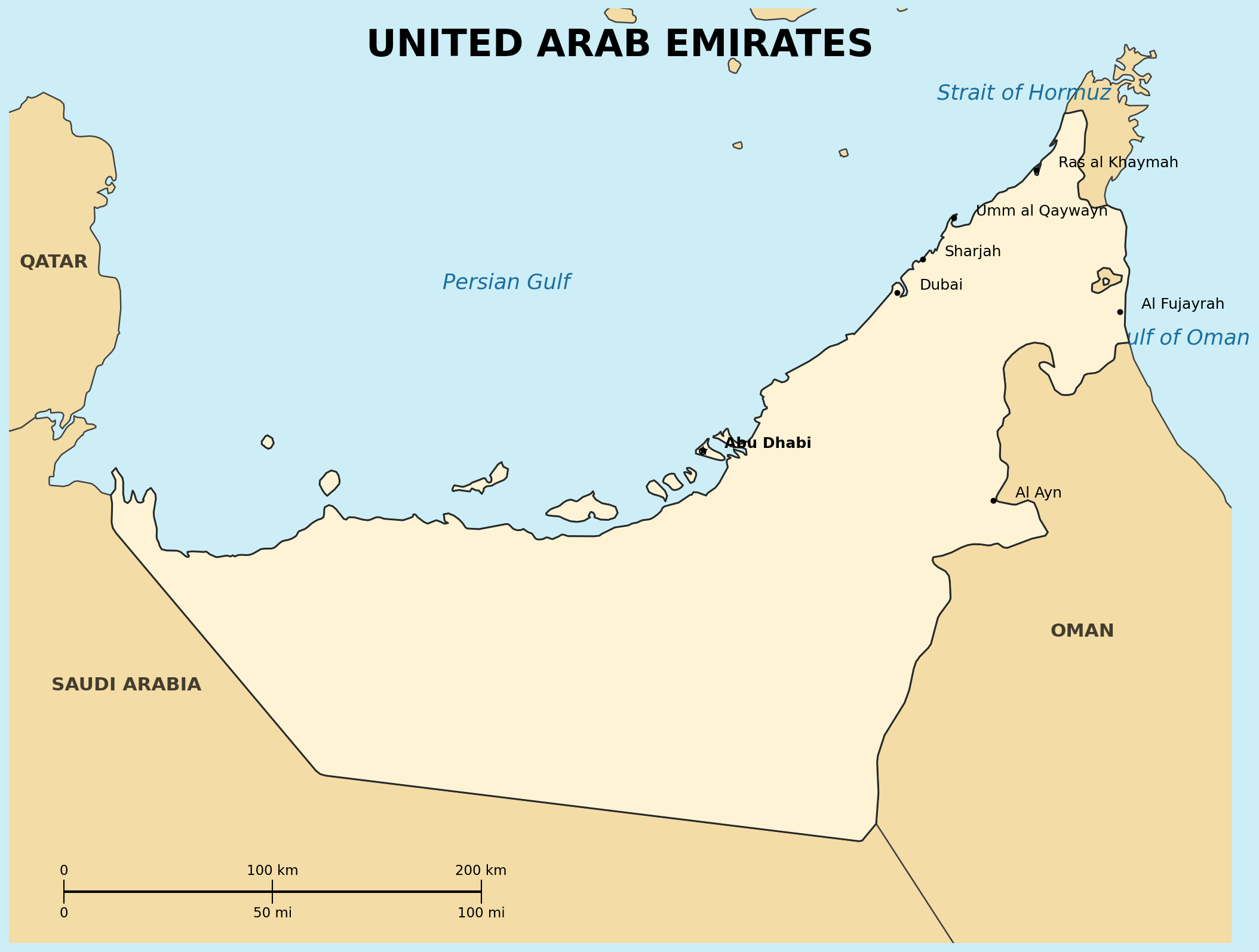
Location: Middle East, bordering the Persian Gulf and Gulf of Oman, on the Musandam Peninsula, between Oman and Saudi Arabia
Map references: Middle East
Area:
total: 83,600 sq km
Land boundaries:
border countries: Oman, Saudi Arabia
Geography - note: composed of seven emirates - Abu Dhabi, Dubai, Sharjah, Ajman, Umm al-Quwain, Ras al-Khaimah, and Fujairah; population heavily concentrated in the northeast on the Musandam Peninsula, with Abu Dhabi, Dubai, and Sharjah home to nearly 85% of the population
| People |
Population: 9.4-10.1 million (2022-2025 est.); immigrants make up about 88% of the population, among the highest percentages of expatriates in the world after Vatican City
Nationality:
noun/adjective: Emirati(s)
Ethnic groups: Emirati 11.6%, South Asian 59.4% (Indian 38.2%, Bangladeshi 9.5%, Pakistani 9.4%, other 2.3%), Egyptian 10.2%, Filipino 6.1%, other 12.8% (2015 est.)
Religions: Muslim (official) 74.5% (Sunni 63.3%, Shia 6.7%, other 4.4%), Christian 12.9%, Hindu 6.2%, Buddhist 3.2%, agnostic 1.3%, other 1.9% (2020 est.)
Languages: Arabic (official), English, Hindi, Malayalam, Urdu, Pashto, Tagalog, Persian
| Government |
Country name:
conventional short form: United Arab Emirates (UAE)
Data code: AE
Government type: federation of monarchies; a federal presidential elective monarchy
National capital: Abu Dhabi
Independence: 2 December 1971 (from the UK)
Background: the Trucial States of the Persian Gulf coast granted the UK control of their defense and foreign affairs under 19th-century treaties; in 1971, six emirates - Abu Dhabi, Ajman, Al Fujayrah, Ash Shariqah, Dubayy, and Umm al Qaywayn - merged to form the UAE, joined in 1972 by Ras al Khaymah
| Economy |
Economy - overview: high-income, open economy with a high per capita income and sizable annual trade surplus; successful diversification has reduced oil and gas' share of GDP to about 30%; since discovering oil nearly 60 years ago, the country transformed from small desert principalities into a modern state with a high standard of living; strong finance, real estate, tourism, and logistics sectors
GDP (purchasing power parity): $908.9 billion (2025 est.)
GDP - real growth rate: 4.01% (2024f)
GDP - per capita: $82,000 PPP (2025 est.) - among the highest in the world
Inflation rate: 1.62% (2023 est.)
Unemployment rate: 2.2% (2025 est.)
Industries: petroleum, petrochemicals, fishing, aluminum, cement, fertilizer, ship repair, construction materials, handicrafts, textiles
Currency: Emirati dirham (AED)
| Communications |
Space: ambitious, growing national space program; UAE Space Agency (2014) and Mohammed bin Rashid Space Centre (2006); became the first Arab country to place a probe (Al Amal/Hope) in Mars orbit in 2021; signed the US-led Artemis Accords in 2020; sent its first astronaut to the ISS in 2019; continues developing domestically produced remote sensing and Earth imaging satellites (2025)