
About Uruguay
Spanish - the sole official language; Rioplatense is the most widely spoken dialect.
Near the border with Brazil, a mixed Spanish-Portuguese dialect known as "Brazilero" (Portunol) is also spoken.
Spanish is the sole official language of Uruguay.
| Geography |
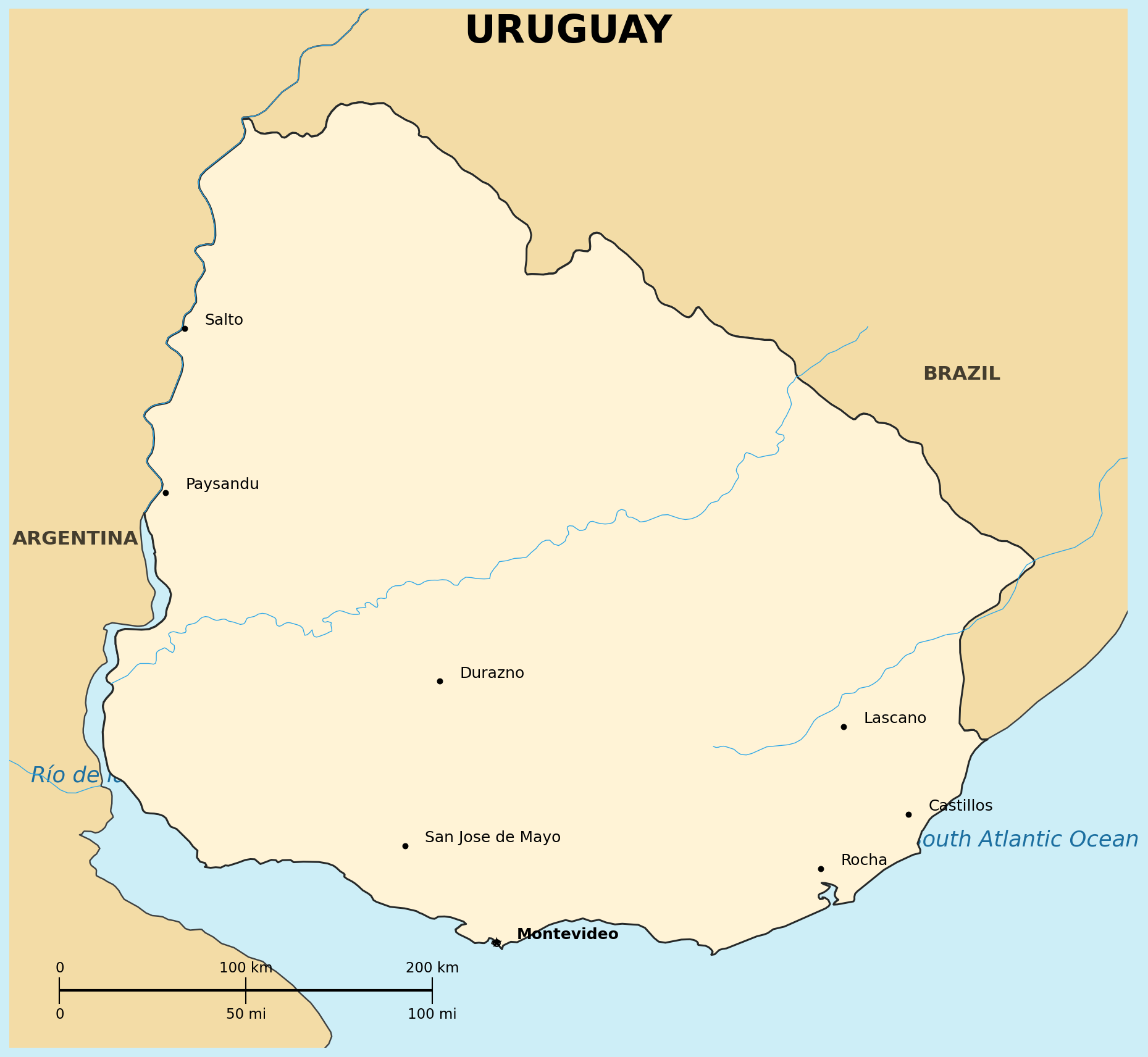
Location: Southern South America, bordering the South Atlantic Ocean, between Argentina and Brazil
Map references: South America
Area:
total: 176,215-177,015 sq km; second-smallest South American country after Suriname
Land boundaries:
border countries: Argentina, Brazil
Terrain: mostly low-lying grassland (about three-quarters of the country), ideal for cattle and sheep; absence of mountains leaves the country vulnerable to rapid weather changes
| People |
Population: 3.38-3.45 million (2025 est.)
Life expectancy at birth: male 74.3 years, female 80.6 years (2025)
Infant mortality rate: 6.9 deaths/1,000 live births (2025 est.)
Nationality:
noun/adjective: Uruguayan(s)
Ethnic groups: White 87.7%, Black 4.6%, Indigenous 2.4%, other 0.3%, none/unspecified 5% (2011 est.); most descended from Spanish settlers, with smaller Italian, Portuguese, French, English, and German populations
Languages: Spanish (official, Rioplatense most widely spoken dialect)
Population distribution: resides mostly in the southern half of the country; about 80-85.6% urban; nearly half the population lives in and around the capital, Montevideo
| Government |
Country name:
conventional long form: Oriental Republic of Uruguay
conventional short form: Uruguay
Data code: UY
Government type: presidential republic with two legislative houses (Senate, House of Representatives)
National capital: Montevideo; founded by the Spanish in 1726 as a military stronghold, it soon became an important commercial center due to its natural harbor
Independence: 25 August 1825 (from Brazil); secured 1828 after a three-year struggle
Background: Argentina initially claimed Uruguay, but Brazil annexed the country in 1821; the administrations of President Jose Batlle in the early 20th century launched widespread political, social, and economic reforms establishing a statist tradition; a violent Marxist urban guerrilla movement, the Tupamaros, launched in the late 1960s pushed the president to cede control to the military in 1973, though civilian rule was restored later; internationally recognized for progressive social policies, including legalizing same-sex marriage, decriminalizing abortion, and becoming the first country to fully legalize marijuana production, sale, and consumption
| Economy |
Economy - overview: high-income, diversified South American economy; moved beyond traditional reliance on agriculture toward manufacturing, services, and tourism; recognized for political stability and progressive social policy, including a digital nomad visa
GDP (purchasing power parity): $135.8 billion (2026 est.)
GDP - real growth rate: 1.8% (2025-2026f)
GDP - per capita: $39,030 PPP (2026 est.)
Inflation rate: 3.96-5.05% (2024-2025)
Unemployment rate: 7.5-7.8% (2025)
Population below poverty line: 9.1% (2022)
Currency: Uruguayan peso (UYU)
| Military |
Military branches: Armed Forces of Uruguay: National Army, National Navy (includes Coast Guard), Uruguayan Air Force; Ministry of Interior: National Police (2025)
Military - note: participates in UN peacekeeping missions and multinational exercises; traditionally holds security ties with Argentina, Brazil, Peru, and the US, and since 2018 has also signed defense cooperation agreements with China and Russia (2025)