
About Uzbekistan
Uzbek - the sole official language, spoken by ~74.3% of the population; a Turkic language.
Russian - spoken by ~14.2%, a legacy of the Soviet era.
Tajik - spoken by ~4.4%.
In the semi-autonomous Republic of Karakalpakstan, Karakalpak also holds official status alongside Uzbek.
Uzbek is the sole official language of Uzbekistan.
| Geography |
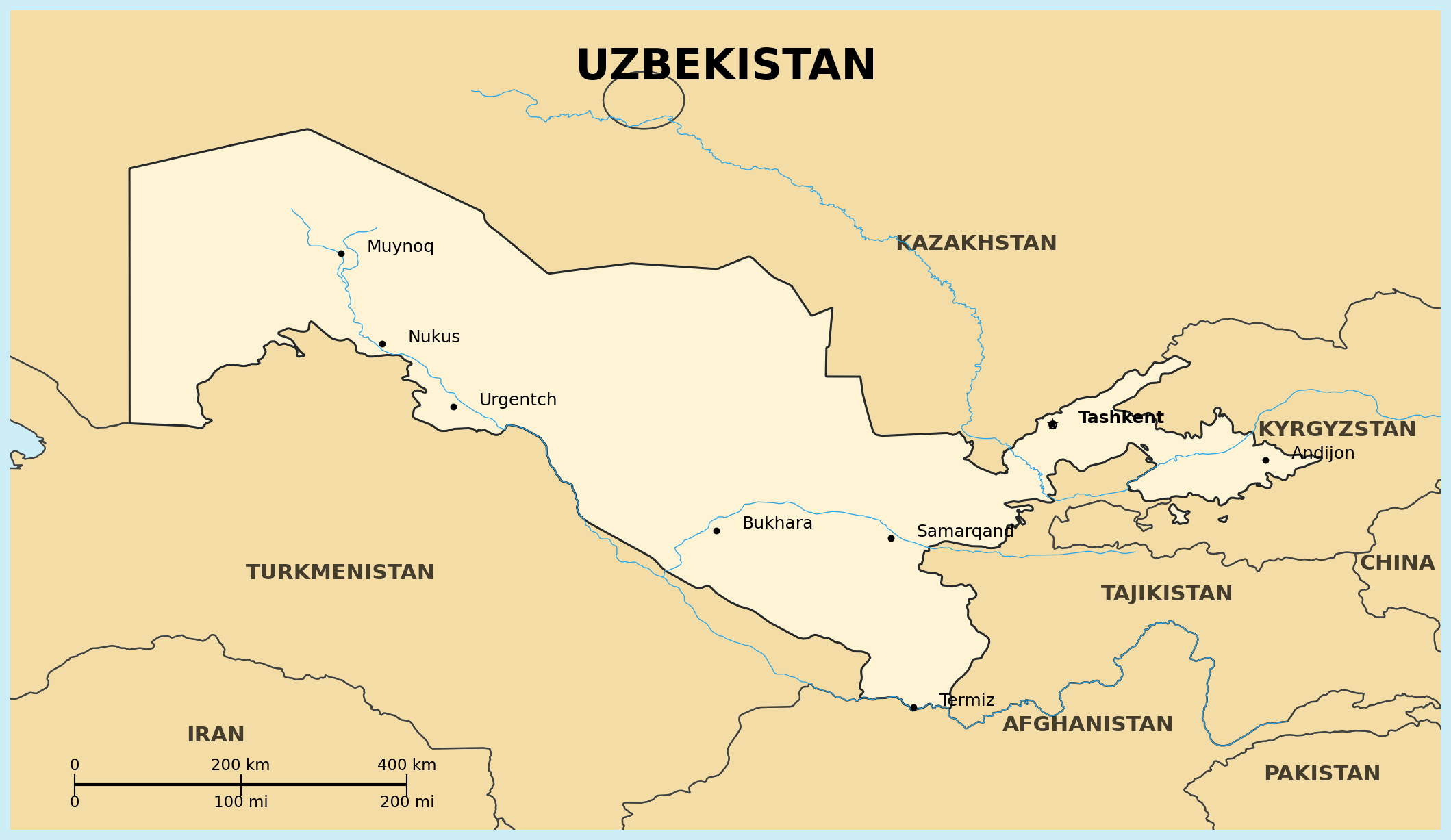
Location: Central Asia, north of Turkmenistan; the geographic and population center of Central Asia
Map references: Central Asia
Land boundaries:
border countries: Afghanistan, Kazakhstan, Kyrgyzstan, Tajikistan, Turkmenistan (borders all four other Central Asian nations)
Geography - note: along with Liechtenstein, one of only two doubly landlocked countries in the world (landlocked and bordered only by other landlocked countries)
| People |
Population: 37-38.3 million (2025-2026 est.); the largest population in Central Asia
Age structure:
0-14 years: 30.1%
65 years and over: 5.3% (2022 est.)
Life expectancy at birth: total population 75.29 years (male 72.27, female 78.5)
Infant mortality rate: 18.98 deaths/1,000 live births
Nationality:
noun/adjective: Uzbekistani(s)/Uzbek(s)
Ethnic groups: Uzbek 83.8%, Tajik 4.8%, Kazakh 2.5%, Russian 2.3%, Karakalpak 2.2%, Tatar 1.5%, other 2.9% (2017 est.)
Religions: predominantly Sunni Muslim
Languages: Uzbek (official) 74.3%, Russian 14.2%, Tajik 4.4%, other 7.1%; Karakalpak also official in the semi-autonomous Republic of Karakalpakstan
Population distribution: most of the population concentrated in the fertile Fergana Valley in the easternmost arm of the country; significant clusters also in the south; central and western deserts sparsely populated
| Government |
Country name:
conventional short form: Uzbekistan
Data code: UZ
Government type: presidential republic
National capital: Tashkent
Independence: 1 September 1991 (from the Soviet Union)
Background: Russia conquered and united the disparate territories of present-day Uzbekistan in the late 19th century; stiff resistance to the Red Army after the Bolshevik Revolution was eventually suppressed, and a socialist republic was established in 1924; during the Soviet era, intensive production of "white gold" (cotton) and grain led to the overuse of agrochemicals and depletion of water supplies, leaving the land degraded and the Aral Sea and certain rivers half-dry; independent since the USSR dissolved in 1991, the country has diversified agricultural production while developing mineral and petroleum export capacity and expanding its manufacturing base, though cotton remains significant to the economy
| Economy |
Economy - overview: lower-middle-income Central Asian economy with the region's most diversified economic base; since 2017 the government has implemented bold reforms to liberalize the economy and strengthen private-sector-led growth; real GDP growth has averaged 6% annually since 2017; pursuing WTO accession, expected to substantially boost GDP and reduce poverty
GDP (purchasing power parity): $552.16 billion (2026f)
GDP - real growth rate: 7.7% (2025)
GDP - per capita: $14,179 PPP (2026f)
Inflation rate: 7.3% (2025)
Unemployment rate: 4.6% (2025 est.)
Population below poverty line: 5.1% (2025 est.)
Currency: Uzbekistani som (UZS)
| Military |
Military - note: the Uzbek Armed Forces use mainly Russian or Soviet-era armaments, with smaller quantities from China, Turkiye, and the US; maintains a small defense industry repairing and maintaining aircraft and armored vehicles, and producing light armored vehicles and drones (2025)