

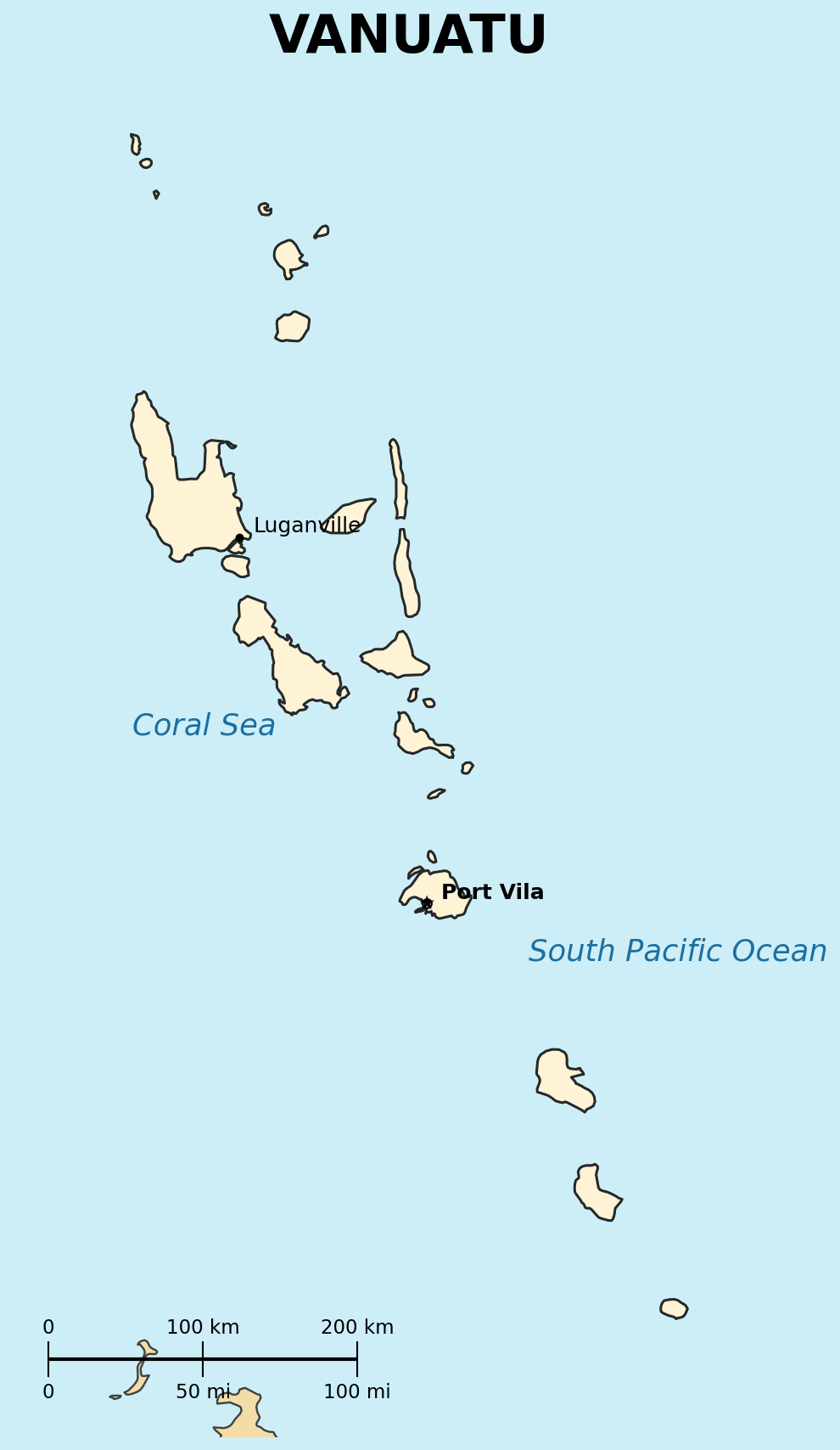
Country information
Vanuatu
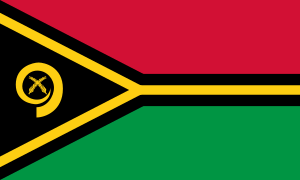
- Capital
- Port Vila
- Population
- 321,409
Languages spoken
About Vanuatu
Indigenous languages - more than 100 distinct languages spoken across the islands, making Vanuatu one of the most linguistically dense societies on Earth relative to its population.
Bislama - an English-based creole, the official lingua franca connecting speakers across the islands.
English and French - both official, legacies of Vanuatu's unique dual British-French colonial administration (the "Condominium").
Bislama, English, and French are all official languages of Vanuatu.
| Geography |
Location: Oceania, island group in the South Pacific Ocean, east of Australia, consisting of approximately 83-84 volcanic islands
Map references: Oceania
Area:
total: 12,189 sq km
Natural hazards: tropical cyclones (January to April); volcanism causes minor earthquakes and occasional tsunamis; Mount Yasur is one of the world's most accessible active volcanoes; a major earthquake struck near Port Vila in 2024
| People |
Population: 300,000-342,561 (varies by source; 2025-2026 est.)
Age structure:
0-14 years: 31.1%
15-64 years: 63.8%
65 years and over: 5% (2024 est.)
Median age: 24.9 years (2025 est.)
Infant mortality rate: 13.4-14.2 deaths/1,000 live births
Nationality:
noun/adjective: Ni-Vanuatu
Ethnic groups: Ni-Vanuatu 99%, other 1% (European, Asian, other Melanesian, Polynesian, Micronesian) (2020 est.)
Religions: Protestant 39.9% (Presbyterian, Seventh Day Adventist, Anglican, and others), Roman Catholic 12.1%, Apostolic 2.3%, Church of Jesus Christ 1.8%, customary beliefs (including the Jon Frum cargo cult) 3.1%, other 12%, none 1.4% (2020 est.)
Languages: indigenous languages (more than 100) 82.6%, Bislama (official, creole) 14.5%, English (official) 2.1%, French (official) 0.8% (2020 est.)
Population distribution: about three-quarters of the population lives in rural areas
| Government |
Country name:
conventional short form: Vanuatu; former name New Hebrides
Data code: NH
Government type: parliamentary republic
National capital: Port-Vila
Independence: 30 July 1980 (from France and the UK, as a unique jointly administered "Condominium")
Background: Austronesian speakers from the Solomon Islands first settled Vanuatu around 2000 BC; around 1600, Melanesian Chief Roi Mata united some of the islands under his rule; a Portuguese explorer became the first European to see Vanuatu's Banks Islands and Espiritu Santo in 1606; further European exploration followed in the 1760s, and the islands (then called the New Hebrides) were frequented by whalers in the 1800s; European interest in the islands' sandalwood caused conflict with inhabitants, and in the 1860s European planters kidnapped nearly half the adult male population for indentured labor abroad
| Economy |
Economy - overview: lower-middle-income Pacific island economy; extremely reliant on subsistence agriculture and tourism; environmentally fragile and highly vulnerable to natural disasters; economic growth increasingly dependent on citizenship-by-investment (passport) sales, public infrastructure spending, and aid flows following the collapse of tourism; rural populations engage in subsistence farming and export production of copra, beef, cocoa, tuna, and kava
GDP (purchasing power parity): $1.16-1.18 billion (2024-2025 est.)
GDP - real growth rate: 0.9% (2024)
GDP - per capita: $3,410 (2024-2025 est.)
Inflation rate: 11.2% (2023)
Unemployment rate: 5.1% (2025)
Currency: Vanuatu vatu (VUV)