

About Venezuela
Spanish - the official language, spoken by ~98.2% of the population.
Indigenous languages are also official and spoken by ~1.3% of the population.
Portuguese is also spoken by a small minority.
Spanish is the official language of Venezuela, with indigenous languages also holding official status.
| Geography |
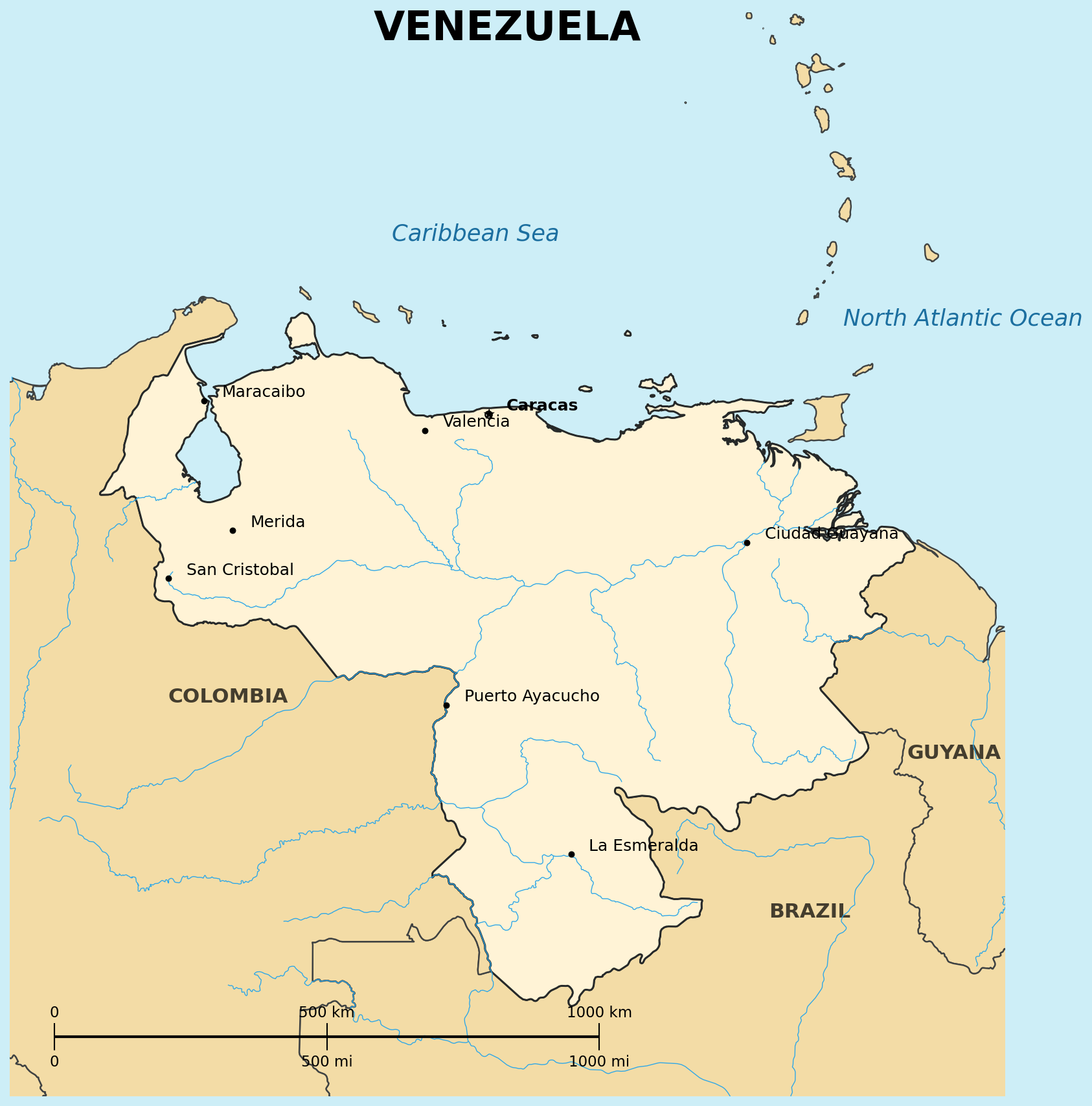
Location: Northern South America, bordering the Caribbean Sea and the North Atlantic Ocean, between Colombia and Guyana
Map references: South America
Area:
total: 912,050-916,445 sq km
Land boundaries:
border countries: Brazil, Colombia, Guyana
Geography - note: a physiographically diverse country incorporating the northern Andean mountain chains, the Orinoco River basin with its expansive Llanos (plains), Lake Maracaibo (the largest lake in South America), and Angel Falls, the world's highest waterfall
| People |
Population: 28.4-31.8 million (varies significantly by source, reflecting mass emigration; 2024-2025 est.)
Age structure:
0-14 years: 24.9-25%
15-64 years: 65.1-65.9%
65 years and over: 9.1-10%
Median age: 31.3 years (2025 est.)
Life expectancy at birth: total population 72.8 years (male 69.1, female 76.8)
Infant mortality rate: 13.6-14.4 deaths/1,000 live births
Nationality:
noun/adjective: Venezuelan(s)
Ethnic groups: Multiracial 51.6%, White 43.6%, African descent 3.6%, other 1.2%; over 7.8 million Venezuelans have emigrated abroad in recent years due to the country's economic and political crisis, primarily to Colombia, Peru, and the United States
Religions: Roman Catholic 48.1%, Protestant 31.6% (Evangelical 31.4%, Adventist 0.2%), Jehovah's Witness 1.4%, other 4.7%, none 13.6% (2023 est.)
Languages: Spanish (official) 98.2%, Indigenous (official) 1.3%, Portuguese 0.1%, other 0.4% (2023 est.)
Population distribution: concentrated in the northern and western highlands, along an eastern spur
| Government |
Country name:
conventional long form: Bolivarian Republic of Venezuela
conventional short form: Venezuela
Data code: VE
Government type: in flux; nominally a federal presidential republic, though the executive branch has exercised increasingly authoritarian control since Hugo Chavez's presidency (1999-2013)
National capital: Caracas
Executive branch: a major political shift occurred in early January 2026, when Venezuela's Supreme Court designated Executive Vice President Delcy Rodriguez as acting president after Nicolas Maduro was captured by US forces; Rodriguez exercises presidential powers on an interim basis, though she, the Venezuelan government, and the Supreme Court continue to formally recognize Maduro as president
Background: Venezuela was one of three countries that emerged from the collapse of Gran Colombia in 1830, alongside Ecuador and New Granada (Colombia); military strongmen ruled for much of the first half of the 20th century; democratically elected governments held sway until 1999, when Hugo Chavez began exercising authoritarian control over other branches of government; Nicolas Maduro claimed the presidency for a second term in a 2018 election widely viewed as fraudulent, and the 2020 legislative elections were similarly viewed as illegitimate by most opposition parties and international actors; the country entered a severe, prolonged economic and humanitarian crisis marked by hyperinflation, shortages, and mass emigration
| Economy |
Economy - overview: lower-middle-income economy in prolonged crisis; despite vast oil reserves, hyperinflation, mismanagement, sanctions, and falling oil prices have devastated the economy since 2014; widespread shortages of consumer goods and medicine; heavy reliance on imports; state oil company PDVSA entered selective default in 2017; ongoing political transition following Maduro's capture may significantly affect the economic trajectory
GDP (purchasing power parity): $234.34-254.37 billion (2025-2026 est.)
GDP - real growth rate: 4.0% (2026f)
GDP - per capita: $8,790-9,461 PPP (2025-2026 est.)
Inflation rate: 628.8% (2026f) - among the highest in the world
Unemployment rate: 5.3% (2025 est.)
Population below poverty line: 87% (2017 est.)
Currency: Venezuelan bolivar (VES)
| Transnational Issues |
Trafficking in persons - tier rating: Tier 3 (2025) - Venezuela does not fully meet the minimum standards for the elimination of trafficking and is not making significant efforts to do so