

About Belgium
Dutch - an official language, spoken by ~60% of the population, predominant in Flanders (the north).
French - also an official language, spoken by ~40%, predominant in Wallonia (the south).
German - the third official language, spoken by less than 1%, in a small eastern community bordering Germany.
Dutch, French, and German are all official languages of Belgium, reflecting its Flemish, Walloon, and German-speaking communities.
| Geography |
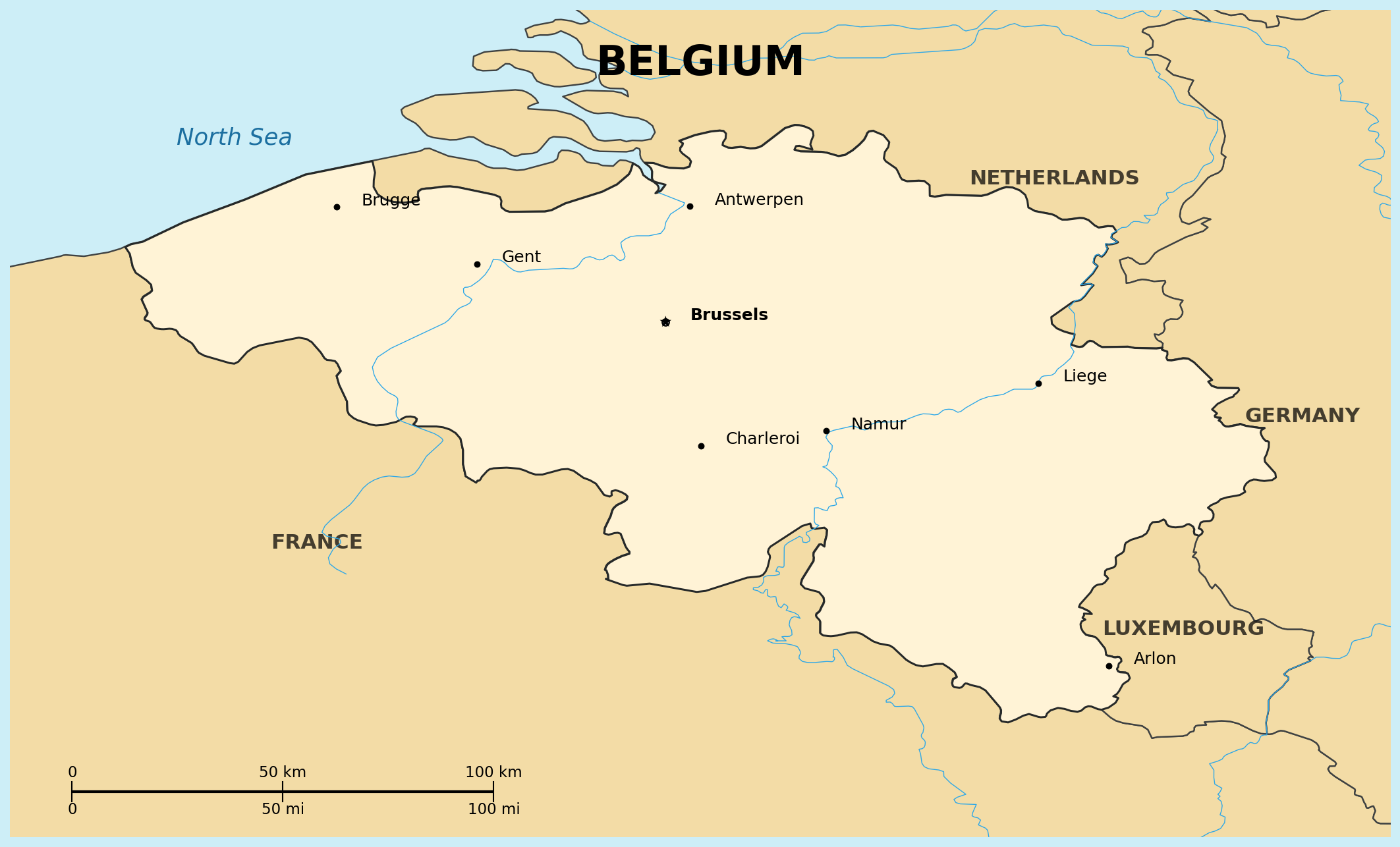
Location: Western Europe, bordering the North Sea, between France and the Netherlands
Map references: Europe
Area:
total: 30,528 sq km
Land boundaries:
total: 1,297 km
border countries: France 556 km, Germany 133 km, Luxembourg 130 km, Netherlands 478 km
Natural hazards: flooding is a threat along rivers and in areas of reclaimed coastal land, protected from the sea by concrete dikes
Geography - note: crossroads of Western Europe; most West European capitals are within 1,000 km of Brussels, the seat of both the EU and NATO
| People |
Population: 11,960,170-11,977,634 (2024-2025 est.); one of the highest population densities in the world, with approximately 97% living in urban areas
Infant mortality rate: 3 deaths/1,000 live births (2025 est.)
Nationality:
noun/adjective: Belgian(s)
Ethnic groups: Belgian 75.2%, Italian 4.1%, Moroccan 3.7%, French 2.4%, Turkish 2%, Dutch 2%, other 10.6% (2012 est.)
Religions: Roman Catholic 57.1%, Muslim 6.8%, no religion/agnostic/atheist 29.3%, other 6.8%
Languages: Dutch (official) 60%, French (official) 40%, German (official) less than 1%
Population distribution: most concentrated in the northern two-thirds of the country; the southeast is more thinly populated
| Government |
Country name:
conventional long form: Kingdom of Belgium
conventional short form: Belgium
Data code: BE
Government type: federal parliamentary democracy under a constitutional monarchy
National capital: Brussels
Executive branch:
chief of state: King Philippe (since 21 July 2013)
head of government: Prime Minister Bart De Wever (since 3 February 2025)
Independence: 4 October 1830 (provisional government declared independence from the Netherlands); 21 July 1831 (King Leopold I ascended the throne)
Background: became independent from the Netherlands in 1830; occupied by Germany during both World Wars; prospered as a modern, technologically advanced European state and NATO/EU member; longstanding tensions between the Dutch-speaking Flemish (north) and French-speaking Walloons (south) have led to constitutional amendments granting these regions formal recognition and autonomy
| Economy |
Economy - overview: highly developed, diversified mixed economy combining private enterprise and government involvement; strategic location and strong transport/logistics infrastructure make it central to EU trade; key industries include chemicals, automotive, and machinery
GDP (purchasing power parity): $889.83 billion (2025 est.)
GDP - real growth rate: 1.2% (2024)
GDP - per capita: $75,199 PPP (2025 est.)
Inflation rate: 3.6% (2024)
Unemployment rate: 5.9% (2025 est.)
Currency: Euro (EUR)
| Military |
Military branches: Belgian Armed Forces (Defensie/La Defense): Land Component, Marine (Naval) Component, Air Component, Medical Component, Cyber Command (2025)
Military - note: on average about 1,000 personnel deployed on foreign missions, including more than 300 ground forces on NATO's eastern flank (2025)