

About Yemen
Arabic - the sole official language.
Socotri - a distinct language widely used on Socotra Island and Archipelago.
Mahri is still fairly widely spoken in eastern Yemen.
Arabic is the sole official language of Yemen.
| Geography |
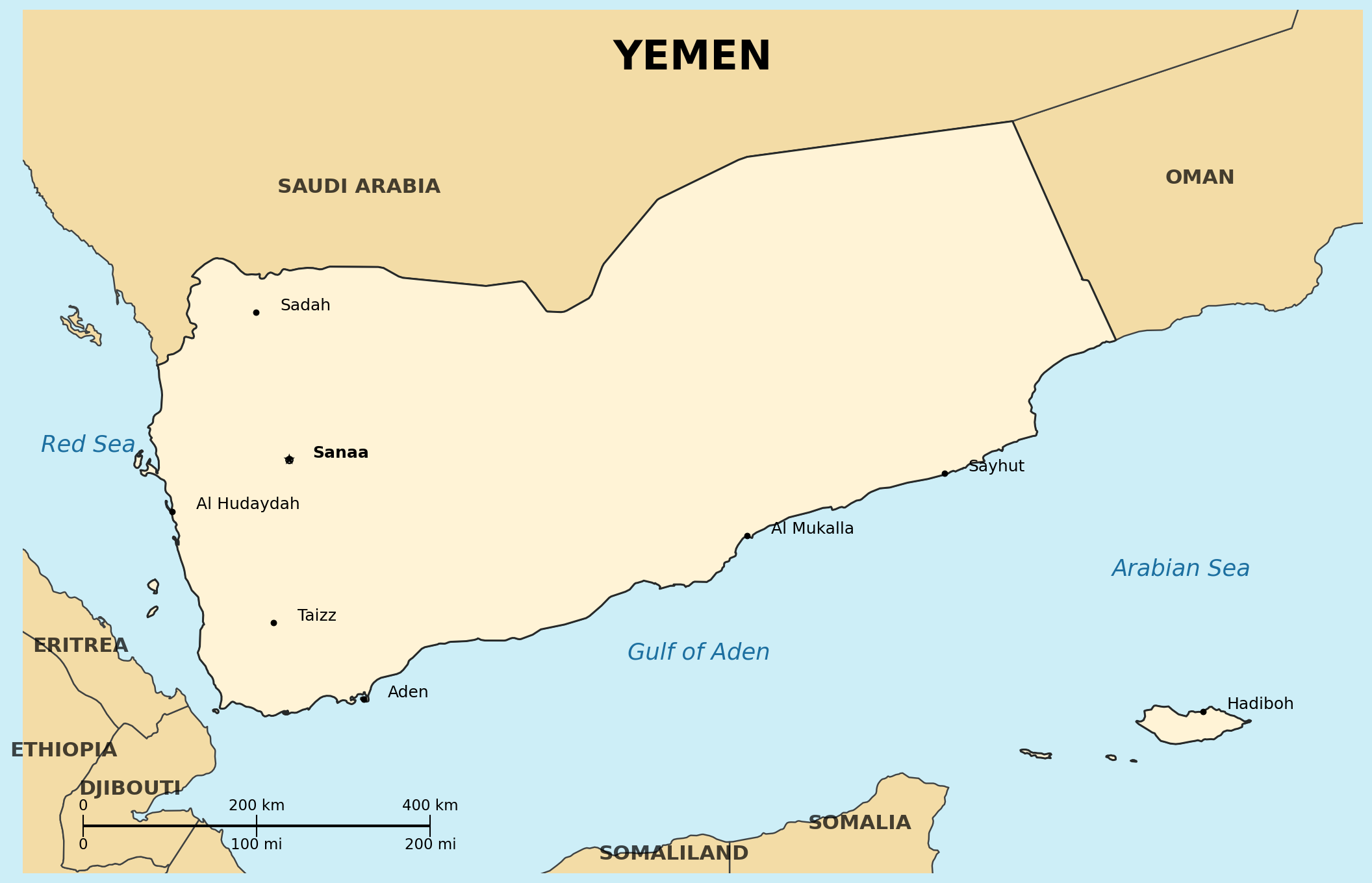
Location: Middle East, bordering the Arabian Sea, Gulf of Aden, and Red Sea, between Oman and Saudi Arabia
Map references: Middle East
Area:
total: 455,503-527,968 sq km
Land boundaries:
border countries: Oman, Saudi Arabia
Terrain: narrow coastal plain backed by flat-topped hills and rugged mountains; dissected upland desert plains in the center slope into the desert interior of the Arabian Peninsula; the vast majority of the population is found in the Asir Mountains (part of the Sarawat Mountain system) in the far western region
| People |
Population: 32.7-34.5 million (varies by source; 2025 est.)
Age structure:
0-14 years: 34.4%
15-64 years: 62.2%
65 years and over: 3.4% (2024 est.)
Median age: 20.5 years (2025 est.)
Life expectancy at birth: total population 69.3 years (World Bank, 2025)
Infant mortality rate: 42.4 deaths/1,000 live births
Nationality:
noun/adjective: Yemeni(s)
Ethnic groups: predominantly Arab, with smaller communities of Afro-Arabs, Jews, and others
Religions: Muslim (official) 99.1% (estimated 65% Sunni, 35% Shia), other 0.9% (Jewish, Baha'i, Hindu, Christian; many refugees or temporary residents) (2020 est.)
Languages: Arabic (official); Socotri (distinct language, widely used on Socotra Island and Archipelago); Mahri still fairly widely spoken in eastern Yemen
Population distribution: total urban 61.8%, rural 38.2% (2022 est.)
| Government |
Country name:
conventional long form: Republic of Yemen
conventional short form: Yemen; formerly two separate states, the Yemen Arab Republic (North Yemen) and the People's Democratic Republic of Yemen (South Yemen)
Data code: YM
Government type: in transition; fragmented, with competing governing authorities amid ongoing civil war
National capital: Sanaa (contested; internationally recognized government operates from Aden)
Independence: 22 May 1990 (Republic of Yemen unification of North and South Yemen)
Background: Yemen has been embroiled in a devastating civil war since 2014-2015, when Houthi rebels (Ansarallah) seized the capital Sanaa, prompting a Saudi-led military coalition intervention on behalf of the internationally recognized government; the conflict has caused one of the world's worst humanitarian crises, with widespread famine, disease, and displacement; in 2022 the Yemeni government and the Houthis signed a truce, halting most large-scale fighting and establishing humanitarian measures, though former front lines remain largely static; al-Qa'ida in the Arabian Peninsula (AQAP) and ISIS-Yemen remain active in remote areas
| Economy |
Economy - overview: least-developed, low-income economy devastated by prolonged civil war; among the poorest countries in the Arab world even before the conflict; widespread humanitarian crisis with severe food insecurity; economy has contracted sharply over the past decade
GDP (purchasing power parity): $69.96-71.175 billion (2025-2026 est.)
GDP - real growth rate: -1.0% (2024)
GDP - per capita: $1,657-1,670 PPP (2025-2026 est.)
Inflation rate: 14.9% (2023 est.)
Unemployment rate: 20.2% (2025 est.)
Population below poverty line: 48.6% (2014)
Currency: Yemeni rial (YER)
| Military |
Military branches: Yemeni Armed Forces: Yemeni National Army, Air Force and Air Defense, Navy and Coastal Defense Forces, Border Guard, Strategic Reserve Forces, Popular Committee Forces (government-backed tribal militia); Ministry of Interior: Security Forces, Emergency Forces, Counterterrorism Units (2025)
Military - note: government forces face the Houthi movement, AQAP, and ISIS-Yemen; a 2022 truce halted most large-scale fighting, though sporadic conflict and instability persist (2025)