
Country information
Zimbabwe
- Capital
- Harare
- Population
- 17,073,087
Languages spoken
About Zimbabwe
Shona - the most widely spoken official language, spoken by the largest ethnic group.
Ndebele - the second most widely spoken official language.
English - official, traditionally used for official government business.
Zimbabwe officially recognizes 16 languages in total, including Chewa, Chibarwe, Kalanga, Nambya, Ndau, Sotho, Tonga, Tswana, Venda, Xhosa, and Zimbabwean Sign Language.
Zimbabwe holds the record for the most official languages of any country in the world.
| Geography |
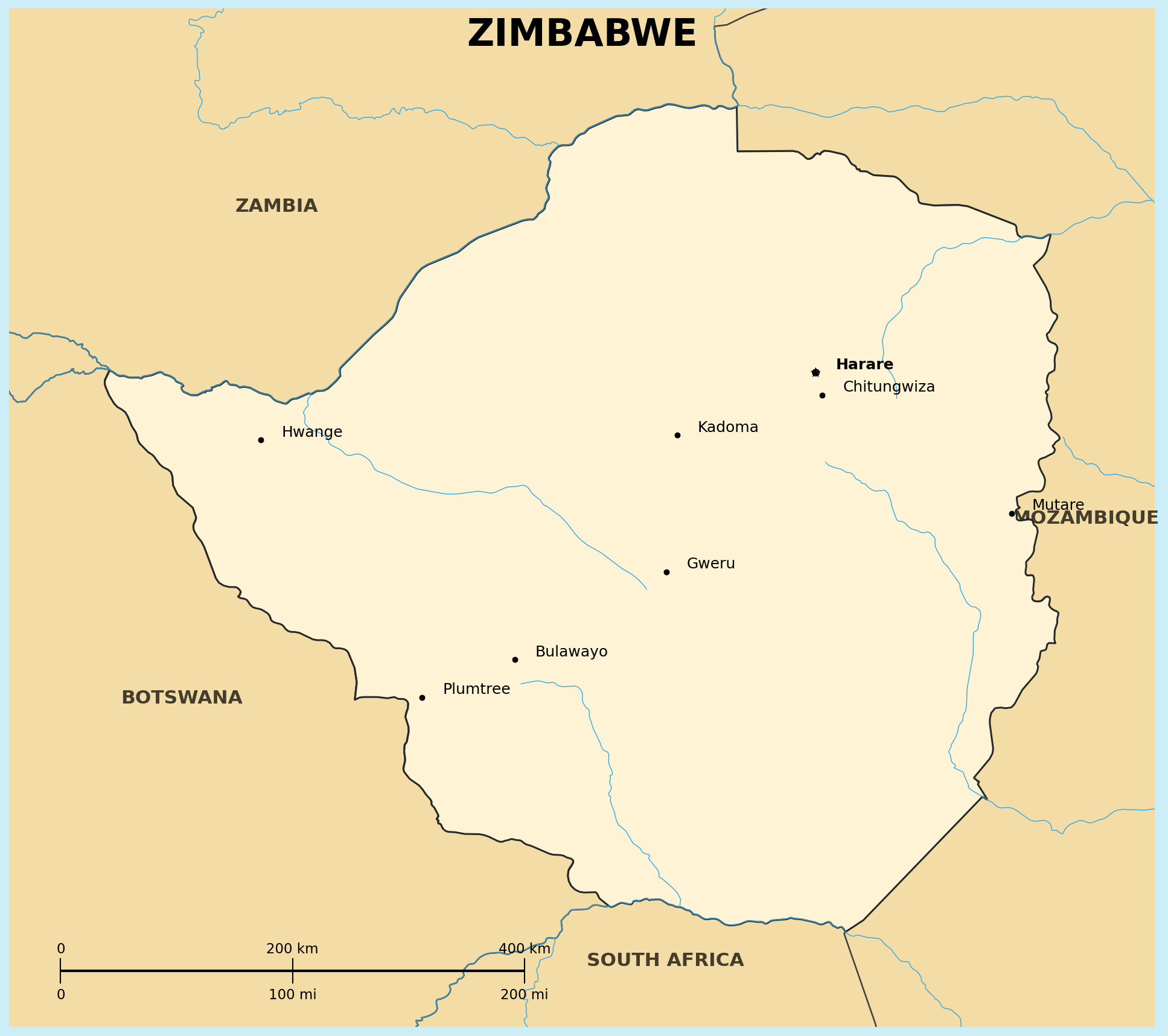
Location: Southern Africa, landlocked between South Africa and Zambia
Map references: Africa
Area:
total: 390,757 sq km
Land boundaries:
border countries: Botswana, Mozambique, South Africa, Zambia
Coastline: 0 km (landlocked)
| People |
Population: 17,166,852-17,472,752 (2025-2026 est.)
Nationality:
noun/adjective: Zimbabwean(s)
Ethnic groups: African 99.4-99.6% (predominantly Shona; Ndebele is the second largest), European 0.2%, other 0.2-0.4% (2012-2022 census)
Religions: Christianity 84.1% (Protestant 69.2%, other Christian 14.9%), no religion 10.2%, traditional faiths 4.5%, other 1.2% (2017 est.)
Languages: Shona (official, most widely spoken), Ndebele (official, second most widely spoken), English (official, traditionally used for official business), 13 minority languages (official) including Chewa, Chibarwe, Kalanga, Khoisan, Nambya, Ndau, Shangani, Sotho, Tonga, Tswana, Venda, Xhosa, Zimbabwean Sign Language; 16 official languages total - the most of any country in the world
| Government |
Country name:
conventional short form: Zimbabwe
former: Rhodesia, Southern Rhodesia
Data code: ZI
Government type: presidential republic
National capital: Harare
Independence: 18 April 1980 (from the UK)
Executive branch:
chief of state and head of government: President Emmerson MNANGAGWA
Background: the hunter-gatherer San people first inhabited the area; Bantu farming communities and Shona-speaking societies developed from around the 9th century, organizing under the Kingdom of Mapungubwe and later the Kingdom of Zimbabwe; in 1965 the white-minority government unilaterally declared independence as Rhodesia, which the UK did not recognize; UN sanctions and a guerrilla uprising led to free elections in 1979 and independence as Zimbabwe in 1980; Robert MUGABE ruled from independence until his resignation in November 2017
| Economy |
Economy - overview: lower-middle-income, developing economy; has experienced tumultuous economic conditions since 1980, including hyperinflation and a controversial 2000s land reform program that seized thousands of white-owned commercial farms; introduced the gold-backed Zimbabwe Gold (ZiG) currency in April 2024 in an effort to stabilize the economy; over one-third of the population faced food insecurity as of March 2025
GDP (purchasing power parity): $93.87-127.3 billion (2025 est., varies by source)
GDP - real growth rate: 6.0% (2025)
GDP - per capita: $5,410-8,443 PPP (2025 est.)
Inflation rate: 172.2% (2023 est.)
Labor force: 6,560,725 (2023)
Population below poverty line: 1.0% on less than $3.20/day (2017; likely understated given more recent food-insecurity reports)
Currency: Zimbabwe Gold (ZWG); US dollar and South African rand also widely used
| Military |
Military branches: Zimbabwe Defense Forces (ZDF): Army, Air Force (2025)
Military service age and obligation: 18-22 years of age for voluntary service (enlisted); 18-24 for officer cadets; 18-30 for technical/specialist personnel; no conscription (2025)
| Transnational Issues |
Trafficking in persons - tier rating: Tier 2 Watch List (2025)