

About Korea (North)
Korean - the sole language of the country, spoken by the vast majority of the population, which is racially and linguistically homogeneous.
Small Chinese and ethnic Japanese communities exist, but Korean is spoken universally.
Korean is the sole official language of North Korea.
| Geography |
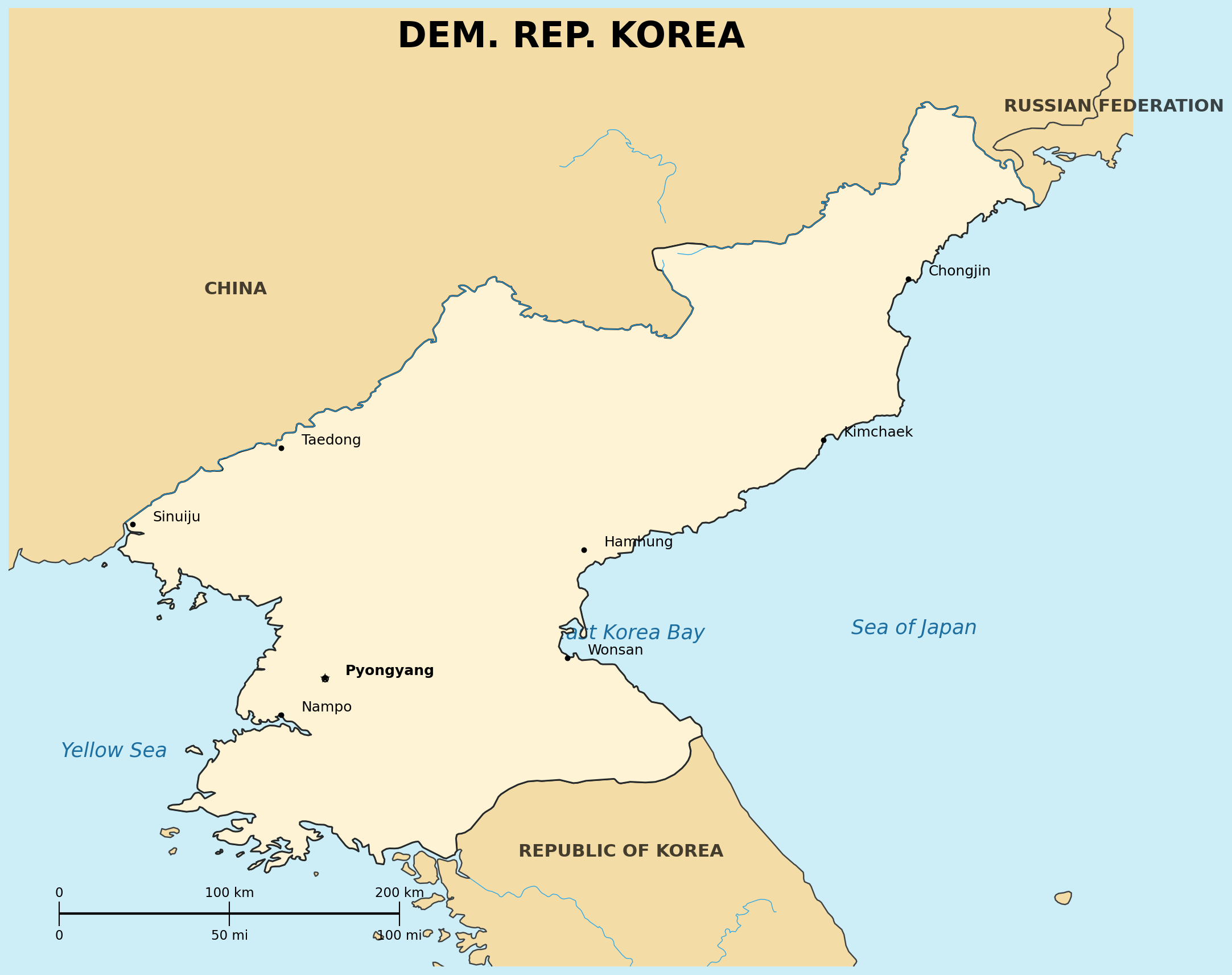
Location: Eastern Asia, northern half of the Korean Peninsula bordering the Sea of Japan and the Yellow Sea, between China and South Korea
Map references: Asia
Area:
total: 120,538 sq km
Land boundaries:
border countries: China, Russia, South Korea
Climate: temperate, with rainfall concentrated in summer; long, harsh winters that significantly impact agricultural productivity
Natural resources: coal, iron ore, limestone, magnesite, graphite, copper, zinc, lead, precious metals
Geography - note: strategic location bordering China, South Korea, and Russia; mountainous interior is isolated and sparsely populated
| People |
Population: 26,298,666-26,627,992 (2024-2025 est.)
Infant mortality rate: 14.7 deaths/1,000 live births (2025 est.)
Population growth rate: 0.4% (2024 est.)
Nationality:
noun/adjective: Korean(s)
Ethnic groups: racially homogeneous; there is a small Chinese community and a few ethnic Japanese
Religions: traditionally Buddhist and Confucian, some Christian and syncretic Chondogyo (Religion of the Heavenly Way); note - autonomous religious activity is almost nonexistent; government-sponsored religious groups exist to provide an illusion of religious freedom
Languages: Korean
Population distribution: concentrated in the plains and lowlands; least-populated regions are the mountainous provinces adjacent to the Chinese border; largest concentrations are in the western provinces, particularly around Pyongyang, and around Hungnam and Wonsan in the east
| Government |
Country name:
conventional long form: Democratic People's Republic of Korea
conventional short form: North Korea
Data code: KN
Government type: dictatorship; single-party communist state
National capital: Pyongyang
Executive branch:
chief of state: State Affairs Commission President KIM Jong Un (since 17 December 2011)
head of government: Supreme People's Assembly President CHOE Ryong Hae (since 11 April 2019)
Background: the first recorded kingdom (Choson) on the Korean Peninsula dates from approximately 2300 BC; over subsequent centuries three main kingdoms - Kogoryo, Paekche, and Silla - were established; by the 5th century AD, Kogoryo emerged as the most powerful, controlling much of the peninsula and part of Manchuria
| Economy |
Economy - overview: one of the last centrally planned economies in the world; hard hit by COVID-19, crop failures, international sanctions, and isolationist policies; declining growth and trade, heavily reliant on China; poor exchange rate stability and significant economic data integrity issues
GDP (purchasing power parity): $14.959-40 billion (varies significantly by source and year; 2015-2023 est.)
GDP - per capita: $600-1,500 (varies by source; 2023 est.)
Unemployment rate: 0% according to North Korea's Central Bureau of Statistics; approximately 3% (2023 est.) according to World Bank estimates
Labor force: 15,836,683 (2023)
Industries: military products, machine building, electric power, chemicals, mining (coal, iron ore, limestone, magnesite, graphite, copper, zinc, lead, precious metals), metallurgy, textiles, food processing, tourism
Currency: North Korean won (KPW)
| Military |
Military branches: Korean People's Army (KPA): Ground Forces, Navy, Air Force and Air Defense Forces, Strategic Forces (missile forces), Special Forces; Security Guard Command; Military Security Command; Ministry of Social Security: Border Guard General Bureau, civil security forces; Ministry of State Security: internal security, investigations (2025)
Military service age and obligation: compulsory for men (17-30 years) and women (17-23 years); reportedly up to 10-year obligation for men and up to 7 years for women (2025)
| Transnational Issues |
Trafficking in persons - tier rating: Tier 3 (2025)