
About Mauritania
Arabic - the official and national language.
Pular, Soninke, and Wolof - also recognized national languages, spoken by Sub-Saharan Mauritanian communities.
French is also spoken. Note: spoken Arabic in Mauritania differs considerably from Modern Standard Arabic; the local dialect, incorporating many Tamazight words, is known as Hassaniya.
Arabic is the sole official language of Mauritania, with Pular, Soninke, and Wolof recognized as national languages.
| Geography |
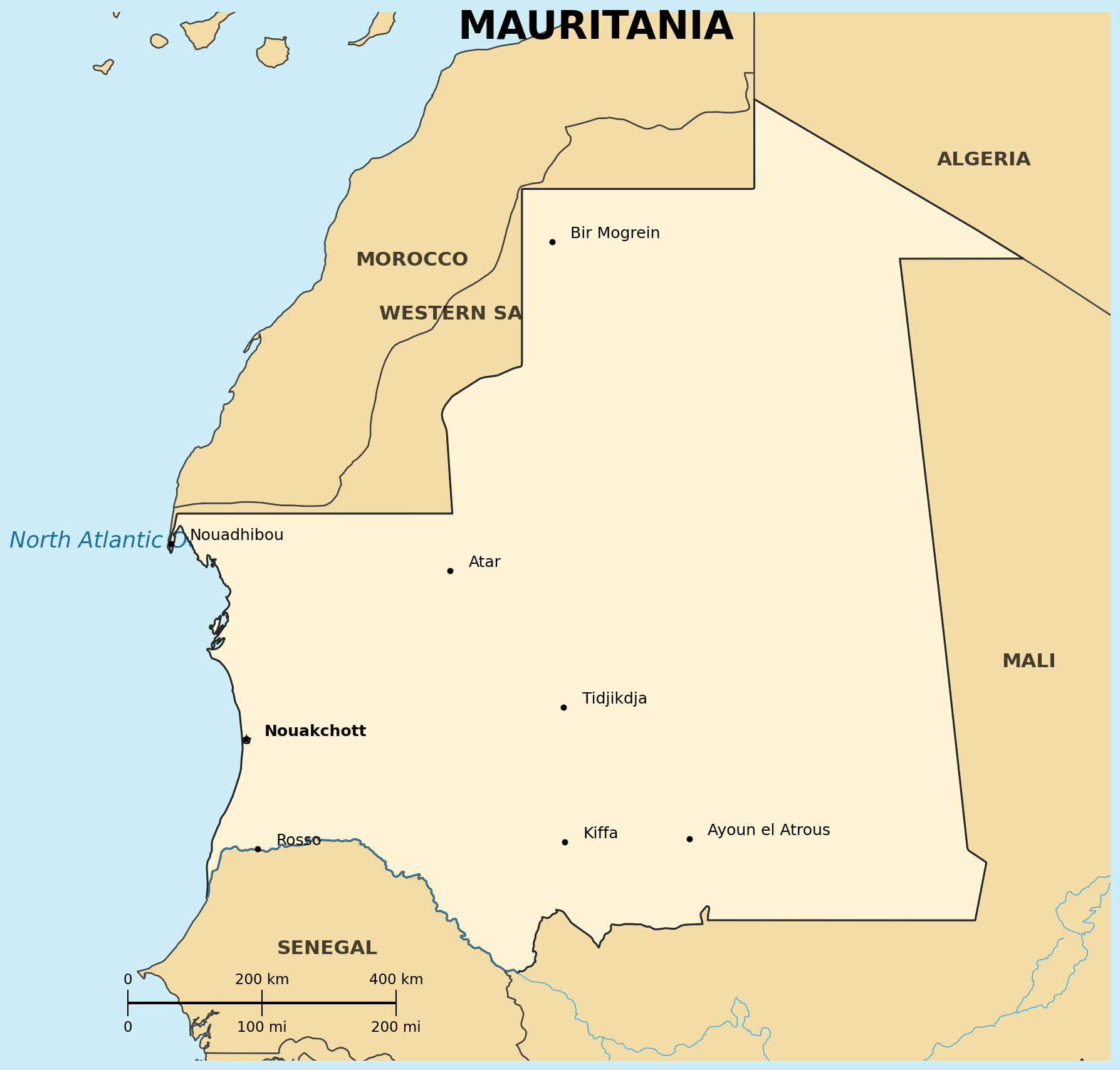
Location: Western Africa, bordering the North Atlantic Ocean, between Senegal and Western Sahara; part of both North Africa's Maghreb region and West Africa's Sahel region
Map references: Africa
Area:
total: 1,030,000-1,030,700 sq km
Land boundaries:
border countries: Algeria, Mali, Senegal, Western Sahara
| People |
Population: 4.93-5.46 million (2023-2026 est.)
Age structure:
0-14 years: 35.7-40.92%
15-64 years: 55.87-59.9%
65 years and over: 3.21-4.4%
Median age: 18.6 years (2025 est.)
Life expectancy at birth: total population 65.22 years
Infant mortality rate: 50.99 deaths/1,000 live births
Nationality:
noun/adjective: Mauritanian(s)
Ethnic groups: Black Moors/Haratines 40%, White Moors (Beydane, Arab-Amazigh descent) 30%, Sub-Saharan Mauritanians (Halpulaar, Fulani, Soninke, Wolof, Bambara) 30%
Religions: Sunni Islam (official)
Languages: Arabic (official and national), Pular, Soninke, Wolof (national languages), French
Population distribution: vast areas, particularly central, northern, and eastern regions, are desert and lack sizeable population clusters; half the population lives in or around the coastal capital, Nouakchott; smaller clusters near the southern border with Mali and Senegal
| Government |
Country name:
conventional long form: Islamic Republic of Mauritania
conventional short form: Mauritania
Data code: MR
Government type: unitary semi-presidential Islamic republic
National capital: Nouakchott
Executive branch:
chief of state: President Mohamed Ould Ghazouani
head of government: Prime Minister Mokhtar Ould Djay
Independence: 28 November 1960 (from France)
Background: the Amazigh and Bafour people were among the earliest settlers, among the first in recorded history to convert from a nomadic to agricultural lifestyle, accounting for roughly one-third of the country's ethnic makeup; gained independence from France in 1960; after years of dictatorships, flawed elections, and military coups, the country is now considered an emerging democracy
| Economy |
Economy - overview: lower-middle-income West African economy; primarily agrarian, with rising urbanization; mining (iron ore, gold, copper, gypsum), petroleum, and fish processing are key industries; poor property rights, systemic corruption, and wide-scale terrorism concerns persist; environmentally fragile with significant foreign over-fishing pressure
GDP (purchasing power parity): $32.948-40.06 billion (2023-2025 est.)
GDP - per capita: $7,437-8,650 PPP (2023-2025 est.)
Inflation rate: 3% (2018 est.)
Unemployment rate: 30% (2008 est.)
Population below poverty line: 40% (2004 est.)
Industries: mining (iron ore, gold, copper, gypsum), petroleum, fish processing
Currency: Mauritanian ouguiya (MRU)
| Military |
Military - note: founded in 1960, the Mauritanian military is responsible for territorial defense and internal security, and also assists in economic development projects, humanitarian missions, and disaster response; border/maritime security and the threat of terrorist groups in the Sahel (particularly Mali) are key focus areas; has received security assistance from the EU, France, NATO, and the US (2025)