
About Somalia
Somali - one of two official languages, spoken by the vast majority of the ethnic Somali population.
Arabic - also an official language, reflecting Somalia's strong Islamic heritage and historical Arab trade ties.
Italian and English are also spoken, legacies of the country's colonial history.
Somali and Arabic are both official languages of Somalia.
| Geography |
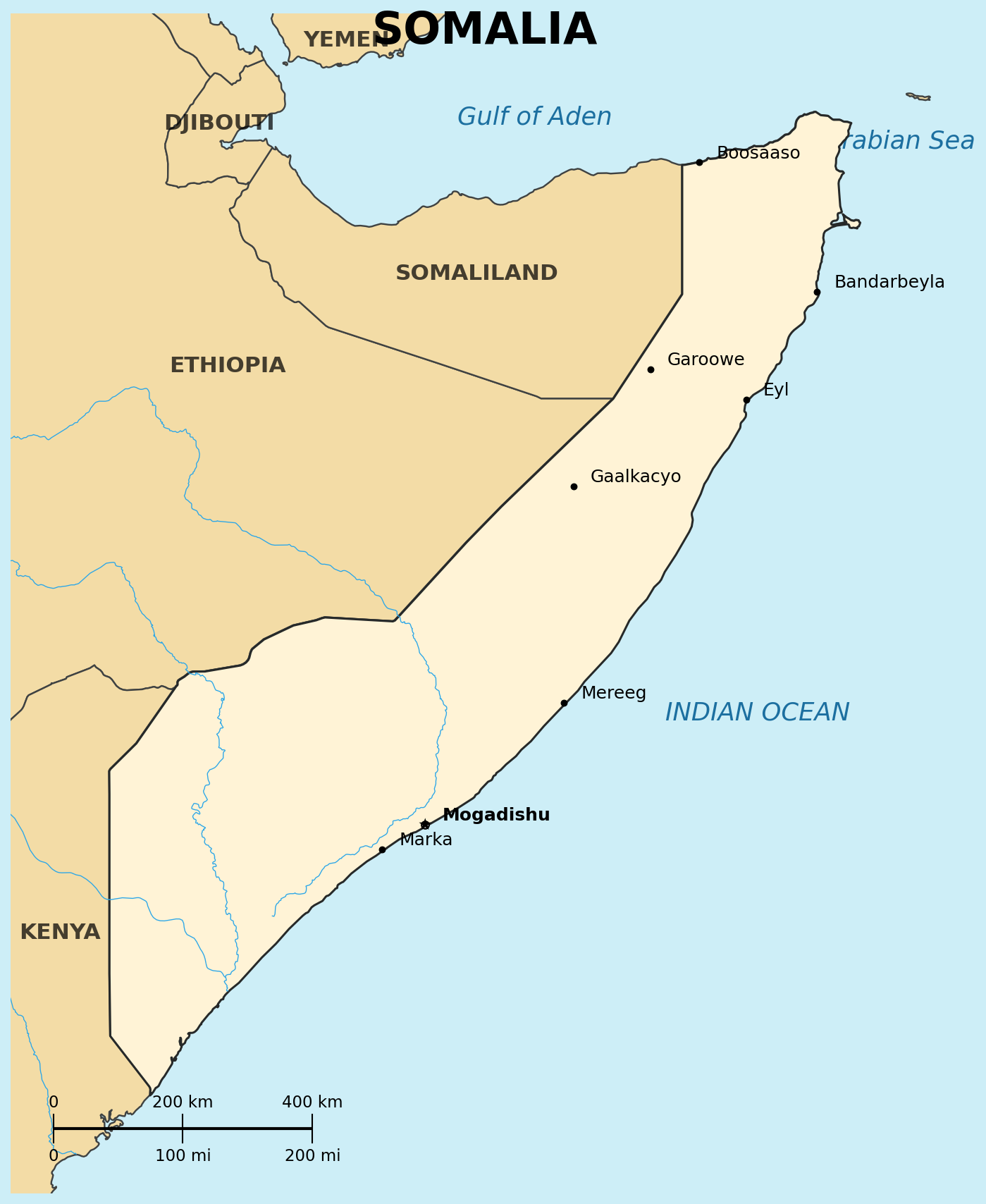
Location: Eastern Africa, bordering the Gulf of Aden and the Indian Ocean, east of Ethiopia; strategic location on the Horn of Africa along the southern approaches to Bab el Mandeb and the route through the Red Sea and Suez Canal
Map references: Africa
Area:
total: 637,657 sq km
Land boundaries:
border countries: Djibouti, Ethiopia, Kenya
Natural hazards: recurring droughts; frequent dust storms over eastern plains in summer; floods during rainy season
| People |
Population: 19-20.3 million (varies by source; 2024-2025 est.)
Life expectancy at birth: total population 58.8 years (World Bank, 2025)
Infant mortality rate: 67.8 deaths/1,000 live births
Nationality:
noun/adjective: Somali(s)
Ethnic groups: predominantly Somali, making up about 85% of the population
Religions: Sunni Islam, the predominant religion of the population
Languages: Somali (official), Arabic (official), Italian, English
Population distribution: distribution varies greatly throughout the country; least densely populated areas are in the northeast and central regions and along the Kenyan border; most populated areas are in and around Mogadishu, Marka, Boorama, Hargeysa, and Baidoa
| Government |
Country name:
conventional long form: Federal Republic of Somalia
conventional short form: Somalia
Data code: SO
Government type: federal parliamentary republic
National capital: Mogadishu
Background: between 800-1100 AD, immigrant Muslim Arabs and Persians set up coastal trading posts along the Gulf of Aden and Indian Ocean, solidifying present-day Somalia's close trading relationship with the Arab Peninsula; in the late 19th century, Britain, France, and Italy established colonies in the Somali Peninsula lasting until 1960, when British Somaliland gained independence and joined with Italian Somaliland to form the Republic of Somalia; regional and local governing bodies continue to control various areas of the country, including the self-declared Republic of Somaliland in the northwest
| Economy |
Economy - overview: low-income African Horn economy; three decades of war and instability have crippled economic potential; heavy reliance on remittances for basic survival; pursuing a new fiscal federalism approach; cleared some unsustainable debt; environmentally fragile; livestock accounts for about 40% of GDP and over half of export earnings; nomads and semi-pastoralists dependent on livestock make up a large share of the population
GDP (purchasing power parity): $33.85 billion (2026 est.)
GDP - real growth rate: 3.7-4.1% (2024-2025)
GDP - per capita: $1,940 PPP (2026 est.)
Inflation rate: 1.5% (2017)
Unemployment rate: 18.9% (2025 est.)
Population below poverty line: 63% (est.)
Currency: Somali shilling (SOS)
| Transnational Issues |
Trafficking in persons - tier rating: Special Case (2025)